
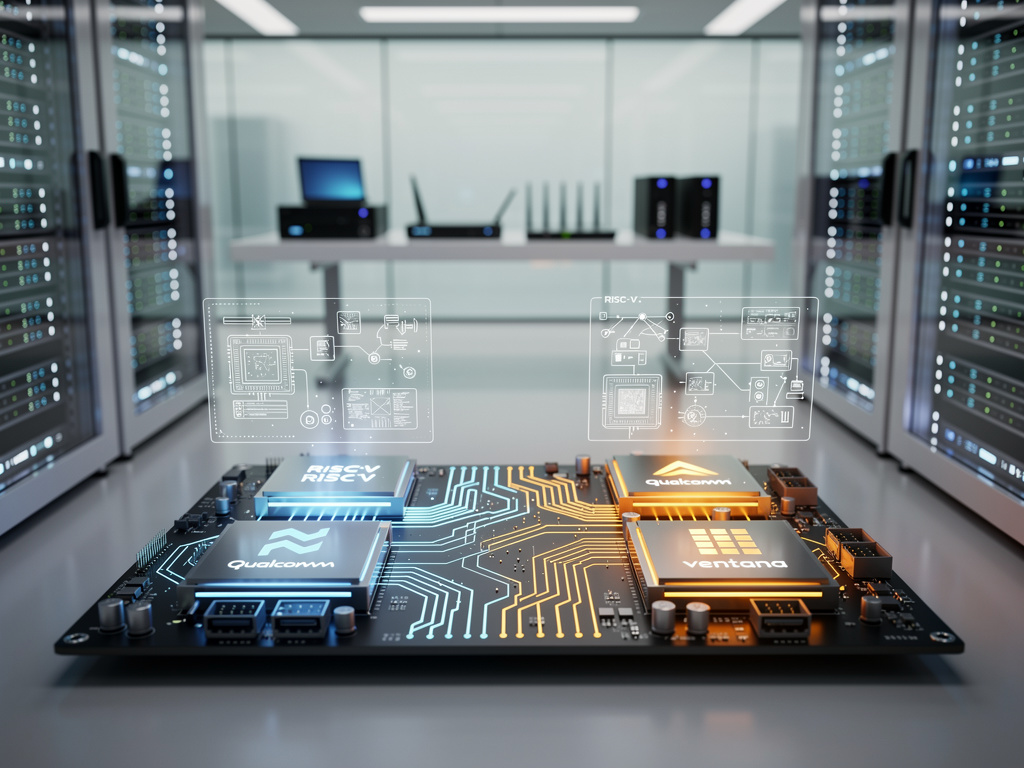
Qualcomm’s RISC-V Gambit: Snapping Up Ventana to Redefine Chip Power Plays
In a move that signals a seismic shift in the semiconductor arena, Qualcomm Technologies Inc. has acquired Ventana Micro Systems Inc., a Cupertino-based startup renowned for its high-performance RISC-V processor designs. Announced on December 10, 2025, this acquisition bolsters Qualcomm’s push into open-architecture computing, particularly for data centers and edge devices. By integrating Ventana’s expertise, Qualcomm aims to enhance its custom CPU development, including the Oryon line, while committing to the growth of the RISC-V ecosystem. This deal comes at a time when the industry is increasingly eyeing alternatives to Arm’s dominant instruction set, driven by desires for customization and cost efficiency.
Ventana, founded in 2018, has carved out a niche in developing extensible and secure compute chiplets based on RISC-V’s open architecture. The company, a key player in RISC-V International’s board and technical steering committee, focused on server CPUs that promise high performance for demanding workloads. Qualcomm’s press release highlights how Ventana’s team will complement ongoing efforts in custom silicon, potentially accelerating innovations in mobile, AI, and infrastructure sectors. Industry observers note that this acquisition aligns with broader trends toward open standards, as companies seek to reduce dependency on proprietary technologies.
The timing is intriguing, following Qualcomm’s recent launches like the Snapdragon 8 Elite Gen 5 SoC, which boasts impressive performance gains. By absorbing Ventana, Qualcomm not only gains intellectual property but also a talented engineering pool experienced in RISC-V instruction set architecture (ISA). This could enable parallel development of Arm and RISC-V cores, allowing Qualcomm to offer versatile solutions across markets. As one source put it, this is Qualcomm taking a “RISC” on alternatives to Arm, positioning itself as a multifaceted player in the chip design space.
Strategic Depth in a Competitive Field
Delving deeper, Qualcomm’s strategy appears multifaceted. The company has been investing heavily in custom CPUs, with the Oryon family representing a homegrown effort to rival established players. Integrating Ventana’s RISC-V prowess could supercharge this, enabling more power-efficient and scalable processors for everything from smartphones to data centers. According to reports from CRN, the acquisition is seen as a boost to Qualcomm’s server CPU ambitions, where RISC-V’s modularity offers advantages over rigid architectures.
On social platforms like X, the announcement generated buzz, with Qualcomm’s official post garnering thousands of views and highlighting the deal’s role in advancing next-generation computing. Users and analysts alike speculated on how this might influence Snapdragon’s evolution, tying into recent AI and edge computing pushes. For instance, posts on X emphasized Ventana’s contributions to open-source hardware, suggesting Qualcomm could foster greater ecosystem collaboration.
Financial details of the deal remain undisclosed, but the strategic value is clear. Ventana’s focus on high-performance chiplets aligns with Qualcomm’s ventures into AI workloads and secure computing. This isn’t Qualcomm’s first foray into acquisitions; recent moves like buying Arduino underscore a pattern of expanding into accessible, innovative tech stacks. By blending Ventana’s RISC-V innovations with its existing portfolio, Qualcomm could pioneer hybrid architectures that blend the best of multiple ISAs.
Ventana’s Legacy and RISC-V’s Rising Tide
Ventana Micro Systems emerged as a disruptor by targeting data center processors with RISC-V, an open-source ISA that’s gained traction for its flexibility and lack of licensing fees. Founded by industry veterans, the startup aimed to revolutionize processor markets with chiplets that allow customizable, high-performance designs. As detailed in a 2022 Forbes profile, Ventana was at the forefront of making RISC-V “data-center grade,” challenging incumbents like Intel and Arm in server environments.
The RISC-V market itself is booming, with projections from Global Market Insights estimating growth from $2.3 billion in 2025 to $8.57 billion by 2030. This surge is fueled by applications in embedded systems, automotive, and IoT, where RISC-V’s extensibility shines. Qualcomm’s acquisition taps into this momentum, potentially accelerating adoption by leveraging its vast resources and partnerships.
Critics, however, question whether RISC-V can truly compete with Arm’s mature ecosystem. Yet, endorsements from major players like Google and Alibaba indicate growing confidence. Qualcomm’s move, as reported by TechPowerUp, reinforces leadership in RISC-V development, with Ventana’s team enhancing Qualcomm’s engineering depth. This could lead to breakthroughs in areas like multimodal AI and efficient neural networks, aligning with Qualcomm’s presence at events like NeurIPS 2025.
Implications for Industry Rivals and Ecosystems
The acquisition’s ripple effects extend to competitors. Arm Holdings, which licenses its ISA to Qualcomm and others, might face increased pressure as RISC-V offers a royalty-free alternative. Qualcomm has stated it will continue developing both Arm and RISC-V in parallel, as noted in coverage from The Register. This dual-track approach allows flexibility, catering to clients preferring established standards while exploring open innovations.
In the mobile space, where Snapdragon chips dominate, integrating RISC-V could yield more efficient designs for AI-driven features. Reports from XiaomiTime suggest this bolsters the Snapdragon 8 Elite era, enhancing power efficiency and security for devices. Qualcomm’s recent collaborations, such as with Google on Android XR, illustrate how such acquisitions fit into broader ecosystem plays.
Moreover, this deal underscores geopolitical undercurrents. With U.S.-China tech tensions, RISC-V’s open nature provides a neutral ground, avoiding export restrictions tied to proprietary tech. Industry insiders speculate that Qualcomm’s investment could standardize RISC-V for critical infrastructure, from transportation to healthcare, without the vulnerabilities of closed systems.
Engineering Synergies and Future Innovations
At the heart of the acquisition is engineering talent. Ventana’s team, steeped in RISC-V ISA development, joins Qualcomm’s ranks, potentially fast-tracking custom Oryon enhancements. As per Qualcomm’s release at their official site, this deepens expertise in scalable, secure processors. The integration could yield chiplets that modularly combine with Qualcomm’s 5G and AI technologies, revolutionizing edge computing.
Looking ahead, expect innovations in hybrid CPU designs. For instance, combining RISC-V’s extensibility with Arm’s performance could create versatile SoCs for diverse applications. News from Tweakers in Dutch markets echoes this, noting Ventana’s data center focus as a perfect fit for Qualcomm’s ambitions.
Challenges remain, including ecosystem maturity. RISC-V lacks the software support of Arm, but Qualcomm’s influence could bridge this gap through developer tools and partnerships. Recent X posts from Qualcomm highlight commitments to open standards, suggesting community-driven advancements.
Market Reactions and Long-Term Outlook
Market response has been positive, with Qualcomm’s stock ticking up post-announcement. Analysts from various outlets praise the strategic foresight, seeing it as a hedge against Arm’s licensing costs. In a Mashdigi report, the acquisition is framed as solidifying Qualcomm’s compute leadership, especially in Asia-Pacific regions hungry for innovative silicon.
For industry insiders, this signals a broader pivot toward open architectures. As embedded systems evolve, per insights from Semiconductor Digest, RISC-V’s freedom fosters unprecedented innovation. Qualcomm, with Ventana aboard, is poised to lead this charge, potentially reshaping how processors are designed and deployed.
Ultimately, this acquisition isn’t just about buying tech—it’s about building a future-proof foundation. By embracing RISC-V, Qualcomm diversifies its portfolio, mitigates risks, and drives competition that benefits the entire sector. As the chip world watches, the real test will be in execution, turning acquired expertise into market-leading products that redefine performance and accessibility.


 WebProNews is an iEntry Publication