
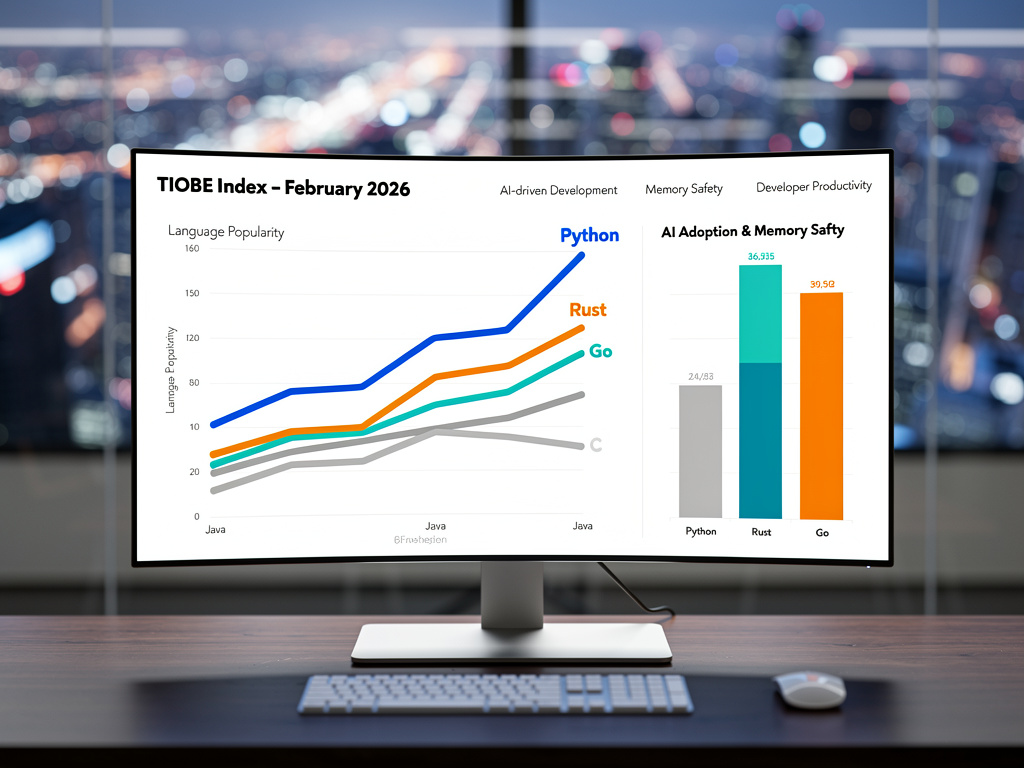
For decades, the programming world has cycled through eras defined by dominant languages — from COBOL’s mainframe reign to Java’s enterprise ubiquity. Now, in early 2026, the data is unmistakable: Python has not merely held its position atop the TIOBE Programming Community Index but has extended its lead to a degree that raises fundamental questions about whether any challenger can unseat it in the foreseeable future. Meanwhile, beneath the surface of that dominance, a quieter but consequential reshuffling is underway, with Rust and Go climbing steadily while legacy stalwarts like Java and C show signs of structural decline.
The TIOBE Index, published monthly by the Dutch software quality company TIOBE, measures the popularity of programming languages based on search engine queries, course offerings, and skilled engineer availability worldwide. While imperfect — critics note it reflects buzz as much as actual usage — it remains one of the industry’s most closely watched barometers. The February 2026 edition, analyzed in detail by TechRepublic, paints a picture of a market where the rich are getting richer and the old are getting older.
Python’s Commanding Lead Shows No Signs of Erosion
Python’s share in the February 2026 TIOBE Index has surged past previous highs, reinforcing a trend that began accelerating around 2018 and received rocket fuel from the artificial intelligence and machine learning boom. According to the TIOBE data reported by TechRepublic, Python’s rating now sits comfortably above its nearest competitors by a margin that would have been unthinkable a decade ago, when C and Java routinely traded the top spot between themselves.
The reasons are by now well-documented but worth restating for their cumulative force. Python is the lingua franca of data science, machine learning, and AI development. It dominates academic instruction, serving as the first language taught at a majority of top computer science programs globally. Its ecosystem of libraries — from TensorFlow and PyTorch to pandas and scikit-learn — is unmatched in breadth and depth. And critically, Python has become the default scripting and automation language across industries far removed from traditional software development, including finance, healthcare, and manufacturing.
The AI Effect: How Generative Models Supercharged Python’s Dominance
The generative AI revolution that began with ChatGPT’s launch in late 2022 and has only intensified through 2025 and into 2026 has been an extraordinary tailwind for Python. Nearly every major large language model framework, fine-tuning toolkit, and inference pipeline is built in or primarily accessed through Python. OpenAI’s APIs, Google DeepMind’s tooling, Meta’s LLaMA ecosystem, and Anthropic’s developer interfaces all treat Python as the first-class citizen among programming languages.
This has created a self-reinforcing cycle. As more AI tools are built in Python, more developers learn Python, which in turn encourages more AI tool developers to prioritize Python support. TIOBE CEO Paul Jansen has noted in previous commentary that Python’s growth correlates almost perfectly with the rise of AI-related search queries, a trend that the February 2026 data continues to confirm, as reported by TechRepublic.
Rust’s Quiet Ascent: From Systems Programming Darling to Mainstream Contender
If Python’s dominance is the headline, Rust’s continued climb is the story that systems-level engineers and infrastructure architects are watching most closely. The February 2026 TIOBE Index shows Rust continuing its upward trajectory, building on a multi-year trend that has seen it move from a niche language beloved by Mozilla enthusiasts to a serious player in operating systems, embedded development, cloud infrastructure, and even web backend services.
Rust’s appeal is rooted in its promise of memory safety without garbage collection — a combination that eliminates entire categories of bugs that have plagued C and C++ codebases for decades. The White House’s Office of the National Cyber Director made headlines in early 2024 when it explicitly recommended the adoption of memory-safe languages, with Rust being the most prominent example. That endorsement, combined with adoption by major technology companies including Microsoft, Amazon, Google, and Meta, has given Rust institutional legitimacy that few newer languages achieve.
Go Holds Steady as the Cloud-Native Workhorse
Google’s Go language, often called Golang, continues to maintain a strong position in the TIOBE rankings, firmly established as the language of choice for cloud-native development, microservices, and DevOps tooling. Kubernetes, Docker, Terraform, and a vast swath of the cloud infrastructure stack are written in Go, giving it a durable base of usage that is unlikely to erode quickly.
Go’s simplicity — often cited as both its greatest strength and its most frustrating limitation — makes it particularly attractive for teams building backend services that need to be fast, concurrent, and maintainable by large groups of engineers with varying skill levels. Unlike Rust, which has a notoriously steep learning curve, Go can be productive for new developers within days. This pragmatic design philosophy, championed by creators Rob Pike and Ken Thompson, continues to pay dividends in enterprise adoption. The TIOBE data suggests Go’s position has stabilized in the upper tier of languages, a significant achievement for a language that only reached version 1.0 in 2012.
Java and C: The Fading Giants Face Structural Headwinds
Perhaps the most consequential trend in the February 2026 TIOBE Index is the continued erosion of Java and C, two languages that defined enterprise and systems programming respectively for the better part of three decades. According to the analysis published by TechRepublic, both languages have seen their TIOBE ratings decline year over year, continuing a pattern that has been evident since at least 2020.
Java’s decline is particularly notable given its enormous installed base. Billions of devices run Java, and enterprise systems built on Java frameworks like Spring Boot remain critical infrastructure at banks, insurers, and government agencies worldwide. But new projects are increasingly choosing alternatives. Kotlin has absorbed much of Android development. Python and JavaScript dominate web-adjacent backend work. And for high-performance computing, Rust is increasingly seen as the modern alternative. Java’s stewards at Oracle have responded with an accelerated release cadence and features like virtual threads (Project Loom) and pattern matching, but these improvements have slowed rather than reversed the decline.
C’s Long Goodbye and the Memory Safety Imperative
C’s situation is even more structurally challenged. While it remains essential in embedded systems, operating system kernels, and performance-critical applications, the growing emphasis on memory safety across the industry is a direct threat to C’s long-term relevance. The Linux kernel’s acceptance of Rust as a second implementation language — a development that would have been heretical just five years ago — signals a generational shift. New embedded development platforms are increasingly offering Rust support alongside or instead of C, and university curricula are beginning to de-emphasize C in favor of languages that prevent buffer overflows and use-after-free vulnerabilities by design.
The TIOBE commentary, as covered by TechRepublic, highlights that C’s decline, while gradual, appears irreversible absent some fundamental shift in the industry’s priorities. The language will remain in use for decades given the volume of existing C code, but its share of new development is shrinking measurably with each passing year.
JavaScript Remains the Web’s Backbone Despite Growing Competition
JavaScript and its typed superset TypeScript continue to occupy critical positions in the TIOBE rankings, reflecting the language’s inescapable role in web development. Every major browser executes JavaScript natively, and the Node.js runtime has extended its reach into server-side development. TypeScript, which adds static typing to JavaScript, has become the preferred choice for large-scale frontend and full-stack applications, with adoption at companies like Microsoft, Airbnb, and Stripe.
However, the emergence of WebAssembly (Wasm) as a compilation target for languages like Rust, Go, and C++ introduces a potential long-term challenge to JavaScript’s browser monopoly. While Wasm has not yet displaced JavaScript for typical web applications, its use in performance-sensitive browser applications, edge computing, and serverless functions is growing. Industry observers are watching whether Wasm could eventually reduce JavaScript’s dominance in the browser, though most believe this remains a distant prospect given JavaScript’s massive ecosystem and developer base.
What the 2026 Index Tells Us About the Next Decade of Software Development
The February 2026 TIOBE Index, taken as a whole, reveals an industry in the midst of a generational transition. Python’s dominance, powered by AI, shows no signs of abating. Rust is establishing itself as the heir apparent to C and C++ in systems programming. Go has carved out a durable niche in cloud infrastructure. And legacy titans Java and C, while far from dead, are ceding ground to languages better suited to modern priorities around safety, developer productivity, and AI integration.
For hiring managers, the implications are clear: Python fluency is table stakes, Rust expertise commands a premium, and Go skills remain highly marketable for infrastructure roles. For technology leaders making long-term architectural decisions, the data suggests that betting on Python for AI and data workloads, Rust for performance-critical and safety-sensitive systems, and Go or TypeScript for cloud-native services represents the most defensible strategy heading into the second half of the decade. The TIOBE Index is, as always, a lagging indicator — but the trends it captures in early 2026 are powerful enough to shape investment, hiring, and engineering decisions for years to come.


 WebProNews is an iEntry Publication