
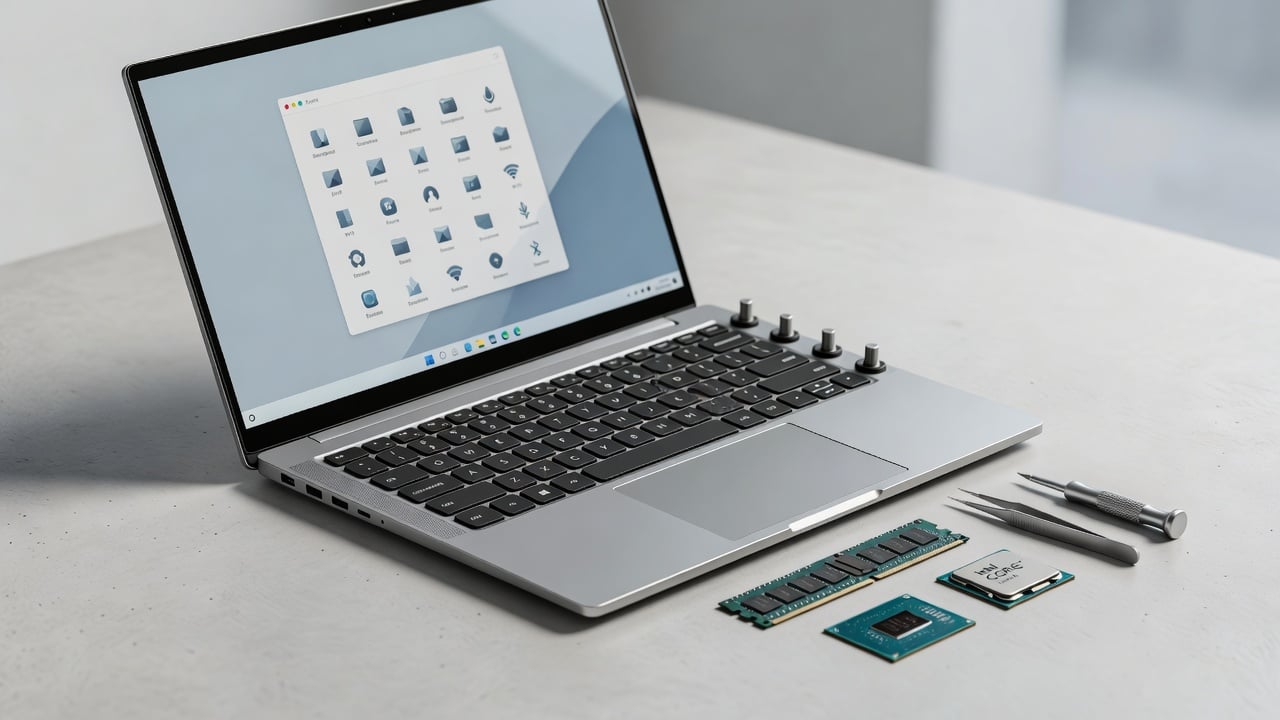
Purism has introduced the Librem 16, a 16-inch laptop designed for users who rank hardware-level privacy and software freedom above cost or mainstream performance expectations. The company, long known for its focus on open-source systems and physical kill switches for sensitive components, positions this new model as its largest and most capable machine to date. According to a report from The Register, the device targets buyers willing to spend significantly more than the average laptop price to gain control over their personal data and computing environment.
The Librem 16 carries a starting price of $2,399, which places it firmly in premium territory. That figure reflects several deliberate choices. The machine ships with PureOS, Purism’s Debian-based Linux distribution that receives regular security updates and avoids proprietary blobs where possible. Buyers can configure the system with up to 64GB of DDR4 RAM, a 2TB NVMe SSD, and an Intel Core Ultra 7 processor from the Meteor Lake family. While these specifications do not match the highest-end Windows gaming laptops or MacBook Pros, they deliver respectable performance for productivity, software development, and media consumption without forcing users to accept closed-source firmware or telemetry.
Physical privacy controls remain central to the design. The laptop includes hardware kill switches for the microphone, camera, Wi-Fi, and Bluetooth. When flipped, these switches physically disconnect the respective circuits rather than simply mute them at the software level. This approach addresses concerns that malicious software or compromised firmware could bypass operating-system controls. The 1080p webcam sits behind one of these switches, and the device ships with the camera module disabled by default until the user explicitly activates it.
Screen real estate forms a major part of the appeal. The 16-inch display offers a 2560 x 1600 resolution with 100 percent DCI-P3 color coverage and a 60Hz refresh rate. Reviewers who have handled early units describe the panel as bright and sharp, suitable for extended coding sessions or video editing. The larger chassis also provides room for a full-sized keyboard with good key travel and a dedicated number pad. A glass trackpad spans nearly the full width of the palm rest and supports multi-touch gestures under PureOS.
Battery life receives mixed early feedback. The 75Wh battery delivers between six and eight hours of moderate use according to initial tests shared in the The Register article. Heavy workloads or maximum screen brightness reduce that figure closer to four hours. Purism chose not to pursue the thin-and-light design trends that dominate consumer laptops, resulting in a device that weighs just over four pounds and measures roughly one inch thick. The trade-off prioritizes repairability and component access over portability.
Repairability stands out as a deliberate feature. The bottom panel removes with standard screws, exposing most major components. Users can replace the battery, upgrade storage and memory, or even swap the Wi-Fi card without specialized tools. This modularity aligns with Purism’s long-term support philosophy, which includes promises to provide replacement parts and firmware updates for years after purchase. In an industry where many manufacturers glue components together or discourage third-party repairs, the Librem 16 offers a more sustainable path for users who expect to keep their hardware for a decade or longer.
The laptop’s security foundation begins at the hardware level. It ships with a TPM 2.0 module and supports measured boot through PureBoot, Purism’s fork of the Heads boot firmware. PureBoot replaces the traditional UEFI boot process with a system that cryptographically verifies each stage of the boot chain. If tampering is detected, the laptop can alert the user or refuse to boot. This setup makes the device resistant to certain classes of boot-level attacks that affect more conventional PCs.
For connectivity, the Librem 16 includes two USB-C ports with Thunderbolt 4 support, two USB-A ports, an HDMI 2.1 output, a microSD card reader, and a 3.5mm audio jack. Wireless networking relies on an Intel AX211 module that can be disabled via the hardware switch. The inclusion of Thunderbolt 4 allows users to attach external GPUs, multiple 4K monitors, or high-speed storage docks, expanding the system’s capabilities for users who need occasional bursts of extra power.
Software choices reflect the company’s commitment to openness. PureOS comes preinstalled and includes a curated selection of free software applications. Users who prefer different distributions can install Ubuntu, Fedora, or Debian without major obstacles, though some hardware-specific features like the kill switches require additional configuration. The company maintains its own repositories for firmware and drivers, ensuring that users do not need to rely on binary blobs from Intel or other vendors for basic operation.
Critics point out that the Librem 16’s price exceeds what many consumers would consider reasonable for the performance delivered. A similarly configured Dell XPS or Lenovo ThinkPad often costs several hundred dollars less while offering faster processors, brighter screens, and longer battery life. Purism counters that the added expense buys something intangible: independence from surveillance capitalism and the ability to verify that the machine behaves exactly as expected. For certain professionals—journalists, activists, security researchers, or developers who handle sensitive data—this assurance carries tangible value.
The company has built a loyal following over the past decade by releasing a series of Librem laptops, phones, and mini PCs that consistently emphasize the same principles. Each new model refines the formula rather than chasing broader market appeal. The Librem 16 continues that pattern by scaling up the screen size while maintaining the same focus on transparency and user control. Early adopters who have placed orders report that the larger display makes a noticeable difference when working with multiple windows or reading long documents.
Thermal performance appears adequate but not exceptional. Under sustained load, the fans become audible, though they do not reach the jet-engine levels found in some gaming laptops. The chassis uses a combination of magnesium alloy and plastic to balance weight and rigidity. Build quality receives generally positive comments, though some reviewers note minor flex in the lid and a keyboard deck that feels less premium than competitors at similar price points.
Purism also offers a privacy bundle that includes additional services such as a pre-configured VPN, encrypted email, and secure cloud storage. These extras push the total cost even higher, but they create an integrated experience for users who want to minimize their reliance on big technology companies. The company’s approach stands in contrast to mainstream manufacturers that collect telemetry data and partner with advertising networks.
Looking ahead, the Librem 16 represents another step in Purism’s effort to prove that privacy-focused computing can exist at larger scale. The company has faced supply chain challenges and production delays in the past, yet it continues to ship devices and expand its lineup. Whether the broader market will embrace such expensive, principled machines remains uncertain. For a dedicated segment of buyers, however, the combination of open-source software, hardware kill switches, verifiable boot processes, and a spacious high-resolution display creates an attractive package despite the premium price.
The laptop’s release comes at a time when public awareness of data privacy issues continues to grow. High-profile breaches, government surveillance programs, and corporate scandals have convinced many professionals that default consumer devices no longer meet their security needs. In this environment, Purism’s message finds a receptive audience even if the company’s sales volumes remain modest compared to major brands.
Users who order the Librem 16 can expect delivery within several months, as the company builds machines in small batches to control quality. Configuration options allow for various storage, memory, and processor choices, though the base model already includes 16GB of RAM and 512GB of storage. Upgrading to the top specifications pushes the price close to $3,500 before taxes or additional services.
In the end, the Librem 16 succeeds or fails based on how well it delivers on its core promise: a laptop that respects user privacy at every layer without forcing major compromises in daily usability. Early indications suggest it meets that standard for its target customers, even if it will never compete on raw speed or battery longevity with mass-market alternatives. For those who place freedom and transparency first, the extra cost may represent money well spent on a device that aligns with their principles rather than undermining them. The machine’s thoughtful design choices, from the physical switches to the repairable construction and open-source foundation, demonstrate that privacy can be engineered into hardware rather than treated as an afterthought. As more people question the hidden costs of convenient technology, products like the Librem 16 offer a concrete alternative built on different priorities.


 WebProNews is an iEntry Publication