
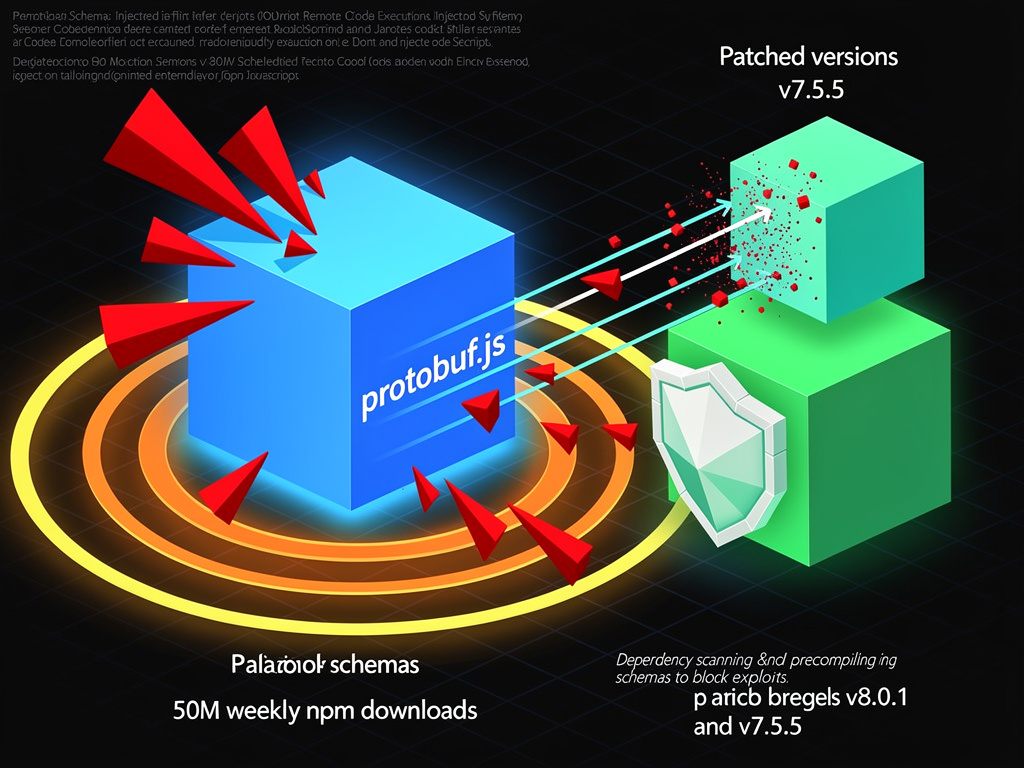
A critical remote code execution vulnerability lurks in protobuf.js, the JavaScript port of Google’s Protocol Buffers. Downloaded nearly 50 million times weekly on npm, this library powers inter-service messaging, gRPC calls, Firebase integrations, and countless cloud apps. Attackers need only slip a poisoned schema into the mix. Boom. Arbitrary JavaScript runs on decode.
Endor Labs researcher Cristian Staicu spotted it first, on March 2. He reported it promptly. Patches dropped for the 8.x branch on April 4, the 7.x on April 15. Yet the proof-of-concept hit public view this week, tracked as GHSA-xq3m-2v4x-88gg and now CVE-2026-41242 with a CVSS score of 9.4. Versions 8.0.0 and below, plus 7.5.4 and below, stay vulnerable. Upgrade to 8.0.1 or 7.5.5. Now.
Here’s the mechanics. Protobuf.js compiles schemas into JavaScript functions at runtime. It strings together code snippets using message names as identifiers, then fires them off via the Function() constructor. No checks on those names. An attacker crafts a type like "); require('child_process').execSync('id >>a'); //. The generated function closes early. Executes the payload. Prints user ID to file. Scales to fetch secrets, pivot networks, wipe data.
Endor Labs details the attack: “Exploitation is straightforward.” A minimal PoC exists in researcher dinosn’s repo. Feed the app a malicious .proto or reflection response. Process one message. RCE triggers without auth or interaction. Servers fall. Dev machines too, if they load untrusted schemas.
Why Schemas Spell Trouble in Modern Stacks
Dynamic schema loading isn’t rare. gRPC reflection serves them over the wire for service discovery. Apps pull from shared registries or partners. Firebase and Google Cloud SDKs lean on protobuf.js under the hood, often as transitive deps via @grpc/proto-loader. Node.js microservices swap protobufs for efficiency over JSON. browsers handle them in WebAssembly edges.
But transitive pulls blind teams. npm audit might flag it, yet many lockfiles lag. VulDB noted elevated scans on CVE-2026-41242 just yesterday. X chatter from @co11ateral and @UpwindMDR warns of active interest. No mass exploits yet. Doesn’t mean none brewing.
The patch? Simple sanitization. Strips non-alphanumeric chars from type names. Blocks the injection. Endor Labs pushes further: ditch dynamic loads. Precompile schemas. Treat them as code, not data. Static is safer. Always.
Risk amplifies in chains. A compromised schema registry poisons downstream services. gRPC-Web clients in browsers? Client-side RCE. Node servers? Full process takeover, spilling env vars, tokens, DB strings. Cloudflare Workers, Deno scripts, Bun apps—any protobuf.js consumer checks deps now.
Remediation Paths for Enterprise Teams
Scan your npm graph. yarn audit. npm ls protobufjs. Pin patched versions. Audit transitive deps; tools like Socket or Endor Labs flag them. Block untrusted schema loads in code review. Prefer compiled roots over runtime parsing.
And monitor. Runtime segmentation contains blasts, as Aviatrix Threat Research Center noted on X. But patching beats detection. This flaw echoes deserialization plagues in Java, Python—eval-like ops on untrusted input. JavaScript’s Function() acts the same fool.
BleepingComputer broke the story April 18. SecurityOnline pegs exposure at 220 million monthly pulls. Tenable lists the CVE. Reddit’s r/SecOpsDaily echoes calls to patch. No major breaches tied yet. Fix before that changes.
Teams shipping protobuf.js face a ticking clock. Schemas look innocent. Execute like shells. Patch. Harden. Move fast.


 WebProNews is an iEntry Publication