
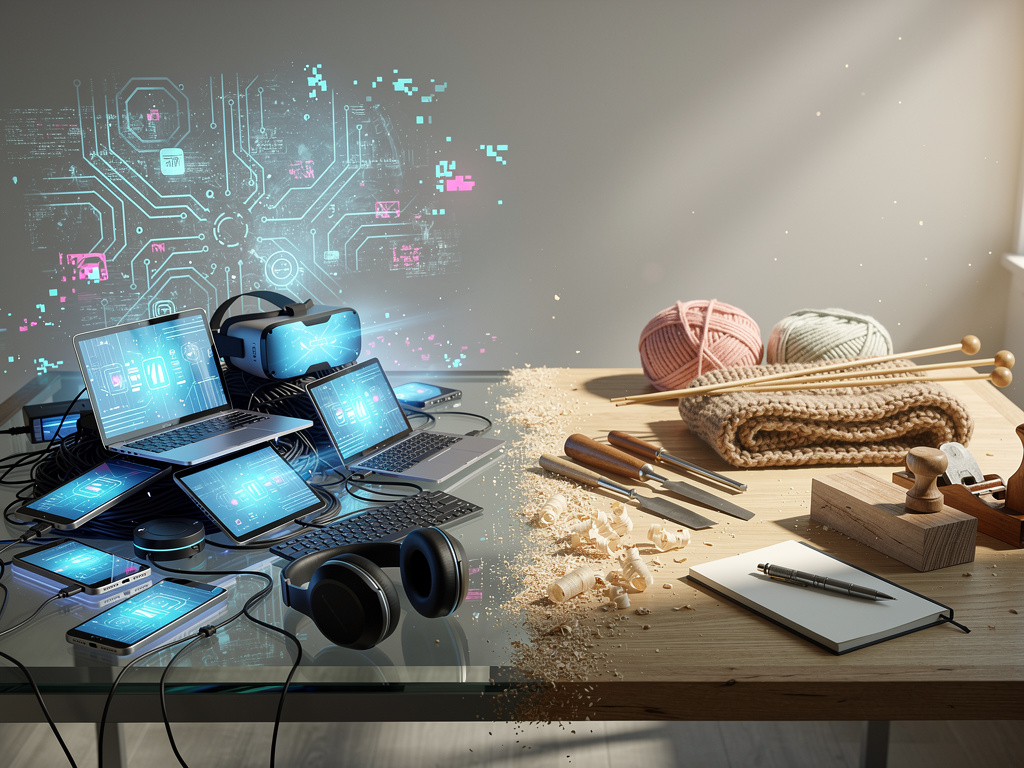
Unplugging the Mind: Analog Hobbies as the Ultimate Defense Against AI-Driven Cognitive Decay
In an era where artificial intelligence permeates every facet of professional life, a quiet rebellion is brewing among workers seeking refuge from the mental haze induced by constant digital immersion. This phenomenon, dubbed “AI brain rot,” describes the cognitive fatigue and diminished critical thinking skills resulting from overreliance on algorithms and screens. As AI tools automate routine tasks and reshape job markets, professionals are turning to tactile, offline activities to reclaim their mental acuity and chart sustainable career trajectories. Recent insights from Business Insider highlight how pursuits like knitting or woodworking offer a tangible counterbalance, emphasizing that “you can’t download the feeling of yarn between your fingers.”
This shift isn’t merely anecdotal; it’s backed by emerging trends in workforce dynamics. With AI projected to disrupt entry-level positions in tech and creative fields by 2025, individuals are exploring analog hobbies not just for leisure but as strategic tools for personal and professional resilience. Posts on X, formerly Twitter, reflect a growing sentiment among users who advocate for “analog living” as a antidote to the “gross” feeling of tech saturation. One viral thread notes how activities like reading physical books or playing board games foster deeper human connections and sharper problem-solving abilities, countering the superficiality bred by AI-assisted workflows.
Industry experts argue that this pivot toward hands-on hobbies could redefine career progression in the coming years. As generative AI handles more data analysis and content creation, human workers must differentiate themselves through uniquely human skills—creativity, empathy, and manual dexterity—that analog pursuits nurture. For instance, a software engineer might take up pottery to enhance spatial reasoning, directly applicable to designing user interfaces that feel intuitive rather than algorithmically sterile.
The Rise of Analog Resistance in a Digital World
The concept of AI brain rot has gained traction in recent discussions, with studies linking prolonged exposure to AI-driven platforms to reduced attention spans and impaired decision-making. A report from The New York Times explores how AI search tools and chatbots contribute to this decline, suggesting that constant algorithmic assistance erodes independent thought. In response, analog hobbies are positioned as a practical remedy, encouraging mindfulness and deliberate practice away from screens.
This trend aligns with broader cultural shifts, where younger generations, often labeled digital natives, are rediscovering the joys of offline creation. TikTok influencers and X posters alike share stories of trading endless scrolling for knitting circles or woodworking shops, reporting improved mental health and productivity. As one X user put it, analog hobbies represent a “radical act” against a society profiting from overconsumption and doomscrolling, fostering joy through slow, hands-on learning.
Moreover, career advisors are increasingly recommending these activities as buffers against AI-induced job displacement. In sectors like software development, where entry-level roles are vanishing due to automation, professionals are advised to build hybrid skill sets. A piece from Rest of World details how AI is automating debugging and coding tasks, leaving graduates to pivot toward fields that blend technology with tangible crafts, such as embedded systems or electronics.
Career Pathways Evolving Amid AI Disruption
Looking ahead to 2025 and beyond, the integration of analog hobbies into career strategies is poised to create new professional niches. Industries least affected by AI, including trades like plumbing, electrical work, and artisanal manufacturing, are seeing a surge in interest. According to Final Round AI, job postings in these areas are increasing, attracting talent disillusioned with volatile tech sectors. This migration underscores a broader reevaluation of what constitutes fulfilling work in an AI-dominated economy.
Professionals in creative fields are particularly embracing this approach. Writers and designers, facing AI tools that generate content at scale, are turning to analog methods like journaling or sketching to preserve originality. X posts from video editors and designers emphasize the importance of human-centric activities—reading, socializing, and immersing in nature—to combat the robotic tone creeping into digital outputs. One user warns that without such balance, “deep thoughts become surface-level,” highlighting the risk of homogenized creativity.
Educational initiatives are adapting accordingly. Programs under the EIT Deep Tech Talent Initiative forecast that by 2030, emerging job trends will favor those skilled in AI-human hybrids, where analog expertise enhances technological applications. For example, a background in traditional art could inform more empathetic AI interface design, creating roles that AI alone cannot replicate.
Real-World Examples and Expert Insights
Personal stories illustrate the transformative power of analog hobbies. Benjamin Chipman, featured in a DNyuz article, exemplifies younger Americans finding solace in hobbies that provide an “analog, in-person alternative” to tech-centric lives. His experiences, shared on TikTok, resonate with millennials and Gen Z workers navigating AI’s encroachment on traditional career ladders.
Experts from various fields echo this sentiment. In a CNBC analysis, it’s noted that AI’s replacement of entry-level jobs deprives young workers of foundational skills needed for advancement. Analog hobbies fill this gap by building resilience and adaptability—qualities essential for leadership roles in an automated future. One X poster, a self-described “seed oil disrespecter,” predicts that analog living will become the “next big thing,” countering how AI reliance “destroys critical thinking.”
Furthermore, businesses are recognizing the value of encouraging such pursuits. Companies investing in employee upskilling, as discussed in InformationWeek, are fostering environments where analog breaks enhance innovation. This approach contrasts with cost-cutting firms that rely heavily on AI, often leading to workforce disruption and lower morale.
Navigating Challenges and Future Prospects
Despite the enthusiasm, adopting analog hobbies isn’t without hurdles. Time constraints in demanding careers can make it difficult to commit to new pursuits, and initial frustration with learning curves may deter beginners. However, proponents argue that the long-term benefits—improved focus, reduced burnout, and enhanced creativity—outweigh these obstacles. Insights from BizToc reinforce that hobbies offer a grim-free AI future, providing in-person alternatives that rebuild community ties eroded by digital isolation.
On a societal level, this movement could influence policy and education. Calls for digital detox programs, as mentioned in X posts about global trends, suggest a push for curricula that integrate analog skills from an early age. Parents are encouraged to model offline activities, ensuring children witness diverse skills beyond screen-based tasks, as one X user points out the invisibility of complex digital work to young observers.
As AI evolves toward autonomous systems by 2026, per Artificial Intelligence News, the need for human counterbalances will intensify. Careers in electronics and hardware, starved for talent amid software saturation, represent promising paths. An X post urges software professionals to pivot to fields like chips and sensors, wiring intelligence into physical matter.
Integrating Analog into Professional Growth
To effectively incorporate analog hobbies into career development, experts recommend starting small. Begin with accessible activities like bread baking or bird watching, as suggested in recent X discussions lamenting the ubiquity of AI in everyday training. These not only provide mental respite but also spark innovative thinking applicable to work challenges.
In creative industries, this integration is already yielding results. Brand experience trends for 2025, outlined in Sense Marketing, depict how cultural shifts toward analog engagement influence consumer behavior, creating opportunities for marketers skilled in tactile storytelling.
Ultimately, the embrace of analog hobbies signals a broader quest for authenticity in an increasingly synthetic world. By fostering skills that AI cannot easily mimic, professionals are not just surviving the tech revolution but thriving within it, ensuring their careers remain vibrant and human-centered.
Voices from the Frontlines of Change
Interviews with industry insiders reveal a consensus: analog pursuits are essential for maintaining cognitive edge. A UX designer on X advises fleeing purely digital roles for “analog interaction design,” focusing on human-to-human connections that AI overlooks.
Similarly, in education and parenting, the emphasis is on visibility. By demonstrating analog skills, adults inspire the next generation, countering the dream-killing potential of AI replacing service jobs, as noted in global digital detox movements.
As 2025 unfolds, this trend toward unplugging promises to reshape not only individual careers but entire industries, proving that in the battle against AI brain rot, the human touch remains irreplaceable.


 WebProNews is an iEntry Publication