
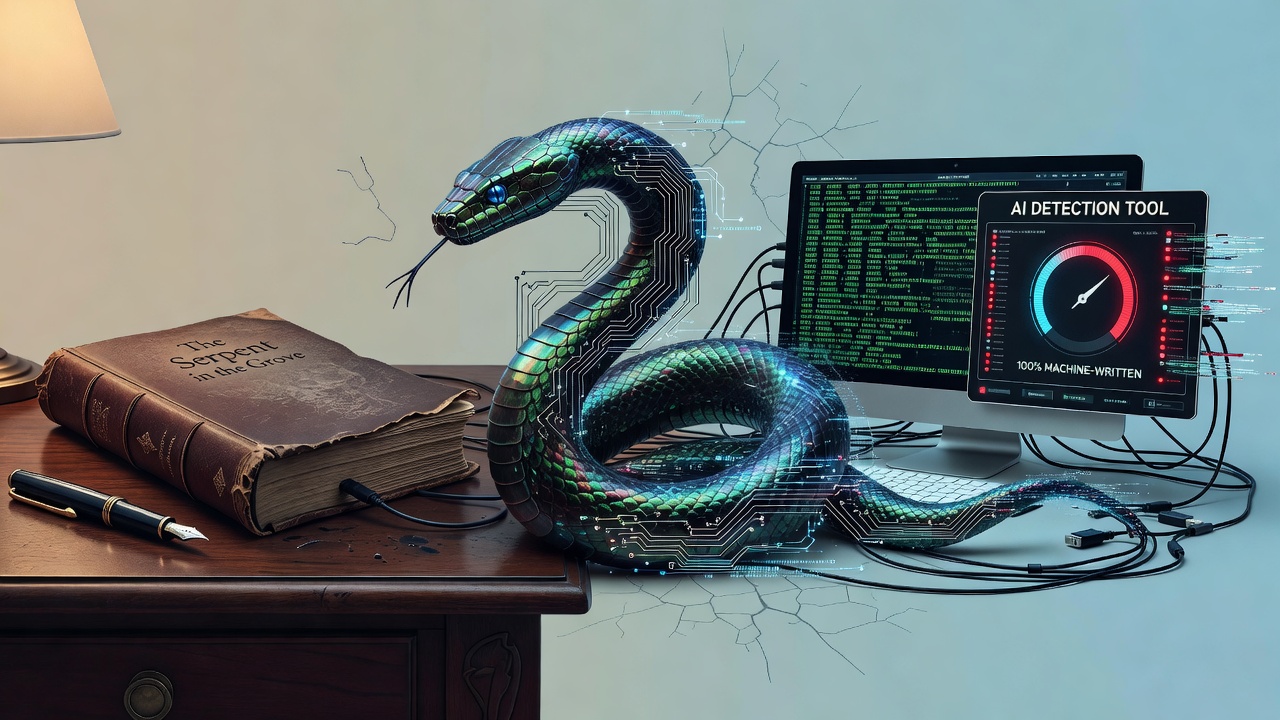
Jamir Nazir’s short story The Serpent in the Grove has done what few works manage. It captured first place in the overall Commonwealth Short Story Prize. This happened even after waves of online critics insisted the prose carried every hallmark of machine generation. The win, announced on July 1, 2026, came months after the story first took the Caribbean regional category and appeared in Granta. Back then, suspicion spread like wildfire across social platforms.
Critics pointed to specific lines. “Sun on galvanise is a cruel instrument.” “They called her Zoongie. Maybe it was a name; maybe rain took a shape and decided to keep it.” Passages like these, with their odd metaphors and rhythmic repetitions, struck many as too polished. Too consistent. Too much like the output of large language models trained on vast libraries of literary fiction. One researcher, Nabeel S. Qureshi, posted on X that the piece showed a distinct AI rhythm hard to describe but easy to spot. Soon others piled on.
The Guardian reported the full arc. Judges had praised Nazir’s work as original, poetic and deeply moving. It beat more than 7,800 other entries. Yet the praise collided head-on with accusations that no human hand shaped the final text. Ethan Mollick, a Wharton professor known for his work on AI and innovation, fed the story into Pangram, an AI-detection tool. The result came back 100 percent machine-written. Similar flags hit two other regional winners that year.
But here’s the complication. Detection software isn’t perfect. The Commonwealth Foundation reviewed the matter. Officials examined drafts, time-stamped documents and writers’ notes. They accepted the authors’ sworn statements that no generative AI produced the core text. Razmi Farook, the foundation’s director-general, told reporters the tools available today simply cannot deliver certainty. Software, after all, has wrongly flagged classics by Ursula K. Le Guin and even passages from Mary Shelley.
Nazir himself pushed back in an interview. He described a writing process built around speech-to-text dictation on an Android phone. Chronic health issues, including diabetes that has required chemotherapy, make long sessions at a keyboard difficult. He writes six or seven drafts. He polishes obsessively. In conversation with The Times of India, Nazir asked a pointed question. Are we saying a piece of writing can’t be that polished unless AI wrote it? He sees artificial intelligence as another instrument, like a word processor. Useful, but no substitute for human imagination or lived memory. One of his poems, posted years earlier on Facebook, already spoke of neuropathy and its limits.
The controversy didn’t stop at one story. Analysis by Pangram’s own team, covered in their blog post, showed a pattern. One 2025 regional winner scored 86 percent AI. Three of five 2026 regional winners triggered strong flags. Wired described the episode as feeling like the new normal. Literary communities have watched similar flare-ups before. Yet this one carried extra sting. The Commonwealth Prize carries prestige. Publication in Granta opens doors. When a suspected AI entry claims the top spot, the entire system of judging and vetting comes under scrutiny.
Sigrid Rausing, publisher of Granta, took an unusual step. Her team queried Claude, another large language model, about the story’s origins. The AI responded that the text was almost certainly not produced unaided by a human. Rausing’s statement, quoted in The New York Times, captured the unease. It may be that the judges have now awarded a prize to an instance of AI plagiarism. We don’t yet know, and perhaps we never will know.
Reactions poured in. On X, users called the outcome immensely disappointing. Some saw it as proof that literary juries favor certain stylistic tics. Others worried the flood of machine-assisted submissions would drown out genuine voices. Sharon Aruparayil, whose story also drew suspicion, dismissed the claims as an entertaining witch-hunt. She denied any AI role. John Edward DeMicoli faced similar questions. The literary world split between those demanding stricter rules and those arguing tools have always shaped creation. Dictation software. Grammar checkers. Even research databases. Where exactly does assistance cross into deception?
Farook acknowledged the pressure. In statements to both The New Yorker and The New Yorker, he noted the foundation might need to examine its processes more closely. Contestants already attest twice that their work contains no AI generation. Yet enforcement remains difficult. No watermark survives every editing pass. No single test delivers perfect accuracy. And judges, reading hundreds of entries, operate under time constraints that favor clean, fluent prose. The very qualities AI now produces at scale.
Recent coverage adds layers. A July 2026 update in Substack’s Moonshots newsletter examined historical winners. The data suggested AI influence has crept upward since 2025. Four out of ten recent regional slots showed strong signals. That trend alarms established authors who spent decades honing craft without algorithmic help. It also raises practical questions for publishers. If readers cannot reliably tell human from machine, does the distinction still matter? Or does the story’s emotional power become the only metric that counts?
Nazir’s win forces a reckoning. The judging chair stood by the choice. The foundation defended its review. Yet doubt lingers in comment threads, private editorial chats and public forums. Some see this as the moment literary institutions must adapt. Others view it as a warning that standards are eroding faster than anyone predicted. Speech-to-text helped Nazir overcome physical barriers. That fact complicates easy condemnation. Assistive technology differs from full generation. The line, however, grows harder to draw with each new model release.
So the prize stands. The story remains published. Readers continue to debate its merits in isolation from the scandal. One fragment stays with many who encountered the opening pages. That cruel sun on galvanised metal. The image lands with force. Whether it sprang from a farmer’s rum-soaked memory in Trinidad or from patterns distilled across millions of similar scenes matters less to some than the shiver it creates. To others, origin is everything.
The literary community has no easy exit from this debate. Detectors improve slowly. Writers experiment with new workflows. Contests tighten language in entry forms. And stories like The Serpent in the Grove keep arriving. Polished. Evocative. Accused. Awarded. The conversation they spark may prove more lasting than any single prize.


 WebProNews is an iEntry Publication