
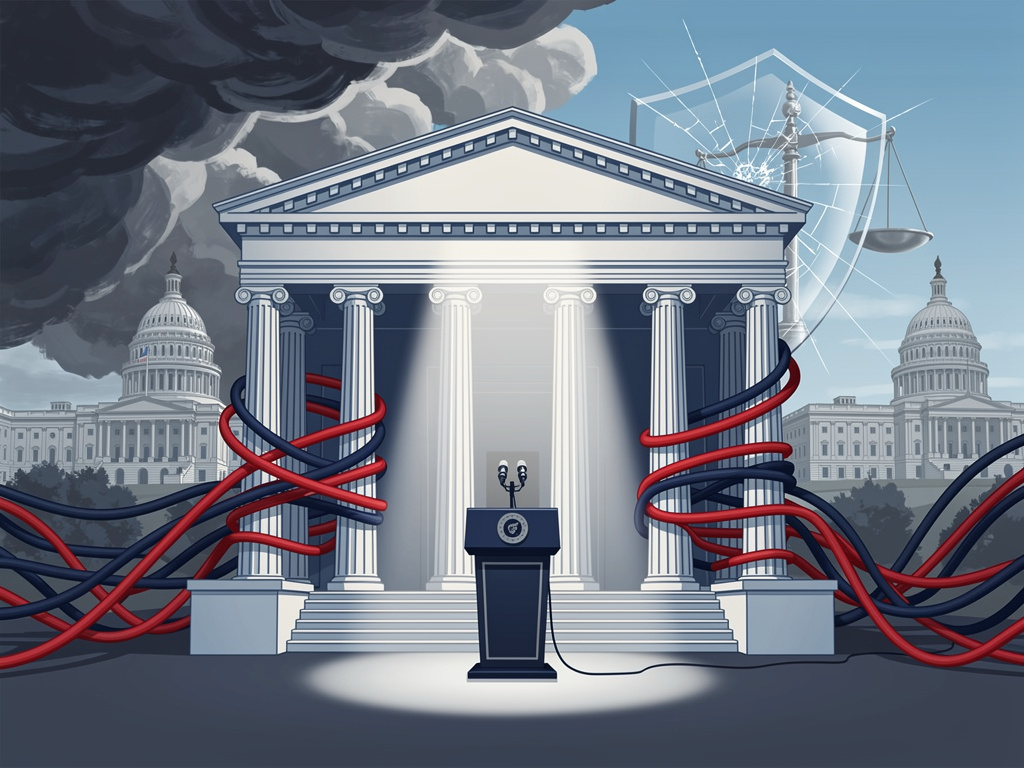
Jerome Powell stepped to the podium Sunday evening in his first public appearance since handing over the chairmanship of the Federal Reserve. The occasion was the John F. Kennedy Profile in Courage Award. The message carried far beyond ceremony.
“Democratic institutions take much time, effort, and patience to build but can be torn down all too quickly,” he said, accepting the honor from the John F. Kennedy Library Foundation. He listed courts, universities, and the central bank itself. Then he turned directly to the stress test his own institution had endured.
The timing was no accident. Powell’s term as chair ended May 15. Kevin Warsh was sworn in as his successor on May 22. Yet Powell chose to remain on the Fed’s Board of Governors. The decision blocks an immediate Trump appointee from filling the seat. It also keeps the former chair inside the building as legal and political pressure continues.
Those pressures are not abstract. President Donald Trump pushed repeatedly for faster interest-rate cuts. When the Fed held its ground, the response escalated. Efforts surfaced to remove Fed Governor Lisa Cook. Calls came for Powell’s resignation. A criminal investigation opened into testimony he gave about renovations at the Fed’s headquarters. Powell described the probe as a pretext.
In a rare video statement released in January, he confronted the moves head-on. The threat of criminal charges, he said, was “a consequence of the Federal Reserve setting interest rates based on our best assessment of what will serve the public rather than following the preferences of a president.” The words landed like a warning shot across the bow of executive power.
And now, months later, Powell returned to the theme with measured force. “These protections have served the public well, and administrations from both parties have respected them,” he told the audience. “If any administration finds a way to remove Fed officials over policy differences, then future administrations will do so as well. The public would lose faith that the central bank will make decisions based only on what’s best for all Americans.”
Short sentence. Long consequence.
Markets have watched the drama unfold with unease. Bond yields spiked at moments of heightened rhetoric. Currency traders priced in added uncertainty. Economists pointed to historical cases where political interference produced higher inflation volatility and weaker anchoring of expectations. The pattern is familiar from other countries. It is new terrain for the United States.
Yet the erosion did not begin this year. Studies documented partisan swings in public trust well before the latest confrontation. An analysis released last year by economists Carola Binder and others showed how trust in the Fed tracks party identification more closely during periods of open conflict. When one side perceives the central bank as opposing its leader, confidence drops. The gap widens. Recovery takes years.
NPR detailed that pattern in April 2025, noting how Trump’s public criticism appeared to shift Republican views almost immediately. Supporters took cues from the president. The Fed, once seen as technocratic, became another front in the tribal divide.
Powell’s decision to stay on the board has drawn its own criticism. Some argue the move itself injects politics into an institution meant to stand apart. Others see it as necessary defense. Austan Goolsbee, president of the Federal Reserve Bank of Chicago, offered a succinct verdict in May. “The best thing Jay Powell did for the Fed’s independence is that he just did the job as you are supposed to do it,” he told The Guardian. “Nobody knew how the Fed would respond under direct attack. His approach let us put our heads down and do the job as it’s supposed to be done.”
But the test is far from over. Trump has nominated allies for open seats. Investigations continue. Legal scholars debate whether a president can fire a Fed governor for policy reasons. The Supreme Court may yet weigh in. In the meantime, every headline feeds the narrative that the central bank operates under a cloud.
Independent monetary policy exists for a reason. Politicians face strong incentives to stimulate before elections and tighten afterward. They dislike the messenger who delivers unwelcome rate hikes. Central bankers insulated from those cycles can focus on the dual mandate of maximum employment and stable prices. History shows the alternative. Double-digit inflation in the 1970s helped persuade lawmakers to strengthen the Fed’s independence in following decades.
So the stakes extend beyond one man or one administration. They reach into inflation expectations that shape wage contracts, mortgage rates, and investment decisions. They touch the dollar’s role as the world’s reserve currency. When traders question whether tomorrow’s policy will reflect economic data or political favor, risk premiums rise. Borrowing costs climb for everyone.
Powell made the broader point Sunday. Democratic institutions, he said, deserve defense even as they are improved. The Fed is one such institution. Its structure, with 14-year terms and staggered appointments, was designed to blunt short-term pressure. Both parties honored that design for generations.
That norm now strains. A Reuters report published hours after the speech captured the moment precisely. Powell urged preservation of what works. He warned that once the barrier falls, it falls for every future president. Reuters reported the full context Monday.
Financial analysts are already modeling scenarios. Some forecast that sustained pressure could delay necessary rate adjustments as officials lean harder into hawkish stances to prove autonomy. Others worry about communication. Forward guidance loses potency when markets suspect hidden political influence.
Academic research reinforces the concern. A Stanford Graduate School of Business analysis last June examined how declining trust in institutions affects economic stability. When citizens doubt the Fed’s motives, they adjust behavior in ways that complicate policy transmission. The feedback loop is vicious.
Stanford’s researchers laid out the mechanism clearly.
Powell’s own record adds weight to his words. He steered the Fed through the pandemic shock, massive fiscal support, supply-chain disruption, and the sharpest inflation surge in 40 years. Critics on both sides found fault at different moments. Yet he maintained the institution’s focus on data over doctrine.
His successor inherits a different environment. Kevin Warsh arrives with a reputation as a market-savvy economist. He also arrives amid questions about whether the appointment process itself has been colored by the desire for policy alignment. The early test will come in the first FOMC meetings under new leadership.
Meanwhile, Powell remains on the board. His presence is both shield and lightning rod. It prevents one more seat from flipping quickly. It also keeps the recent history alive in every news cycle. The former chair has signaled he will serve for an undetermined period. Translation: as long as necessary.
Observers on social media captured the split reaction in real time. Some praised the stand for institutional integrity. Others accused Powell of turning the Fed into a political actor by resisting removal. The debate itself illustrates the danger he described. Once trust fractures along partisan lines, restoring it demands more than speeches.
Yet Powell’s core argument resists easy dismissal. The public’s faith that monetary policy serves the broad national interest, not any one party or president, is the foundation on which low and stable inflation expectations rest. Remove that faith and the cost appears in higher risk premiums, more volatile markets, and slower growth over time.
Institutions, he reminded the audience, are hard to build. They prove easier to damage. The Fed has now endured its most sustained political assault in modern memory. How the country responds will shape not only the next business cycle but the credibility of American economic governance for years ahead.
The speech closed on a note of resolve rather than resignation. Preserve what is good. Improve where possible. But never forget how quickly hard-won arrangements can slip away. For an institution whose power flows from public confidence, that warning carries particular force.
And the markets are listening.


 WebProNews is an iEntry Publication