
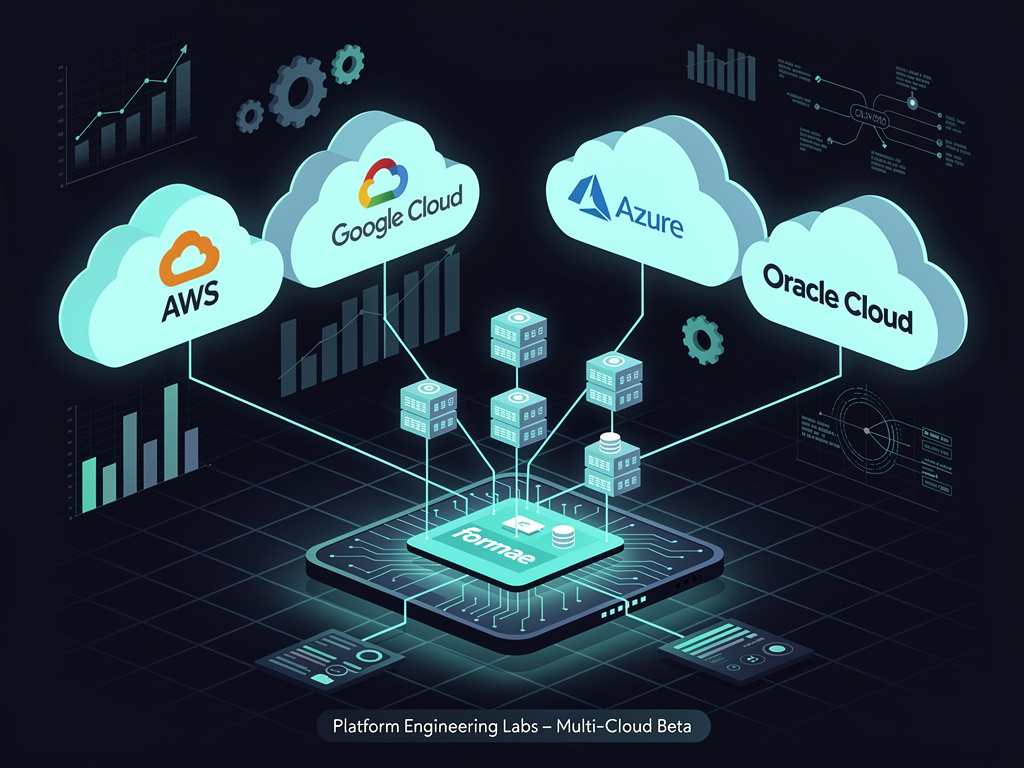
Platform Engineering Labs has introduced a significant expansion to its open-source Infrastructure-as-Code platform formae, launching beta support for four major cloud providers in a move that positions the relatively young platform as a serious contender in the increasingly competitive IaC market. The update, which adds compatibility with Amazon Web Services, Google Cloud Platform, Microsoft Azure, and Oracle Cloud Infrastructure, represents a strategic pivot toward enterprise-grade multi-cloud capabilities that have become essential for organizations navigating today’s distributed computing environments.
According to FutureCIO, the enhancement transforms formae from a single-cloud solution into a comprehensive multi-cloud management platform, addressing one of the most pressing challenges facing platform engineering teams: the complexity of managing infrastructure across disparate cloud environments. This development comes at a time when organizations are increasingly adopting multi-cloud strategies to avoid vendor lock-in, optimize costs, and leverage best-of-breed services from different providers.
The timing of this release is particularly noteworthy given the broader industry trends toward platform engineering as a discipline. The concept, which has gained substantial traction over the past two years, focuses on creating internal developer platforms that abstract away infrastructure complexity while maintaining flexibility and control. formae’s approach to this challenge differs from established players like Terraform and Pulumi by emphasizing developer experience and reducing the cognitive load associated with managing cloud resources across multiple providers.
The Technical Architecture Behind Multi-Cloud Abstraction
Platform Engineering Labs has architected formae to provide a unified interface that translates high-level infrastructure definitions into provider-specific configurations. This abstraction layer represents a significant engineering challenge, as each cloud provider maintains distinct APIs, service models, and operational paradigms. The beta release focuses on core infrastructure primitives—compute instances, storage resources, networking components, and identity management—that form the foundation of most cloud deployments.
The platform’s approach to multi-cloud support differs from simple wrapper solutions by implementing native integrations that respect each provider’s unique capabilities and constraints. Rather than forcing a lowest-common-denominator approach, formae allows developers to access provider-specific features while maintaining a consistent development experience. This architectural decision reflects a sophisticated understanding of enterprise requirements, where organizations often need to leverage specialized services from different providers while maintaining operational consistency.
Industry observers note that the open-source nature of formae provides distinct advantages in the IaC space, particularly regarding transparency, community contributions, and the ability to audit infrastructure code without proprietary black boxes. The platform’s licensing model encourages adoption by removing cost barriers while potentially creating a sustainable ecosystem around commercial support and enterprise features. This strategy mirrors successful open-source infrastructure projects that have achieved widespread adoption by balancing community development with commercial viability.
Market Implications and Competitive Positioning
The IaC market has witnessed significant consolidation and competition in recent years, with HashiCorp’s Terraform dominating mindshare despite recent licensing controversies that prompted the creation of OpenTofu, a community-driven fork. Platform Engineering Labs enters this environment with a platform that appears designed to address perceived gaps in existing solutions, particularly around developer experience and multi-cloud consistency. The beta designation for the multi-cloud features suggests a measured approach to market entry, allowing the company to gather feedback and refine implementations before committing to production-grade support.
Enterprise adoption of multi-cloud strategies has accelerated dramatically, driven by factors including risk mitigation, regulatory requirements, and the pursuit of optimal price-performance ratios for different workload types. Organizations increasingly deploy applications across multiple cloud providers, using AWS for certain services, Google Cloud Platform for data analytics and machine learning workloads, Azure for Microsoft-centric applications, and Oracle Cloud Infrastructure for database-intensive operations. This heterogeneity creates substantial management challenges that platforms like formae aim to address.
The addition of Oracle Cloud Infrastructure to formae’s supported platforms is particularly interesting, as OCI has gained traction in enterprise environments despite having smaller market share than the big three cloud providers. Oracle’s aggressive pricing strategies and specialized database offerings have attracted organizations with significant Oracle technology investments, creating demand for IaC tools that treat OCI as a first-class citizen rather than an afterthought. Platform Engineering Labs’ decision to include OCI in the initial multi-cloud release signals awareness of these enterprise adoption patterns.
Developer Experience and Platform Engineering Philosophy
The platform engineering movement emphasizes creating golden paths that make the right way to build and deploy applications also the easiest way. formae’s design philosophy appears aligned with this principle, focusing on reducing friction in infrastructure provisioning while maintaining the power and flexibility that platform teams require. The multi-cloud beta release extends this philosophy across provider boundaries, allowing organizations to define infrastructure patterns once and deploy them consistently regardless of the underlying cloud platform.
This approach addresses a critical pain point in multi-cloud operations: the cognitive overhead of maintaining expertise across multiple provider ecosystems. Platform engineers must currently master different infrastructure definition languages, understand provider-specific quirks, and maintain separate codebases for each cloud environment. By providing abstraction without sacrificing access to provider-specific capabilities, formae attempts to reduce this burden while avoiding the limitations of overly simplified solutions that break down when organizations need advanced features.
The open-source development model also enables community contributions that can accelerate feature development and improve platform quality through diverse perspectives and use cases. Successful open-source infrastructure projects benefit from contributions by organizations that extend platforms to meet their specific needs, creating a virtuous cycle of improvement that proprietary solutions struggle to match. Platform Engineering Labs’ challenge will be fostering this community while maintaining coherent product direction and ensuring code quality across contributions.
Enterprise Adoption Considerations and Risk Factors
Organizations evaluating formae for production use will weigh several factors, including the maturity of multi-cloud support, the robustness of the provider ecosystem, migration paths from existing IaC solutions, and the long-term sustainability of the project. The beta designation for multi-cloud features signals that production deployment requires careful evaluation and potentially close collaboration with Platform Engineering Labs to address edge cases and ensure stability under enterprise workloads.
The platform’s success will likely depend on several critical factors: the quality and completeness of provider integrations, the responsiveness of the development team to community feedback, the emergence of a robust ecosystem of modules and extensions, and the availability of enterprise support options for organizations that require service level agreements and dedicated assistance. These elements have proven essential for IaC platform adoption in risk-averse enterprise environments where infrastructure failures can have severe business consequences.
Migration considerations also loom large for organizations with existing infrastructure code investments. The effort required to translate Terraform configurations, CloudFormation templates, or other IaC definitions into formae’s format represents a significant undertaking that must be justified by tangible benefits in developer productivity, operational efficiency, or infrastructure cost optimization. Platform Engineering Labs will need to provide compelling migration tools and clear value propositions to overcome the inertia of existing deployments.
Future Trajectory and Industry Impact
The introduction of multi-cloud support positions formae for potential growth in enterprise markets where hybrid and multi-cloud deployments have become standard rather than exceptional. As organizations continue diversifying their cloud strategies to optimize costs, improve resilience, and access specialized services, demand for sophisticated multi-cloud management tools will likely increase. Platform Engineering Labs’ ability to execute on this vision while maintaining the developer experience advantages of their platform will determine whether formae becomes a significant force in the IaC market or remains a niche solution.
The broader platform engineering movement continues gaining momentum as organizations recognize the productivity benefits of well-designed internal developer platforms. Industry analysts project substantial growth in platform engineering adoption over the next several years, driven by the need to manage increasing infrastructure complexity while accelerating application delivery. Tools like formae that align with platform engineering principles and provide practical solutions to multi-cloud challenges are well-positioned to benefit from these trends, provided they can demonstrate production readiness and build sustainable communities around their platforms.
The success of formae’s multi-cloud initiative may also influence competitive dynamics in the IaC market, potentially prompting responses from established players or encouraging other new entrants to focus on developer experience and multi-cloud consistency. As the market matures, differentiation based on these factors could become increasingly important, particularly as basic IaC functionality becomes commoditized and organizations seek solutions that provide higher-level abstractions and better integration with their development workflows. Platform Engineering Labs has staked its position in this evolving market, and the coming months will reveal whether the multi-cloud beta can mature into a production-ready platform that meets enterprise requirements while maintaining the developer experience advantages that distinguish it from competitors.


 WebProNews is an iEntry Publication