
Platform teams built golden paths that cut ticket volume and sped up deployments. Those gains hold. Yet fresh pressures now test the same foundations. AI coding tools generate pull requests at rates once unthinkable. Autonomous agents call platform APIs without human oversight. GPU clusters sit idle or spike unpredictably. Costs balloon from a single inference run. Compliance rules tighten around data residency and model provenance.
Many organizations still run what the CNCF blog post published today labels Platform Engineering 1.0. Internal developer platforms focused on containerized apps for human developers. Self-service worked when the main consumer filed a Jira ticket. That model now shows strain.
But the shift isn’t a full teardown. Core ideas stay: treat the platform as a product, reduce cognitive load, create paved roads, move security earlier. What changes is scope. Who uses it. What it must govern. How fast it adapts.
Five Pillars Define the Next Phase
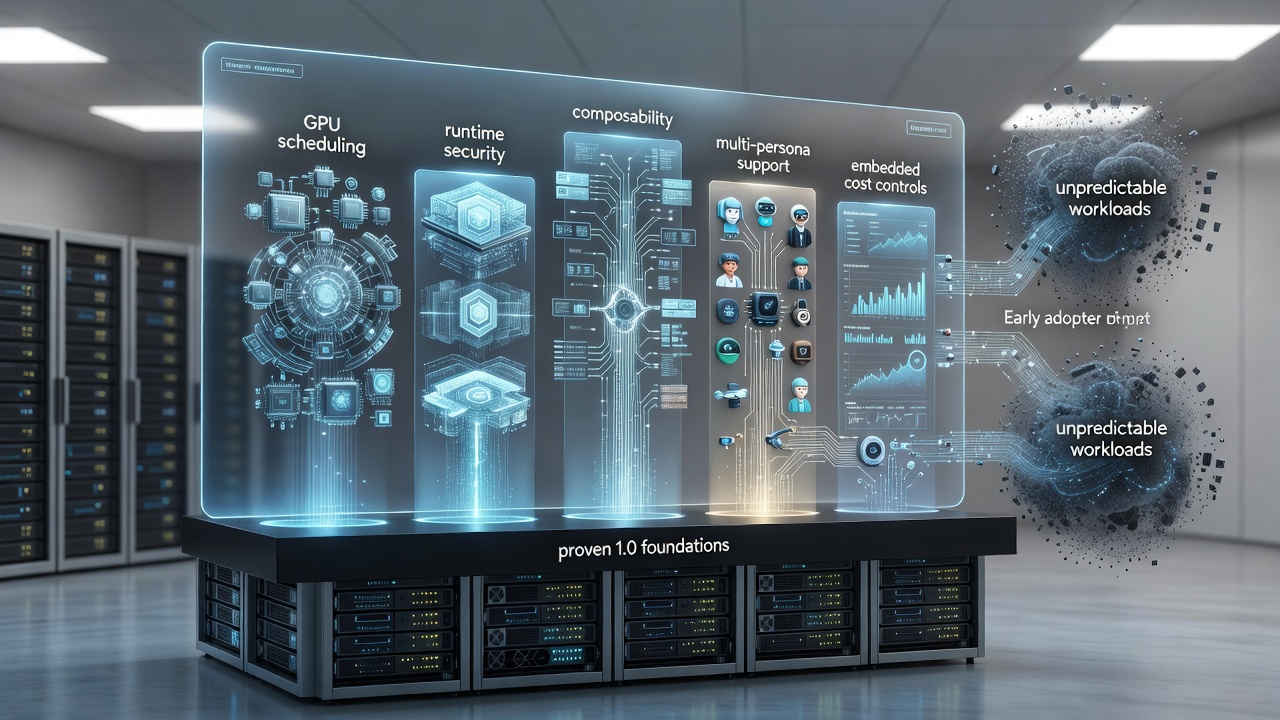
The CNCF article outlines Platform Engineering 2.0 through five pillars. First comes the AI-native platform. It treats model serving, GPU allocation, and agent orchestration as first-class citizens instead of bolted-on features. GPU and TPU scheduling move from afterthought to core runtime primitive. Model lifecycle management gains versioned registries with built-in scanning. MCP gateways and agentic guardrails appear in the control plane so autonomous systems can’t bypass policy.
AI agents become platform consumers. They request resources, trigger workflows, and consume tokens. The platform must rate-limit them, audit their actions, and isolate their blast radius just as it does for engineers. Failure to do so leaves gaps wider than any prompt injection demo.
Next is multi-persona experience. Data scientists want self-service GPU provisioning and experiment tracking without waiting on platform tickets. ML engineers need model registries that enforce approval gates. Business leaders demand live FinOps views tied to DORA metrics. Security teams expect policy-as-code that covers shadow AI sprawl, prompt injection, model poisoning, and inference data leaks. One dashboard no longer suffices.
Embedded FinOps follows. Cost intelligence shifts from monthly reports to provisioning-time gates. A developer spinning up a large language model fine-tuning job sees projected spend before the cluster boots. Attribution ties spend to business outcomes rather than vague “AI experiments.” Real-time decisions replace after-the-fact reconciliation. The PlatformEngineering.com feature on Platform Engineering 2.0 notes that AI consumption patterns break traditional tagging. A single runaway agent can rack up Claude API bills faster than any human review cycle.
Security shifts down. Shift-left pipelines catch code issues. Runtime controls now catch what agents and models introduce at inference time. Continuous compliance runs as platform policy rather than audit theater. Data isolation, prompt sanitization, and model registry governance become table stakes.
Finally, composable by design. Platforms built from fixed stacks accumulate debt when new tools emerge. Modular, API-first blocks let teams swap a CNCF-graduated project for another without rewriting everything. With over 200 projects across the CNCF catalog, this pillar draws directly on open source variety. A team can replace one inference router with another that offers better LoRA support and keep the rest intact.
Infrastructure sits at the center of all five. No longer mere plumbing, it becomes the strategic substrate. Dynamic allocation replaces static pools. Topology-aware scheduling respects GPU locality. The CNCF March post on cloud native for AI engineering highlights Kubernetes Dynamic Resource Allocation reaching general availability in version 1.34. It replaces older device plugins with fine-grained, CEL-based filtering and declarative ResourceClaims. Teams schedule GPUs with awareness of NUMA topology and avoid the fragmentation that once wasted expensive accelerators.
The same article points to the Gateway API Inference Extension, now GA. It routes inference traffic by model name, LoRA adapter, or endpoint health. Shared model server pools serve multiple workloads at higher utilization. Fewer accelerators sit idle. A new Working Group AI Gateway develops standards for token-based rate limiting, semantic routing, prompt filtering, and retrieval-augmented generation patterns.
These Kubernetes extensions matter because platform teams can’t afford separate stacks for AI. They need the same orchestration, observability, and policy engine to cover both traditional apps and new model-driven services. Kubeflow and Kueue already handle ML workflows and queueing at scale. The community response shows open governance can move faster than many vendor roadmaps.
Atulpriya Sharma, co-organizer of the CNCF Platform Engineering Technical Community Group, captured the stakes. “What started as a developer productivity function is now the centralised governance layer for the enterprise – enforcing cost discipline, security posture, and AI readiness across every team,” he said in the July 6 CNCF post. “The platforms that can absorb that scope without structural debt aren’t the ones built around fixed architectures. They’re the ones built to be composable from day one.”
Maturity models help teams plot their path. The CNCF Platform Engineering Maturity Model, originally for 1.0, now serves as baseline. Teams assess current self-service depth, then map gaps in GPU provisioning, agent governance, and cost gates. Progress isn’t binary. Some start with embedded FinOps dashboards. Others tackle model registry governance first. The journey depends on existing Kubernetes footprint, regulatory exposure, and AI ambition.
Recent coverage reinforces the trend. A January New Stack article described AI merging with platform engineering as the defining 2026 story. Golden paths now include safe model access and agent sandboxing. Developer experience metrics expand to cover non-deterministic outputs and evaluation loops.
Broader industry reports echo the message. Platform teams that treat infrastructure as strategic will outpace those who treat it as operational overhead. The PlatformEngineering.com piece argues organizations can avoid full infrastructure rebuilds by extending existing Kubernetes and IDP foundations. Model governance becomes the new control plane. Workload isolation provides structural guarantees against cascading failures from unpredictable agents.
Challenges remain concrete. Prompt injection can bypass naive guardrails. Model poisoning taints shared registries. Inference leaks expose sensitive training data. Shadow AI proliferates when self-service lacks friction. FinOps teams watch token spend climb without clear attribution to features or products. Each issue points back to the platform layer.
Yet the upside looks equally tangible. Teams that deliver composable, multi-persona platforms reduce duplication. Data scientists ship experiments faster. Developers focus on business logic instead of GPU topology. Security and compliance gain visibility without slowing delivery. Costs drop when provisioning gates catch inefficient patterns before they run.
The CNCF community continues shaping the standards. Its AI Conformance Program, working groups, and project contributions show how open collaboration fills gaps that proprietary solutions often miss. Platform engineers who engage with these efforts gain both tools and influence over the direction.
So the question for technology leaders sharpens. Will your internal platform evolve deliberately around these five pillars? Or will AI workloads force ad hoc extensions that create tomorrow’s technical debt?
Early movers already treat platform engineering as the governance layer for the entire AI lifecycle. They embed cost, security, and observability from the start. They design for agents as well as humans. They compose rather than customize. The rest risk watching their platforms become bottlenecks in an agentic world that waits for no one.


 WebProNews is an iEntry Publication