
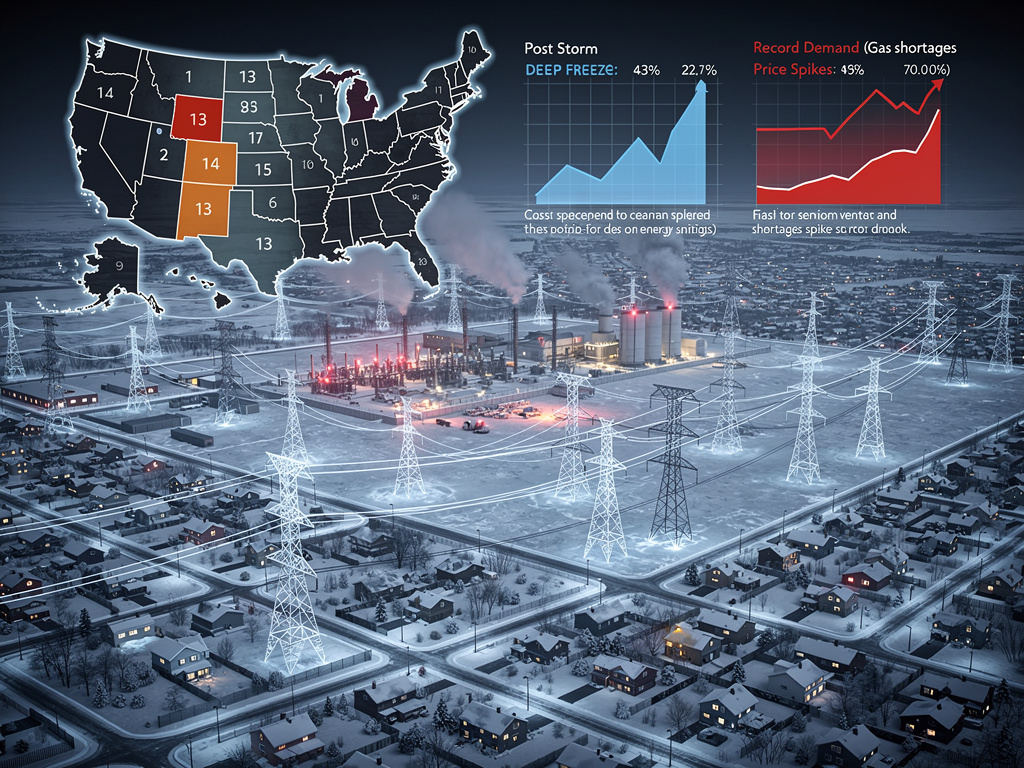
A deep freeze has seized the U.S. Midwest and East Coast following the season’s most ferocious storm, thrusting the nation’s largest power grid into emergency mode and imperiling electricity for 67 million residents. PJM Interconnection LLC, the regional transmission organization overseeing power from New Jersey to Chicago across 13 states and Washington, D.C., declared a Level-1 emergency on Tuesday, January 27, 2026, mandating all generators to operate at maximum capacity amid forecasts of record winter demand.
The crisis stems from Winter Storm Fern, which battered the country over the weekend with heavy snow, ice and gale-force winds, canceling thousands of flights, paralyzing roads and knocking out power to over 1 million homes and businesses. The storm slashed U.S. natural gas production by 12%, crippling supplies critical for power plants and residential heating. “This extreme level of demand coupled with stresses on fuel availability raise a significant risk of emergency conditions that could jeopardize electric reliability and public safety,” Michael Bryson, PJM’s senior vice president for operations, warned in a letter to U.S. Energy Secretary Chris Wright.
Temperatures plunged to around 20°F on Tuesday—milder than the anticipated low teens—but demand still peaked at nearly 138 gigawatts, 6.3% below forecasts yet perilously close to historical highs. Wholesale prices skyrocketed: on-peak power at PJM’s Western hub hit $638.73 per megawatt-hour, a 542% surge from Monday and the highest in 12 years, while Virginia spots briefly exceeded $1,300/MWh before settling at $352.81/MWh. Older, costlier plants fired up as the day-ahead market dominated procurement.
Storm’s Fury Ignites Fuel Crunch
The weekend onslaught left nearly 1 million customers in the dark by Sunday, with over 300,000 outages in Tennessee alone and more than 100,000 each in Mississippi, Texas and Louisiana, per Reuters. PJM reported nearly 21 gigawatts of generation outages—about 16% of Sunday’s 127.4 GW demand—mostly forced offline by freezing conditions and gas shortages. Pipeline constraints exacerbated the issue, as the Eastern seaboard lacks native gas supplies and relies on bottlenecked networks during prolonged cold snaps.
Analysts at PA Consulting noted PJM’s reduced flexibility from plant retirements and surging data center demand, compounded by transmission bottlenecks preventing cheap Illinois wind power from reaching eastern hotspots. “The system is operating on a much thinner razor’s edge,” George Katsigiannakis, vice president at ICF, told The New York Times. Natural gas demand hit 146.7 billion cubic feet per day, ranking 10th all-time, though less severe than 2021’s Uri storm, per S&P Global’s Matthew Palmer.
PJM issued pre-emergency orders Sunday, curbing some demand response customers and calling for generator maintenance outage recalls as early as January 21. The U.S. Department of Energy authorized plants to exceed emissions limits and granted access to data center backups as a last resort, echoing measures from prior crises.
Price Spikes Signal Desperate Measures
Spot prices earlier surged above $3,000/MWh in PJM on Saturday from under $200, per multiple reports including Fox Business. Day-ahead Tuesday delivery topped $2,300/MWh in some areas, up 241%. These extremes activated 40-year-old gas turbines chasing profits, a hallmark of grid stress, as noted by energy trader Joao Rute to Reuters.
No rolling blackouts have materialized yet—weekend outages stemmed mainly from ice-damaged lines—but forecasters predict unrelenting cold. Temperatures across PJM territory could drop 8°F to 15°F below normal through January’s end, with Commodity Weather Group forecasting plunges in the Ohio Valley and Mid-Atlantic Friday and Saturday. Suburban Cleveland eyes -6°F, smashing an 1873 record; Columbus -8°F (1966 mark); Philadelphia 1°F (2014).
Demand projections threaten PJM’s winter record of 143.7 GW from last January, potentially exceeding 147 GW. The National Weather Service dubbed it “the longest duration of cold in several decades,” with wind chills posing hypothermia risks and at least 22 storm-related deaths reported.
Grid Operator’s All-Out Mobilization
PJM’s toolkit includes Cold Weather Alerts issued days ahead, urging generators to winterize equipment and defer maintenance. A January 22 advisory preceded the storm, followed by Maximum Generation Alerts. Neighboring MISO, serving 45 million, echoed with its own alerts through Tuesday. ERCOT in Texas, scarred by 2021’s failures, monitored closely as this marked its biggest test since.
U.S. Steel in Pittsburgh preemptively cut usage, while utilities like Duquesne Light and FirstEnergy reported stable operations but prepared demand response activations paying large industrials to shed load. President Donald Trump approved federal disaster declarations for nearly 20 states, posting on Truth Social: “We will continue to monitor, and stay in touch with all States in the path of this storm. Stay Safe, and Stay Warm.”
The Energy Department expedited orders for Eddystone, Pennsylvania units to run past retirement if needed, addressing PJM’s flagged resource adequacy gaps from retirements outpacing new builds amid load growth.
Historical Echoes and Broader Vulnerabilities
This episode recalls 2022’s near-miss in the Southeast and Mid-Atlantic, where emergency measures barely held the grid, per Global Location Strategies’ Didi Caldwell: “Every region is exposed, but for different reasons… In the southeast, the lack of storage and limited transport capacity means that, during cold snaps, natural gas is competing with itself.” PJM’s gas-heavy fleet falters in extremes, with units freezing or starved of fuel.
Broader U.S. grids—from NYISO to SPP—issued parallel warnings. Battery storage blunted Texas spikes, saving $750 million two years ago per American Clean Power, highlighting a diversification path PJM lags. Data centers, ironically straining capacity, now offer backup relief.
As frigid air bursts return Friday, PJM braces for sustained tests through month’s end. Grid managers cling to thin margins, invoking every protocol to avert catastrophe for 67 million in the crosshairs.


 WebProNews is an iEntry Publication