
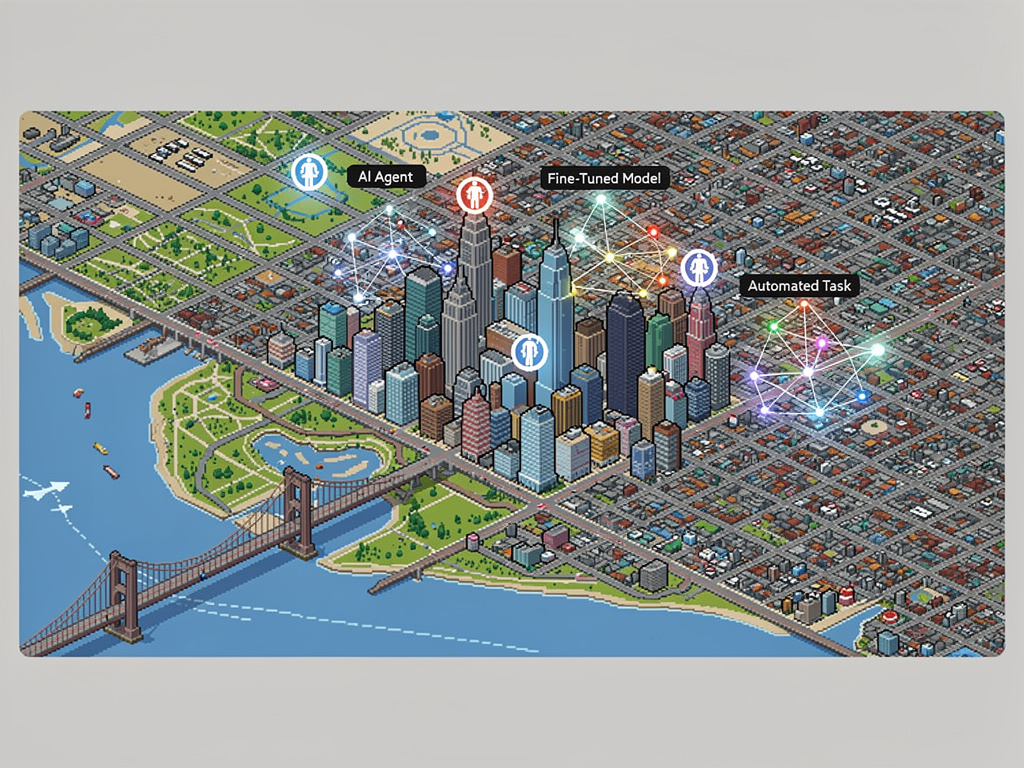
In a striking fusion of nostalgia and cutting-edge artificial intelligence, Andy Coenen, an AI controllability researcher at Google DeepMind, has crafted a sprawling isometric pixel-art map of New York City that evokes the charm of 1990s classics like SimCity 2000. Unveiled last week, the interactive Isometric NYC project spans the five boroughs in meticulous detail, from the dense grid of Manhattan to the winding streets of Queens, all rendered in a retro pixel style that invites endless zooming and exploration.
Coenen, formerly at The M Machine, built the map without writing a single line of code, relying instead on AI coding agents like Claude, Gemini CLI, and Cursor. ‘I didn’t write a single line of code,’ he posted on X, where the announcement garnered over 7,700 likes and widespread acclaim. The project, detailed on his site cannoneyed.com/projects/isometric-nyc, demonstrates how generative AI can scale world-building tasks once deemed impossible for a solo creator.
From Satellite Tiles to Pixel Perfection
The process began with real-world data: Coenen sourced 3D geometry and textures from the Google Maps 3D Tiles API, overlaying them on satellite imagery for precise rendering. Initial experiments with Nano Banana Pro, an AI image generator, produced tiles but suffered from inconsistencies—hallucinated buildings and mismatched geometries plagued early outputs, with success rates hovering at 50%. To achieve uniformity, he fine-tuned a Qwen/Image-Edit model on oxen.ai using just 40 input-output pairs of satellite images and target pixel art, a process that took four hours and cost $12.
This fine-tuning enabled an ‘infill strategy,’ where the model generated 512×512 pixel quadrants seamlessly adjacent to existing tiles via masked inputs, ensuring the 1024×1024 pixel tiles stitched together without visible seams. A SQLite database tracked quadrants by coordinates, while a custom web app allowed selective generation and preview. For scale, Coenen deployed the model on Lambda Labs H100 GPUs, achieving over 200 generations per hour at under $3 per hour—overnight runs populated vast swaths of the estimated 40,000 tiles.
Landmarks emerge vividly: Central Park dominates as a vast green expanse, 432 Park Avenue pierces the skyline, and even the Statue of Liberty’s torch is discernible at maximum zoom. Yet, AI artifacts persist—’goopiness’ in close-ups reveals the lack of deliberate pixel placement, a hallmark of human-crafted art, as noted by PC Gamer.
AI Agents: The Infinite Toolbox
Coenen’s real innovation lies in agentic coding. Tools like Cursor (powered by Opus 4.5 and Gemini 3 Pro) handled everything from CLI micro-tools—a bounds visualizer evolving into a polygon editor, a water classifier—to the full generation pipeline and high-performance viewer using OpenSeaDragon for gigapixel zooming. ‘The biggest joy of this project was the ability to build tools at the speed of thought,’ Coenen wrote. ‘With Claude or Cursor, I can whip them up in 5 minutes. This is absolutely transformational—it’s like having an infinite toolbox.’
Challenges abounded, particularly with edges: Rivers like the Hudson and East River, plus tree-lined areas, defied reliable generation, necessitating manual tweaks in Affinity Designer, custom negative prompts, and an automatic color-picker for water correction. Agents excelled at modular, Unix-philosophy tools but faltered on complex tiling algorithms, requiring human oversight for irreducible complexity.
Manual review consumed disproportionate time, highlighting image AI’s limitations versus code: No tight feedback loops for self-correction, flimsy edit interfaces lacking precise pointing or masking. ‘AI agents unlock a universe of creative projects that were previously unimaginable,’ Coenen stated, yet he candidly flags the gap—image models lack the reliability of code agents that execute, debug, and iterate autonomously.
Why AI Empowers, Not Replaces, Artists
Drawing from a decade as an electronic musician, Coenen spent ‘at least 10,000 hours precisely moving around audio clips,’ tasks he calls ‘grindy repetitive’ slogs. ‘I’m particularly interested in scaling up the grindy repetitive tasks that make many ideas practically impossible,’ he explained. For Isometric NYC, a human team hand-drawing every building would be infeasible; one person alone, a lifetime.
His optimism cuts against fears of AI commoditizing art. ‘If you can push a button and get content, then that content is a commodity. Its value is next to zero. Counterintuitively, that’s my biggest reason to be optimistic about AI and creativity. When hard parts become easy, the differentiator becomes love.’ As PC Gamer reported, this ends ‘drudgery,’ freeing creators for higher pursuits.
The project hit Hacker News’ front page, sparking discussions on AI’s creative potential, with users praising oxen.ai’s role. On X, reactions ranged from awe—’An incredible project’ by @whalefloki—to crypto tie-ins like $NYC tokens, though Coenen has not endorsed them.
Broader Ripples in AI World-Building
Coenen’s mantra: ‘What’s possible now that was impossible before?’ Isometric NYC answers by blending open data like NYC’s CityGML with machine learning, birthing a playable-feeling map. Future plans include AI-driven review for failures and advanced architectures for continuous learning, potentially enabling self-healing generations.
Reactions underscore the buzz: German outlet PC Games Hardware hailed it as SimCity-esque kartografie, while Reddit’s r/artificial marveled at the detail from Qwen-Image-Edit. Hong Kong’s unwire.hk spotlighted the $12 feat, quoting Coenen’s balcony epiphany overlooking Manhattan from Google NYC.
For industry insiders, this signals a shift: AI not as threat, but accelerator. Coenen’s solo endeavor—spanning rendering, training, scaling, and deployment—hints at solopreneur empires in generative media, where love, not labor, defines mastery.


 WebProNews is an iEntry Publication