
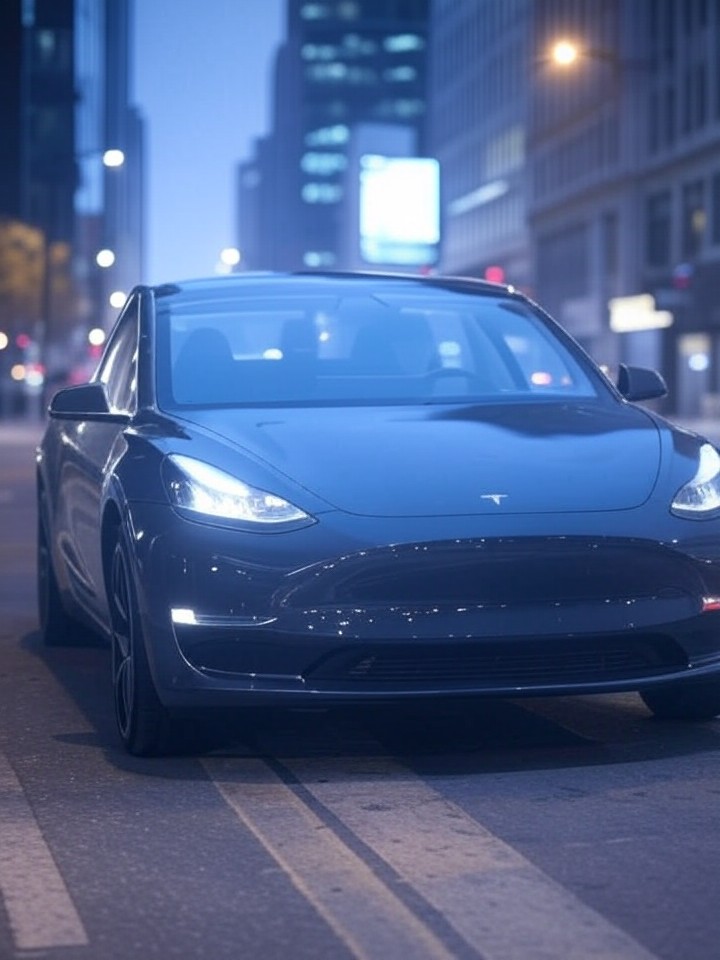
In the rapidly evolving world of automotive technology, a new frontier is emerging where artificial intelligence isn’t just processing data in the cloud—it’s physically interacting with the real world through vehicles. This shift, often dubbed “physical AI,” represents a convergence of robotics, machine learning, and sensory systems that could redefine how cars perceive, decide, and act. Drawing from recent industry buzz, particularly highlighted in a Wired feature, physical AI promises to embed intelligent, adaptive behaviors directly into automobiles, moving beyond traditional software to embodied systems that learn from their environments.
At its core, physical AI in cars involves integrating AI models with hardware like sensors, actuators, and onboard processors to enable real-time responses to physical stimuli. Unlike earlier AI applications focused on predictive analytics or voice assistants, this iteration allows vehicles to “feel” and react—much like a human driver adjusting to road vibrations or sudden obstacles. Industry experts point to advancements in edge computing, where AI processes data locally rather than relying on distant servers, as a key enabler. This reduces latency, crucial for safety in high-speed scenarios, and addresses privacy concerns by keeping sensitive driving data on the device.
Recent developments underscore this trend’s momentum. For instance, automakers are experimenting with AI systems that fuse data from cameras, lidar, radar, and even haptic sensors to create a holistic understanding of the surroundings. Tesla, a frontrunner in autonomous driving, has patented technologies that convert 2D camera feeds into precise 3D maps without expensive lidar, as noted in posts on X. This approach not only cuts costs but also enhances the vehicle’s ability to navigate complex urban settings with sub-centimeter accuracy.
The Push Toward Embodied Intelligence
Nvidia, a major player in AI hardware, is driving much of this innovation through its platforms tailored for automotive use. The company’s recently announced Alpamayo family of open-source AI models and tools, detailed in an Nvidia Newsroom release, focuses on safe, reasoning-based autonomous vehicle development. These models simulate virtual environments for training, then deploy in real-world cars, partnering with firms like Mercedes-Benz for Level 4 autonomy—where vehicles handle most driving without human input. Such collaborations signal a broader industry pivot from electrification to AI-centric mobility, as reported in ETAuto.
Beyond hardware, physical AI is transforming manufacturing processes themselves. Companies are using AI-driven robotics to assemble vehicles with unprecedented precision, learning from physical interactions to optimize workflows. A Deloitte insights piece explores how these adaptive machines operate in complex factories, reducing errors and enhancing safety. For example, AI systems can now predict mechanical failures by analyzing vibrations in real time, preventing costly downtimes on assembly lines.
This integration extends to consumer features, too. Imagine a car that not only detects a pothole but adjusts suspension dynamically based on learned patterns from millions of similar encounters. Recent CES 2026 showcases, as covered in BitcoinWorld, highlighted prototypes where physical AI enables vehicles to “converse” with infrastructure, like smart traffic lights, for smoother traffic flow. These innovations aren’t just theoretical; they’re hitting production lines, with edge AI chips processing data in under 100 milliseconds, as discussed in industry chatter on X.
Challenges in Scaling Physical AI
However, deploying physical AI isn’t without hurdles. One major challenge is ensuring reliability in unpredictable real-world conditions—rain, fog, or erratic pedestrian behavior can confound even advanced sensors. Automakers must balance the computational demands of onboard AI with energy efficiency, especially in electric vehicles where battery life is paramount. A McKinsey analysis delves into this, noting the trade-offs between latency, privacy, and cost as AI moves to the vehicle’s edge.
Regulatory frameworks are another sticking point. Governments worldwide are grappling with how to certify AI systems that learn and adapt post-deployment, unlike static software. In the U.S., the National Highway Traffic Safety Administration is pushing for standards that verify AI’s decision-making in physical contexts, drawing parallels to aviation safety protocols. European regulators, meanwhile, emphasize ethical AI, mandating transparency in how physical systems handle data from physical interactions.
Despite these obstacles, investments are pouring in. Venture capital in AI-automotive startups surged 40% last year, fueled by successes like Waymo’s robotaxi fleets, which embody physical AI through constant environmental learning. Posts on X from industry analysts highlight Nvidia’s partnerships with Siemens for industrial automation and General Motors for self-driving tech, underscoring a multi-billion-dollar ecosystem building around embodied AI.
Innovations Driving Market Transformation
Looking at specific breakthroughs, AI-powered perception is redefining vehicle autonomy. Systems now enable cars to make split-second decisions based on fused sensory inputs, as explained in a SemiEngineering article. For instance, synthetic data generation—creating virtual scenarios to train AI—accelerates development without real-world risks. Nvidia’s Cosmos tool, mentioned in X discussions, simulates millions of driving hours, allowing models to “experience” rare events like black ice or animal crossings.
In design and manufacturing, AI is optimizing aerodynamics and materials through generative models. Neural Concept outlines use cases where AI simulates physical stresses on car bodies, reducing prototypes and speeding time-to-market. This has led to lighter, more efficient vehicles, with companies like BMW incorporating physical AI in wind tunnel testing to refine shapes based on real-time feedback.
Consumer adoption is accelerating with features like predictive maintenance, where AI analyzes engine sounds or tire wear to schedule repairs proactively. A Fullpath blog post details benefits such as improved fuel efficiency and reduced emissions, aligning with global sustainability goals. At CES 2026, as per Autovista24, carmakers like Ford and Toyota unveiled AI assistants that adapt to driver habits, adjusting climate controls or routes based on physical cues like fatigue detected via seat sensors.
The Broader Economic Implications
The ripple effects of physical AI extend to supply chains and labor markets. By automating repetitive tasks in factories, it could reshape jobs, shifting workers toward oversight roles in AI-monitored environments. Deloitte’s report warns of potential disruptions but also opportunities for upskilling in AI maintenance. Economically, the technology could unlock trillions in value, with Nvidia’s CEO Jensen Huang estimating in X-transcribed remarks that physical AI will revolutionize the $50 trillion manufacturing and logistics sectors.
Competitive dynamics are intensifying. Tesla’s vision-only systems, praised in X posts for cost reductions, challenge lidar-dependent rivals like Cruise. Meanwhile, Chinese firms such as BYD are leveraging physical AI for affordable electric vehicles with advanced autonomy, potentially reshaping global market shares. A S&P Global blog forecasts AI driving transformation across the value chain, from design to after-sales service.
As physical AI matures, ethical considerations loom large. Ensuring equitable access—preventing a divide where only luxury vehicles benefit—is crucial. Privacy advocates, cited in Wired’s coverage, stress the need for robust data protections as cars become data-gathering machines in motion.
Future Trajectories and Industry Outlook
Peering ahead, physical AI could enable fully robotic fleets for logistics, with trucks that self-optimize routes based on physical road conditions. Innovations like AutoNeural-VL-1.5B, a production-grade edge AI model discussed on X, process inputs locally, eliminating cloud dependency and enhancing reliability in remote areas.
Collaborations are key to this future. Nvidia’s tie-ups with Mercedes for the CLA model, as per recent announcements, aim for hands-off driving in urban settings. Similarly, Stellantis is exploring sensor-fusion AI for safer maneuvers, blending light, vibration, and motion data, as shared in multilingual X posts.
Ultimately, physical AI isn’t just about smarter cars—it’s about creating symbiotic systems where vehicles evolve alongside their environments. As Wired aptly notes, this buzzword encapsulates a profound shift, promising safer, more efficient mobility. With ongoing advancements from CES to production floors, the automotive sector stands on the cusp of an era where AI doesn’t just drive the car; it becomes the car.


 WebProNews is an iEntry Publication