
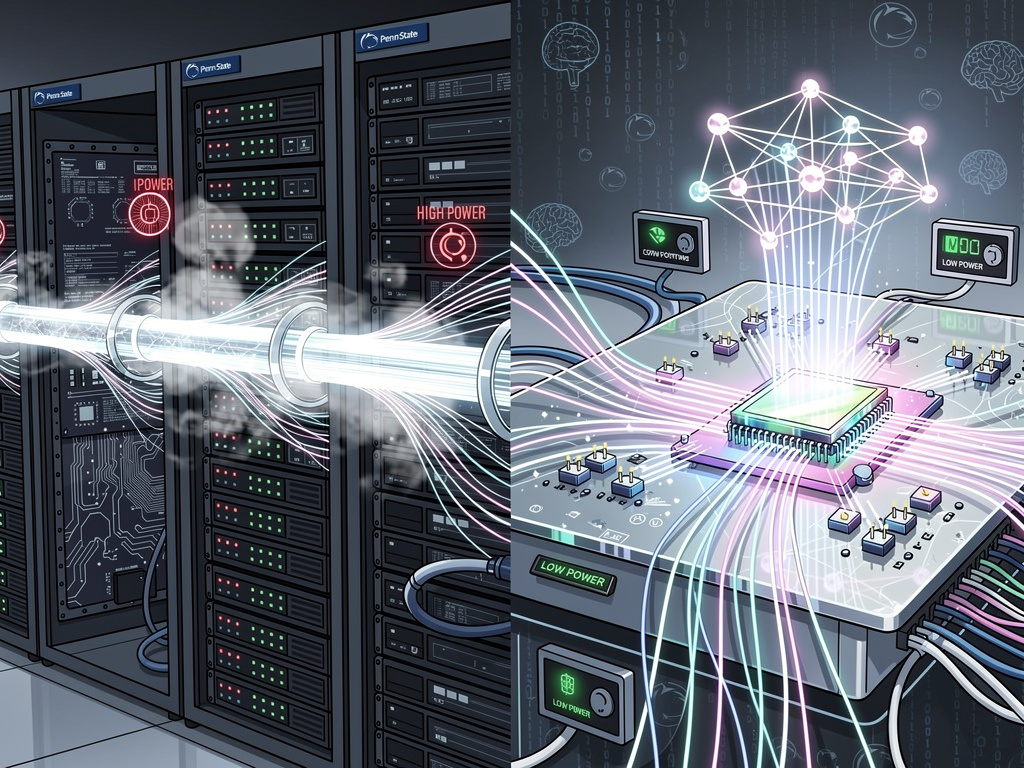
The artificial intelligence revolution has a dirty secret: it is extraordinarily power-hungry. As data centers multiply across the globe to feed the insatiable computational demands of large language models, image generators, and autonomous systems, the energy bill is becoming untenable. Some estimates suggest that AI-related electricity consumption could rival that of entire nations within the next decade. But a team of researchers at Penn State University believes the answer may be hiding in plain sight — or more precisely, in light itself.
Photonic computing, a technology that uses photons instead of electrons to process information, is emerging as one of the most promising frontiers in the quest to make AI sustainable. In a recent Q&A published by Penn State News, researchers laid out a compelling case for why optical processors could dramatically reduce the energy consumption of AI workloads while simultaneously boosting computational speed by orders of magnitude.
The Physics of Speed — Why Photons Beat Electrons
At the heart of the photonic computing proposition is a fundamental advantage rooted in physics. Electrons, which carry information in traditional semiconductor chips, generate heat as they move through transistors and copper interconnects. This heat is not merely a byproduct — it is the primary reason data centers require massive cooling infrastructure and consume enormous quantities of electricity. Photons, by contrast, travel at the speed of light and generate virtually no heat as they propagate through optical waveguides. This means photonic processors could, in theory, perform computations far faster and with a fraction of the energy expenditure.
According to the Penn State researchers featured in the Penn State News article, the energy savings could be transformative. The team noted that photonic systems are particularly well-suited to the matrix multiplication operations that form the backbone of neural network inference — the process by which a trained AI model generates outputs from new inputs. Because light can be manipulated to perform these linear algebra operations in parallel using phenomena like interference and diffraction, a photonic chip can execute in a single pass what might take an electronic processor thousands of clock cycles.
AI’s Growing Energy Crisis Demands Radical Solutions
The urgency of the energy problem cannot be overstated. The International Energy Agency has warned that global data center electricity consumption could double by 2026, driven largely by AI workloads. Goldman Sachs has projected that AI could drive a 160% increase in data center power demand by 2030. Tech giants including Microsoft, Google, and Amazon have all acknowledged that their carbon emissions are rising, in part because of the computational intensity of training and running AI models. Microsoft recently reported that its emissions had increased by roughly 30% since 2020, a trend the company attributed in significant part to data center expansion for AI.
Against this backdrop, photonic computing represents more than an academic curiosity — it is a potential industrial imperative. The Penn State researchers emphasized that while electronic chips have benefited from decades of Moore’s Law scaling, the physical limits of silicon transistors are approaching. Chip designers are running out of room to shrink transistors further, and the energy cost per computation in electronic systems is plateauing. Photonic computing offers a fundamentally different scaling path, one not constrained by the same thermal and dimensional limits that bind electronics.
Inside the Lab: How Photonic AI Chips Actually Work
The basic architecture of a photonic AI processor involves encoding data as properties of light — such as amplitude, phase, or wavelength — and then routing that light through optical components that perform mathematical transformations. Mach-Zehnder interferometers, microring resonators, and phase shifters are among the key building blocks. When configured correctly, these components can implement the weighted sums and activation functions that define neural network layers.
One of the critical advantages highlighted by the Penn State team is parallelism. Because different wavelengths of light can travel through the same waveguide simultaneously — a technique known as wavelength-division multiplexing — photonic chips can process multiple data streams at once without interference. This is analogous to sending many different radio stations through the same antenna, each on its own frequency. The result is a massive increase in throughput without a proportional increase in energy consumption, a property that makes photonic processors especially attractive for the high-bandwidth, low-latency demands of AI inference at scale.
Challenges on the Road to Commercialization
Despite the promise, significant hurdles remain before photonic computing can move from laboratory demonstrations to widespread commercial deployment. The Penn State researchers acknowledged several of these challenges in their discussion, as reported by Penn State News. Chief among them is the difficulty of integrating photonic components with existing electronic systems. Today’s computing infrastructure — from memory architectures to software stacks — is built around electronic processors. Photonic chips will likely need to coexist with electronic components for the foreseeable future, operating as specialized accelerators rather than wholesale replacements.
Manufacturing is another concern. While silicon photonics has made significant strides by leveraging existing semiconductor fabrication techniques, producing photonic chips at scale with the precision required for AI workloads remains a formidable engineering challenge. Optical components are sensitive to fabrication variations, and even nanometer-scale imperfections can degrade performance. Maintaining the coherence and stability of light signals across complex circuits adds another layer of difficulty that electronic systems do not face.
A Growing Ecosystem of Photonic AI Startups and Research
Penn State is far from alone in pursuing this technology. A vibrant ecosystem of startups and established companies is racing to bring photonic AI processors to market. Lightmatter, a Boston-based startup founded by MIT alumni, has developed photonic chips designed specifically for AI inference and has attracted hundreds of millions of dollars in venture capital. Luminous Computing, before its acquisition, was working on photonic interconnects for AI data centers. Meanwhile, companies like Intel and IBM have invested heavily in silicon photonics research, primarily for data communication but with an eye toward computation as well.
Academic research is also accelerating. Groups at MIT, Stanford, the University of Oxford, and numerous institutions across Europe and Asia are publishing breakthroughs in photonic neural networks, programmable photonic circuits, and hybrid electro-optical systems at a rapid pace. The field has moved from theoretical proposals to working prototypes in a remarkably short time, fueled by the dual pressures of AI’s energy demands and the physical limits of electronic scaling.
The Hybrid Future: Light and Electrons Working Together
Most experts, including the Penn State researchers, envision a hybrid future rather than a complete replacement of electronic computing. In this model, photonic accelerators would handle the most energy-intensive and parallelizable portions of AI workloads — particularly the massive matrix multiplications involved in inference — while electronic processors would manage control logic, memory access, and other tasks where electrons still hold an advantage. This division of labor mirrors the way graphics processing units (GPUs) currently complement central processing units (CPUs), but with even greater potential for energy savings.
The implications extend beyond the data center. Edge computing — running AI models on devices closer to the end user, such as autonomous vehicles, smartphones, and industrial sensors — could also benefit from photonic technology. A photonic chip that performs inference with minimal heat generation could enable AI capabilities in form factors and environments where thermal constraints currently limit performance. Imagine a self-driving car that processes sensor data through an optical neural network consuming a fraction of the power of today’s electronic systems.
What This Means for the Future of AI Infrastructure
The stakes are enormous. If photonic computing can deliver on even a portion of its theoretical promise, it could reshape the economics of AI deployment. Lower energy costs per inference would make AI more accessible to smaller companies and developing nations, democratizing a technology that currently favors organizations with the capital to build and operate massive data centers. It could also ease the growing tension between AI expansion and climate goals, a conflict that has drawn increasing scrutiny from regulators, investors, and the public.
For now, the technology remains in its early stages of commercial readiness. But the trajectory is clear, and the investment — both public and private — is accelerating. As the Penn State researchers made plain in their discussion with Penn State News, the question is not whether photonic computing will play a role in AI’s future, but how quickly the engineering challenges can be overcome to make it a practical reality. In a world where the demand for AI computation is growing exponentially and the planet’s energy resources are finite, the race to harness light for computing has never been more consequential.


 WebProNews is an iEntry Publication