
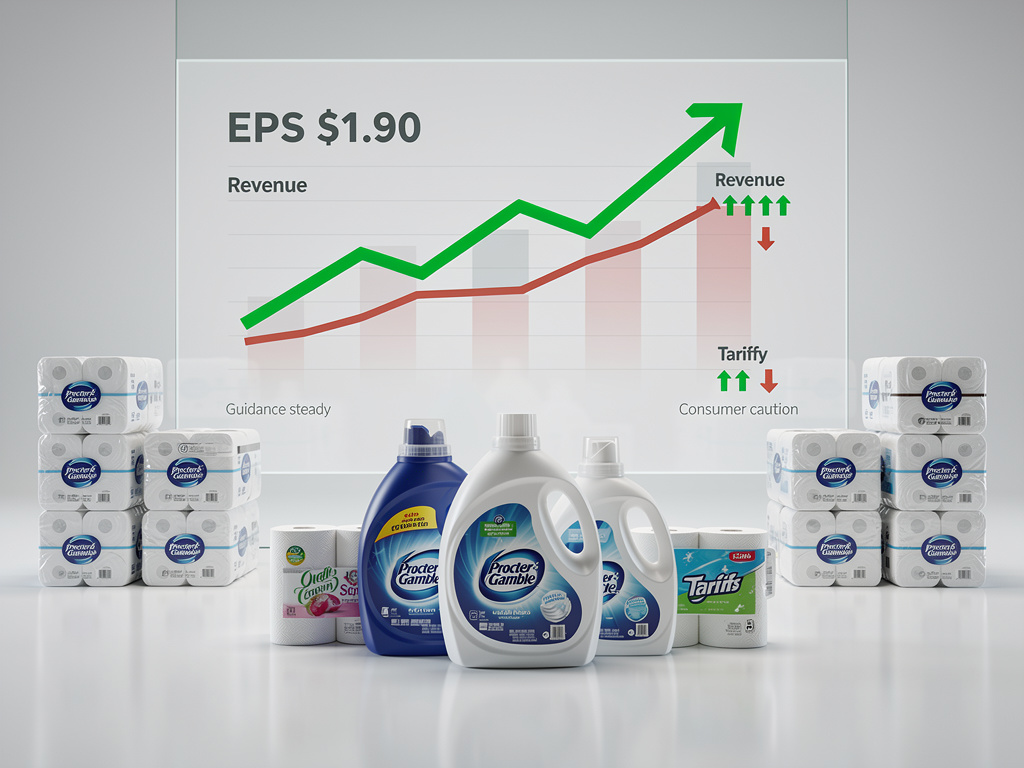
Procter & Gamble Co. surpassed Wall Street’s earnings expectations for its fiscal second quarter, yet revenue fell short as weakening consumer spending in key U.S. categories like laundry detergent and toilet paper dragged on results. The consumer-goods giant reported adjusted earnings per share of $1.90, topping the $1.87 consensus estimate, but net sales of $22.1 billion missed the $22.3 billion forecast. Shares dipped in after-hours trading, reflecting investor concerns over persistent demand softness amid tariffs and economic pressures.
Chief Executive Jon Moeller highlighted resilience in premium beauty segments during the earnings call, where sales grew double digits, offsetting declines elsewhere. ‘We saw strength in higher-end products, but volume pressures in fabric care and baby care persist,’ Mr. Moeller said, according to the CNBC report. Organic sales rose 2%, but foreign exchange headwinds and a $1 billion tariff impact loomed large.
Navigating Tariff Headwinds
Analysts had braced for tariff effects, with previews estimating a $1 billion hit to profitability. ‘PG moves toward Q2 results, with modest sales growth expectations, but margin pressure from commodities, tariffs and competition keeps investors cautious,’ noted Yahoo Finance. P&G maintained its full-year guidance, projecting 2% to 3% organic sales growth and core EPS growth of 8% to 10%.
U.S. consumer caution, particularly in value channels, exacerbated the revenue miss. Reuters reported that ‘Procter & Gamble on Thursday fell just short of Wall Street expectations for its second-quarter revenue, held back by weak consumer spending in core categories such as U.S. laundry detergent and toilet paper.’ Beauty and health care segments provided a buffer, with skincare brands like SK-II driving gains.
Segment Breakdown Reveals Divergences
Fabric and home care sales declined 1%, hit by Tide and Bounty volume drops, while grooming held steady. Baby, feminine and family care faced 2% organic sales declines due to shrinking demand. In contrast, the beauty division shone, with organic sales up 4.5%, fueled by prestige brands. P&G’s first-quarter results earlier showed net sales up 3% to $22.4 billion, per its investor relations site.
Gross margins expanded 170 basis points to 53.4%, thanks to productivity savings and favorable mix, though input costs rose. Operating margins improved slightly to 24.2%. Free cash flow productivity hit 110%, supporting $2.5 billion in dividends and $3 billion in share repurchases.
Analyst Reactions and Forward Outlook
Post-earnings, analysts diverged. JPMorgan’s Andrea Teixeira maintained an overweight rating, citing P&G’s pricing power. ‘The company is navigating tariffs effectively through supply chain shifts,’ she wrote in a note. BofA’s Olivia Tong, however, flagged volume risks, cutting her price target to $180 from $185.
Seeking Alpha previews noted ‘demand headwinds’ and modest EPS/revenue expectations. Ad-hoc News previewed a ‘complex financial picture’ with EPS projected at $1.86-$1.87, down slightly year-over-year, and revenue up 1.6%-1.9%. P&G’s management emphasized innovation, like coldwater laundry tech reducing energy use, though recent X posts from the company focused on historical efforts rather than Q2 specifics.
Strategic Shifts Amid Bifurcation
Consumer bifurcation—premium spending by high-income households versus value-seeking in essentials—poses long-term challenges. FinancialContent highlighted a ‘$1 billion tariff storm,’ suggesting potential M&A into digital-first brands. P&G’s Q1 core EPS of $1.99 rose 3%, maintaining fiscal 2026 guidance.
Mr. Moeller addressed China recovery, where sales grew 5% organically, and emerging markets added momentum. Inventory destocking in North America eased but volumes lagged. Barchart anticipated a ‘marginal profit dip,’ which didn’t materialize on the bottom line.
Investor Implications in Volatile Markets
With shares near 52-week lows, the report tests P&G’s dividend aristocrat status—61 years of increases. Yahoo Finance’s preview urged caution amid competition from private labels. Reuters noted strength in beauty overshadowed core weaknesses.
P&G’s $1.95 diluted EPS in Q1 beat estimates by 21%, signaling operational strength. Management’s tariff mitigation, via sourcing shifts to U.S. and Mexico, aims to protect margins. As peers like Colgate-Palmolive report soon, P&G sets the tone for CPG resilience.


 WebProNews is an iEntry Publication