
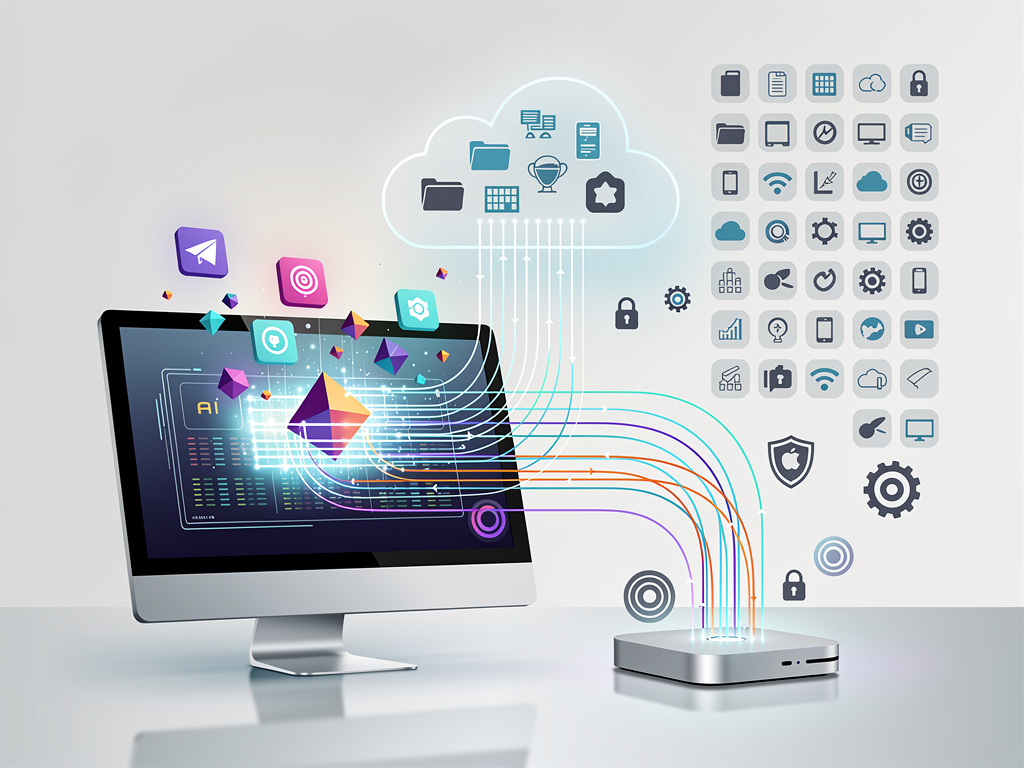
Perplexity just opened its Personal Computer feature to every Mac owner with a Pro or Max subscription. The move marks a sharp turn from cloud-only AI tools toward systems that reach directly into a user’s files, applications and workflows.
Announced Thursday, the software now lives inside a redesigned Perplexity Mac app. Anyone can download it. Only paying subscribers gain access to the agentic capabilities that let the system read local documents, control native programs, browse the web and coordinate across more than 400 connectors. TechCrunch reported the general availability after the company posted its update.
The product builds on Perplexity Computer, a multi-model orchestration engine introduced in February that routes tasks across frontier models including Opus 4.6, Gemini, Grok and GPT variants. Personal Computer pulls that same reasoning onto the device. Or, as the company put it in its announcement, it “takes Computer out of the cloud-only world and onto the device where most of your real work already takes place.”
Early testers saw the difference immediately. A Mac mini left running at home becomes a persistent worker. Agents continue sorting project folders, comparing spreadsheets or drafting reports long after the user steps away. Press both Command keys and the system wakes. It accepts text or voice. It pulls context from whatever application sits in focus.
Security mattered from the start. Files stay inside a sandbox. Every significant action requires explicit approval. Users retain a kill switch and full audit trail. Perplexity designed the experience to feel like managed colleagues rather than an autonomous force with unchecked access. The company repeated those safeguards when it first described the product in March.
Apple itself took notice. During its Q2 2026 earnings call, executives highlighted Perplexity’s choice of Mac hardware for agentic work. The unified memory architecture in Apple silicon, they noted, gives developers an efficient platform for these always-available assistants. 9to5Mac covered the exchange and Perplexity’s subsequent elaboration.
Yet the launch also invites hard questions about control and data. Local agents need broad permissions. OpenClaw, an earlier entrant in the category, drew sharp criticism for security shortcomings. Perplexity positions its approach as safer. It runs sensitive steps in a server-side sandbox while keeping core context on the Mac. Time will test whether that balance holds.
Practical examples illustrate the shift. Ask the system to organize materials scattered across folders. It does. Tell it to compare two reports from different apps and summarize differences. It produces the output. Instruct it to assemble notes from Messages, pull data from a spreadsheet and generate a live dashboard instead of another static document. The agent handles the connective tissue.
That last point matters. Many knowledge tasks begin with a question whose answer depends on materials living outside any single chat window. Personal Computer exists for exactly that shape of work. It does not replace the user. It removes the repetitive steps that sit between intention and result.
Pricing ties to existing tiers. Pro and Max subscribers use their included credits. The company has not disclosed exact consumption rates for heavy agentic sessions. Early Max users gained priority on the initial waitlist that opened in March. Now the barrier is lower. Download the app. Sign in. Start.
Perplexity will deprecate its older Mac application in the coming weeks. The team wants every desktop user on the new foundation. The app remains a direct download for now. It has not yet appeared in the Mac App Store.
Industry observers see larger implications. AI agents that cross the boundary between cloud reasoning and local action could become the default layer for professional computing. Perplexity bets that model-agnostic orchestration, paired with strong privacy controls, will win over users wary of giving any single vendor too much power.
Competitors watch closely. Anthropic, OpenAI and others have signaled their own agent initiatives. None has yet shipped a product that runs persistently on personal hardware with this level of file-system integration. Perplexity’s head start on Apple silicon may prove decisive.
Of course, technical hurdles remain. Model orchestration still consumes significant resources. Long-running agents on a Mac mini will draw power and generate heat. Enterprise IT departments may hesitate before granting such broad local access, even with audit logs. And the quality of results depends entirely on the underlying models’ ability to plan, execute and recover from errors.
Still. The direction feels inevitable. Computers were once machines that executed fixed instructions. Then they became devices that responded to queries. Now they evolve into collaborators that anticipate needs, manage context across apps and keep working when the user logs off.
Perplexity did not invent the agent. It did not invent the Mac mini as a server. But by tying the two together inside a polished desktop app, the company made the concept immediately accessible to hundreds of thousands of professionals already living inside Apple’s ecosystem.
That accessibility could accelerate adoption faster than any marketing campaign. Professionals who struggle to keep up with email, reports, research and coordination now have a persistent assistant that speaks their native environment. The question is no longer whether such agents will matter. It is how quickly users will trust them with real work.
Perplexity’s latest move suggests the answer is sooner than many expected.


 WebProNews is an iEntry Publication