
Perplexity AI once grabbed headlines as a Google slayer. Its clean interface and cited answers drew users tired of traditional search. But the story has shifted. Traffic share has slipped. Competitors have grown. And the company has moved fast into agentic tools and deep enterprise integrations.
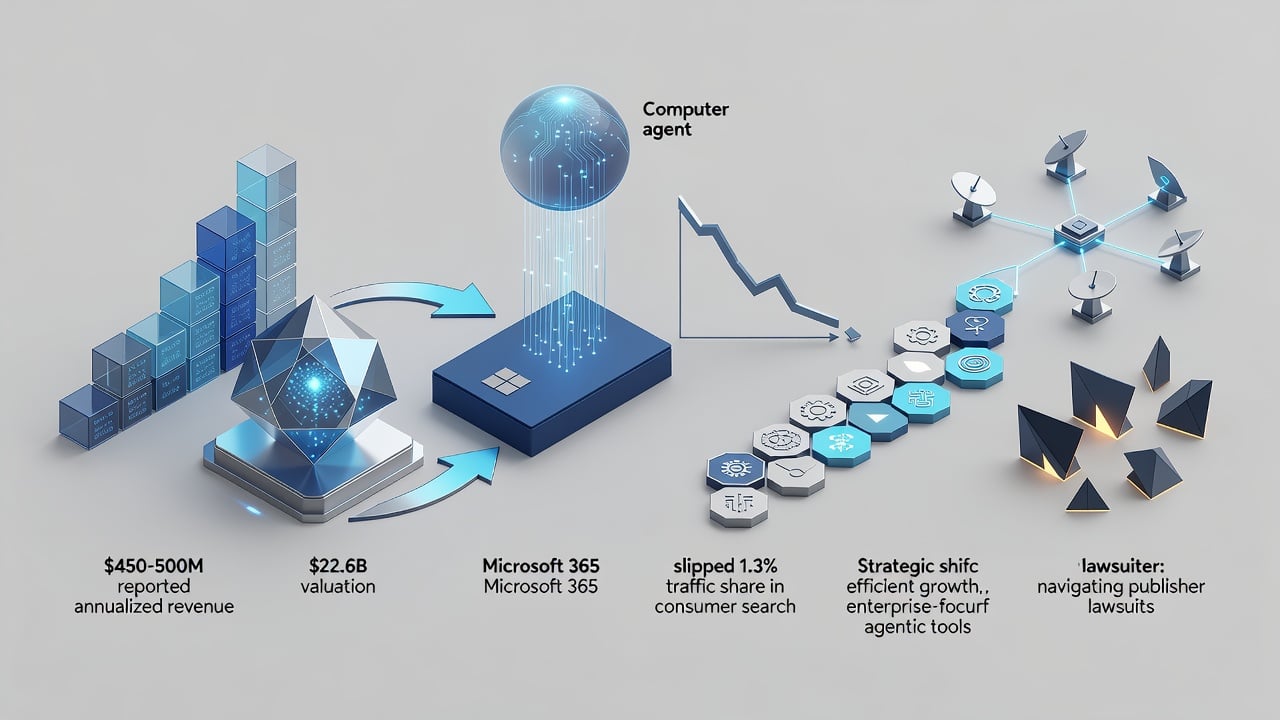
Revenue tells one tale. User metrics tell another. The latest figures show annualized revenue between $450 million and $500 million as of the second quarter of 2026. That's according to a detailed analysis published July 1 by FatJoe. The same report puts the company's valuation at $22.6 billion following a January 2026 funding round. Total capital raised now exceeds $1.72 billion.
Yet web traffic share stands at roughly 1.3 percent globally through late May 2026. It fell from 2.0 percent in March. ChatGPT still dominates at over 52 percent. Gemini has gained ground. These numbers come from Similarweb data cited in the FatJoe report.
Revenue Growth Outpaces User Metrics
Aravind Srinivas, Perplexity's CEO, highlighted the efficiency. In a post on X, he noted the company grew revenue fivefold from roughly $100 million to $500 million while expanding headcount by only 34 percent. The update, referenced across multiple analyses including a recent Omnibound report published this week, underscores a focus on high-margin products.
Subscriptions drive much of that revenue. Perplexity Pro and enterprise offerings command steady payments. Usage splits roughly 55 percent personal, 30 percent professional and 15 percent educational. Productivity and workflow queries make up more than one-third of activity. The FatJoe analysis draws these breakdowns from company statements and third-party data.
But active user counts show mixed signals. Estimates for monthly active users range from 45 million to over 100 million when including all products such as the core search, browser and enterprise tools. A Sacra analysis cited in Omnibound and Business of Apps puts combined usage above 100 million MAU by April 2026. App downloads have surpassed 80 million.
Mobile daily active user share in the U.S. dropped to 2.1 percent in April from a 6 percent peak in October 2025. That decline, also from the FatJoe report, coincides with broader market saturation. One observer put it bluntly. "Perplexity went from 'Google Killer' to completely vanishing from our timelines," wrote user @shiri_shh on X in early July. The post noted the 65 percent collapse in U.S. daily active user share over five months.
So what changed? Perplexity stopped positioning itself as a standalone chatbot. It became an agent company. The shift happened quietly but deliberately. Products like Perplexity Computer now take center stage.
In June 2026 the company integrated Computer directly into Microsoft 365 applications. Users can now access it inside Word, Excel, PowerPoint, Outlook and Teams. No more copy and paste between tools. The AI can draft documents, analyze spreadsheets, build presentations and handle emails using the context already inside those files.
"This integration removes that copy-paste step," Perplexity stated in its official announcement. "Now teams can use Computer to draft, edit, and deliver work without ever leaving Microsoft 365 apps." The details appear in Perplexity's blog post from late May, available at perplexity.ai.
Computer connects further. It links to SharePoint, OneDrive, Salesforce, Snowflake and other enterprise systems. It pulls live web research while citing every source. Deep Research capabilities were added. A command panel, task forking and analytics API give IT teams control. A Personal Computer version runs always-on via a dedicated Mac mini and new Perplexity Mac app.
These moves target knowledge workers. They position Perplexity inside the daily flow of large organizations rather than competing for attention on the open web. A three-year $750 million commitment to Microsoft Azure, signed in January 2026, supports the infrastructure needs. The partnership runs deeper than compute. Microsoft listed Perplexity in federal procurement catalogs. That opens government doors.
Publisher relations have improved too. Over 300 news outlets now participate in a revenue-sharing program. Perplexity pays for citations instead of simply scraping content. The change came after multiple lawsuits from major media companies. Legal pressure remains a risk. Yet the program buys some goodwill.
The API business expands options. Perplexity offers a model-agnostic platform with Search, Agent, Embeddings and a forthcoming Sandbox for code execution. Developers and enterprises can build on top without depending on a single underlying model. This infrastructure play carries higher margins than consumer search.
Still, the traffic numbers raise questions. Global AI search traffic remains dominated by the big players. Perplexity holds a small slice. Its share drifted while ChatGPT and Gemini posted gains. Mobile usage fell. Some analysts wonder if the pivot away from consumer discovery hurt visibility.
But Srinivas and his team appear unfazed. They point to revenue per user and retention in professional segments. Productivity use cases dominate. Enterprise contracts bring predictable income. The valuation, while down from peak multiples of over 100x ARR, still sits at 45 to 50 times current run rate. Investors continue to back the vision.
A fresh $200 million round closed in June at a valuation near $20 billion, according to reporting aggregated in the recent AIBusinessWeekly summary. Total funding now stands at $1.72 billion with backers that include Nvidia, Jeff Bezos, SoftBank, Accel, IVP and Databricks.
Comparisons to other AI firms matter. Many startups chase hype. Perplexity focused on product and distribution. The Microsoft integration gives it a channel that few independents can match. Snapchat integration is slated for later this year. Federal approval adds another vector.
Yet execution risks remain. Larger competitors pour resources into similar agent features. Google, Microsoft and OpenAI all push enterprise AI. Perplexity must prove its technology delivers better results at scale. Accuracy, speed and citation quality have been strengths. They must hold as usage grows.
The company processes hundreds of millions of queries each month. Early days saw just a few thousand daily. That scale demands efficient infrastructure. The Azure spend reflects confidence in continued expansion.
Industry watchers debate the long-term model. Consumer search carries thin margins and high legal exposure. Agentic enterprise tools offer recurring revenue and deeper moats. Perplexity clearly chose the latter. The numbers show revenue accelerating even as standalone web traffic moderated.
Its 45-50x multiple requires continued execution. If revenue doubles again in the coming year while costs stay controlled, the valuation will look conservative. If growth stalls, questions will intensify.
For now the data paints a company in transition. Less visible in public timelines. More embedded in business workflows. The pivot appears deliberate. Results so far support the bet. But the market moves fast. Perplexity's next chapter depends on turning those enterprise integrations into sustained revenue at scale.


 WebProNews is an iEntry Publication