
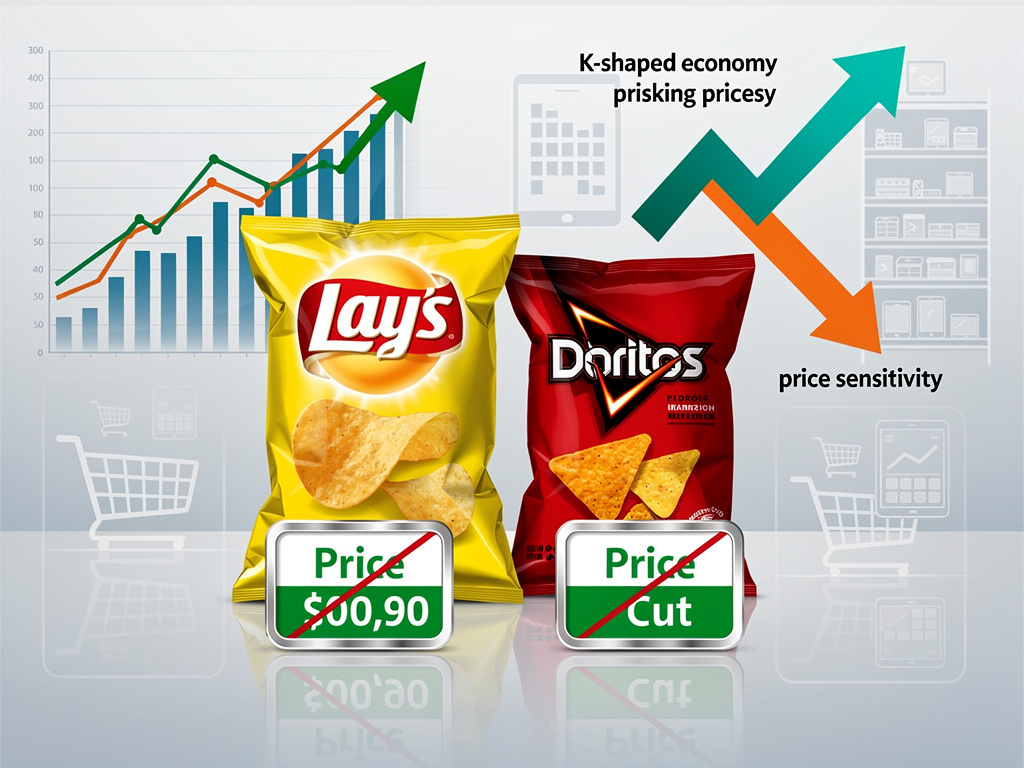
In a striking reversal that signals a fundamental shift in consumer packaged goods strategy, PepsiCo announced it would reduce prices on its flagship snack brands including Lay’s and Doritos, marking one of the most significant pricing retreats by a major food conglomerate since the inflationary surge began in 2021. The decision, revealed during the company’s latest earnings call, reflects a broader reckoning within the food industry as executives confront the limits of their pricing power and the emergence of what economists call a “K-shaped economy” where affluent consumers continue spending while middle and lower-income households pull back dramatically.
According to Business Insider, PepsiCo’s move comes after the company experienced declining sales volumes across multiple quarters, with consumers increasingly trading down to private-label alternatives or simply purchasing fewer snacks altogether. The company’s North American beverage and snack divisions have both reported volume declines, with the Frito-Lay North America segment seeing particular pressure as shoppers balked at prices that had increased by double-digit percentages over the past three years. This pricing strategy, once seen as a reliable path to maintaining margins during inflationary periods, has now backfired as consumers reach their breaking point.
The implications extend far beyond PepsiCo’s portfolio. The company’s decision to cut prices represents a potential inflection point for the entire consumer packaged goods sector, which has relied heavily on price increases rather than volume growth to drive revenue since the pandemic. For years, major food manufacturers operated under the assumption that brand loyalty and the relatively small per-unit cost of their products would insulate them from consumer pushback. That calculus has now fundamentally changed, forcing executives to reconsider strategies that prioritized short-term margin expansion over long-term market share preservation.
The Anatomy of a Pricing Miscalculation
PepsiCo’s pricing journey over the past three years illustrates how quickly market dynamics can shift. Between 2021 and 2023, the company implemented multiple rounds of price increases, initially justified by rising input costs for ingredients, packaging, and transportation. However, as commodity prices began stabilizing in late 2023 and early 2024, many food companies maintained their elevated pricing, a practice that industry critics labeled “greedflation.” While PepsiCo executives defended these decisions as necessary to protect shareholder value and offset persistent labor cost increases, the strategy increasingly alienated core customers who saw their grocery bills climb without corresponding wage growth.
The breaking point came as private-label brands, particularly those from retailers like Costco, Trader Joe’s, and even Walmart, dramatically improved their quality and marketing while maintaining significantly lower price points. Data from market research firms showed that store-brand chips and snacks were capturing market share at an accelerating rate, with some categories seeing private-label penetration increase by five to seven percentage points in just two years. For PepsiCo, which had long enjoyed pricing power due to its iconic brands and extensive distribution network, this represented an existential threat that could no longer be ignored.
The K-Shaped Consumer Economy Takes Hold
The concept of a K-shaped economic recovery, where different segments of the population experience vastly different financial trajectories, has moved from economic theory to retail reality. High-income consumers, buoyed by strong stock market performance and rising home values, have continued purchasing premium products with minimal price sensitivity. Meanwhile, middle-income and lower-income households, facing stagnant wages, higher interest rates on credit cards and auto loans, and depleted pandemic-era savings, have been forced to make difficult choices about discretionary spending.
For snack food manufacturers, this bifurcation has created a strategic dilemma. Premium products and smaller package sizes aimed at affluent consumers have performed relatively well, but these segments represent a limited portion of total volume. The mass market, which has historically driven the bulk of sales for brands like Lay’s and Doritos, has contracted significantly as consumers either trade down or reduce purchase frequency. PepsiCo’s decision to cut prices represents an acknowledgment that the company cannot afford to cede the mass market to private-label competitors, even if it means sacrificing near-term margins.
Competitive Dynamics and Industry Implications
PepsiCo’s move puts enormous pressure on competitors, particularly Mondelez International, Campbell Soup Company, and General Mills, all of which face similar volume challenges. If PepsiCo’s price cuts succeed in recapturing market share, rivals will be forced to follow suit or risk permanent losses in shelf space and consumer mindshare. This dynamic could trigger a broader repricing across the packaged food industry, potentially resetting price levels closer to 2022 benchmarks rather than current elevated levels.
The implications for retailers are equally significant. Grocery chains have benefited from higher prices on branded products, which generate better absolute margins even as percentage margins remain stable. A widespread move toward lower prices could pressure retailer profitability unless offset by increased volume. However, many retailers may welcome the change if it drives higher foot traffic and basket sizes, particularly as they compete with discount chains and online alternatives. The relationship between manufacturers and retailers, always characterized by tension over pricing and promotion, is likely to become even more contentious as both sides navigate this transition.
Wall Street’s Reaction and Long-Term Viability
Investor response to PepsiCo’s announcement has been mixed, reflecting uncertainty about whether the strategy represents prudent long-term thinking or a capitulation that will permanently impair profitability. Some analysts have praised the company for prioritizing volume and market share over short-term earnings, noting that losing customers to private label can create lasting damage that takes years to repair. Others have expressed concern that price cuts, once implemented, are difficult to reverse and may establish a new, lower ceiling for future pricing power.
The financial impact will depend largely on execution and competitive response. If PepsiCo can reduce prices while simultaneously cutting costs through operational efficiency, automation, and supply chain optimization, the strategy could prove successful. The company has indicated that it will focus on SKU rationalization, eliminating slower-moving products to improve manufacturing efficiency and reduce complexity. Additionally, investments in direct-store-delivery capabilities and data analytics may help optimize promotional spending and reduce waste. However, if competitors quickly match price cuts while costs remain elevated, the entire industry could face a prolonged period of margin compression.
Consumer Behavior and Brand Loyalty in Transition
The current moment represents a critical test of brand loyalty in the snack food category. For decades, companies like PepsiCo operated under the assumption that consumers would pay a premium for trusted brands with consistent quality and taste. While this remains true for certain demographics and occasions, the past two years have demonstrated that price sensitivity has increased across nearly all consumer segments. Younger consumers, in particular, show less brand loyalty than previous generations, often willing to experiment with new products or private-label alternatives if they offer better value.
PepsiCo’s challenge is to lower prices enough to stem volume declines without completely eroding the premium that consumers are willing to pay for branded products. This requires sophisticated pricing analytics and a nuanced understanding of elasticity curves across different products, package sizes, and retail channels. The company must also balance national pricing strategies with regional variations, as consumer sensitivity differs significantly between markets. In some regions, particularly those with higher costs of living and greater income inequality, the K-shaped economy is more pronounced, requiring more aggressive pricing actions.
The Path Forward for Big Food
Looking ahead, PepsiCo’s decision may mark the beginning of a new era in food industry economics, one characterized by greater pricing discipline and renewed focus on volume growth. For years, Wall Street rewarded companies that delivered consistent earnings growth regardless of volume trends, creating incentives for aggressive pricing. That paradigm appears to be shifting as investors recognize that sustainable growth requires maintaining market share and consumer relationships, not just maximizing quarterly profits.
The success or failure of PepsiCo’s strategy will be closely watched by the entire consumer packaged goods sector. If the company can stabilize volumes and regain market share without catastrophic margin deterioration, other manufacturers will likely follow. If the experiment fails, it may embolden companies to maintain current pricing and accept lower volumes as the new normal. Either way, the industry is at an inflection point that will shape competitive dynamics for years to come, forcing executives to make difficult choices about the balance between pricing power and market position in an increasingly bifurcated consumer economy.


 WebProNews is an iEntry Publication