
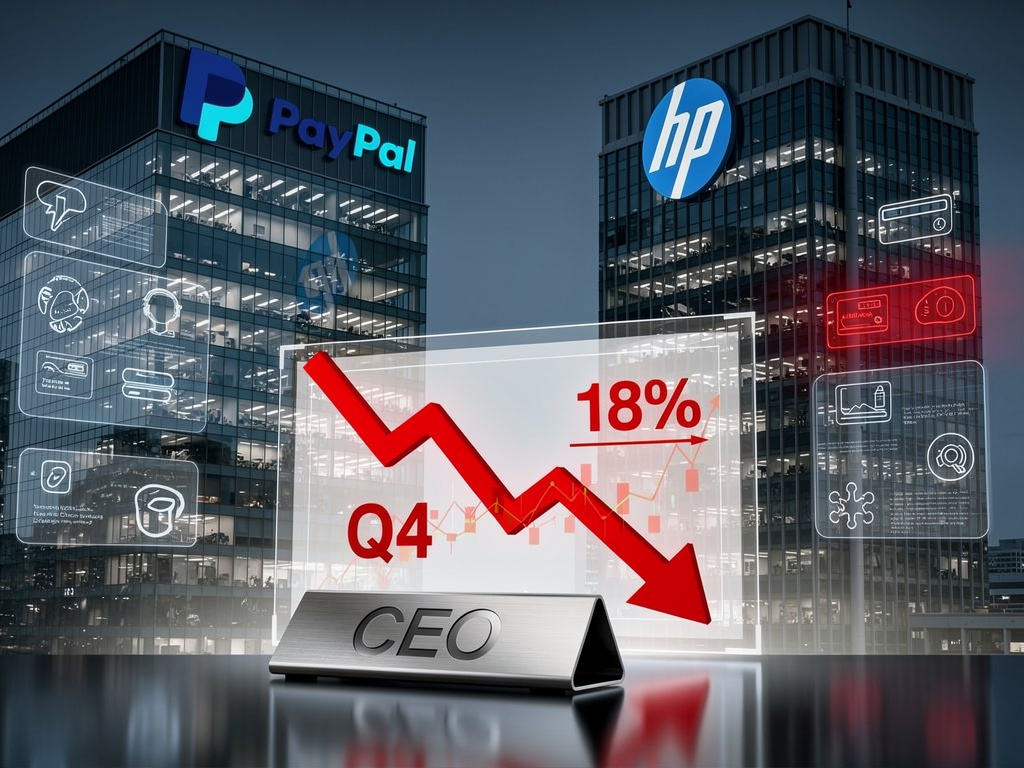
In a dramatic boardroom shakeup that sent shockwaves through Silicon Valley and Wall Street alike, PayPal Holdings Inc. announced on February 3rd that it would replace Chief Executive Officer Alex Chriss with HP Inc.’s Enrique Lores, effective March 1st. The leadership transition, coupled with disappointing fourth-quarter earnings that missed analyst expectations, triggered an 18% plunge in PayPal’s stock price and left HP scrambling to find a replacement for its departing leader. The move represents one of the most significant executive transitions in the payments industry in recent years, as PayPal seeks to reverse a troubling trajectory that has seen the once-dominant digital payments pioneer struggle to compete against nimbler fintech rivals and maintain its market position.
According to Bloomberg, PayPal reported fourth-quarter revenue of $8.7 billion, representing a modest 4% year-over-year increase but falling short of Wall Street estimates. The disappointing financial performance underscored the challenges that have plagued Chriss’s tenure since he assumed the top position. The company’s struggle to articulate a compelling growth strategy in an increasingly competitive digital payments sector has left investors questioning whether PayPal can reclaim its former dominance in an era defined by buy-now-pay-later services, cryptocurrency wallets, and embedded finance solutions.
The selection of Lores, a 35-year HP veteran who joined the computing giant in 1989, signals PayPal’s desire for seasoned operational expertise and proven turnaround capabilities. During his tenure at HP, Lores successfully navigated the company through significant market transitions, including the shift toward hybrid work environments and the evolution of printing and personal computing businesses. His track record of managing complex hardware and services operations, coupled with his experience in global supply chain management, appears to have convinced PayPal’s board that he possesses the skills necessary to stabilize and revitalize the struggling payments platform.
The Chriss Experiment: A Turnaround That Never Materialized
Alex Chriss’s appointment to PayPal’s chief executive role had initially generated optimism among investors and industry observers. Recruited from Intuit, where he led the small business and self-employed group, Chriss brought credentials as a product-focused executive with deep understanding of small business needs—a critical customer segment for PayPal. However, his turnaround plan, which emphasized streamlining operations, enhancing user experience, and pursuing strategic partnerships, failed to gain traction in the face of intensifying competitive pressures and shifting consumer preferences.
The payments industry has undergone seismic shifts during Chriss’s relatively brief tenure. Traditional payment processors have faced mounting challenges from an array of competitors, including Apple Pay, Google Pay, Block’s Cash App, and a proliferation of specialized fintech applications targeting specific use cases. Meanwhile, e-commerce giants like Amazon and Shopify have developed their own payment solutions, reducing their reliance on third-party processors like PayPal. These competitive dynamics have compressed margins and forced PayPal to invest heavily in product development and marketing just to maintain market share.
According to Payments Dive, PayPal’s board concluded that a change in leadership was necessary to address fundamental strategic questions about the company’s direction. The decision to replace Chriss reflects broader concerns about whether PayPal’s existing management team possessed the operational depth and strategic vision required to compete effectively in a rapidly evolving market. The board’s choice of an outside executive with extensive operational experience, rather than promoting from within or selecting another payments industry veteran, suggests a recognition that PayPal’s challenges extend beyond product strategy to encompass operational efficiency, organizational culture, and execution capabilities.
HP Left Reeling as Star CEO Departs for Fintech Challenge
While PayPal celebrated its new leadership acquisition, HP Inc. found itself in an unexpectedly precarious position. Semafor reported that HP’s board was blindsided by Lores’s decision to leave, forcing the company to rush into launching a CEO search process. The departure represents a significant loss for HP, which had relied on Lores’s steady leadership to navigate ongoing transformations in the personal computing and printing markets.
Lores’s 35-year career at HP encompassed numerous roles across engineering, operations, and general management before his elevation to the CEO position. His intimate knowledge of HP’s operations and culture made him an invaluable asset to the company, particularly as it confronted secular declines in traditional PC sales and the need to pivot toward higher-margin services and solutions. The sudden loss of such institutional knowledge and leadership continuity poses substantial risks for HP as it seeks to execute its strategic priorities.
HP’s official statement acknowledged Lores’s contributions while emphasizing the company’s commitment to a smooth transition. However, according to sources familiar with the situation cited by CRN, HP’s board had no advance warning of Lores’s intention to pursue the PayPal opportunity. The lack of succession planning reflects either exceptional discretion on Lores’s part or a potential breakdown in board-management communication—both scenarios that raise questions about HP’s corporate governance practices.
The Operational Playbook: What Lores Brings to PayPal
Enrique Lores’s appointment represents a calculated bet by PayPal’s board that operational excellence and disciplined execution can restore the company’s competitive position. Unlike many technology CEOs who rose through product management or engineering ranks, Lores built his career managing complex global operations, supply chains, and manufacturing processes. This background could prove invaluable as PayPal seeks to improve its operational efficiency, reduce costs, and enhance the reliability and scalability of its payment processing infrastructure.
During his tenure at HP, Lores demonstrated an ability to make difficult decisions about resource allocation, including divesting non-core businesses, restructuring operations, and investing selectively in growth opportunities. These skills may translate well to PayPal’s current situation, where the company must balance investments in innovation against the need to improve profitability and return cash to shareholders. Lores’s experience managing a global workforce and navigating complex regulatory environments across multiple jurisdictions also addresses one of PayPal’s persistent challenges: operating a compliant, efficient payment network across dozens of countries with varying regulatory requirements.
PayPal’s official announcement highlighted Lores’s track record of driving growth and operational excellence at HP, noting his success in transforming the company’s business model and strengthening its competitive position. The announcement also revealed that David W. Dorman would assume the role of independent board chair, suggesting a broader governance restructuring designed to provide stronger oversight and strategic guidance to the new CEO.
Market Reaction Reveals Deep Investor Skepticism
The 18% decline in PayPal’s stock price following the leadership announcement and earnings release reflects profound investor skepticism about the company’s prospects. While some of the sell-off can be attributed to the disappointing fourth-quarter results, the magnitude of the decline suggests that investors view the leadership transition as evidence of deeper strategic and operational problems rather than a positive catalyst for change. The market’s harsh judgment underscores the challenge facing Lores as he prepares to assume his new role: he must quickly articulate a credible turnaround strategy while simultaneously learning the intricacies of a business far removed from his hardware and printing expertise.
Wall Street analysts expressed mixed reactions to the CEO change, with some praising Lores’s operational credentials while others questioned whether his lack of payments industry experience would hinder his ability to address PayPal’s strategic challenges. The payments sector’s rapid evolution, driven by technological innovation, changing consumer behaviors, and regulatory developments, requires deep domain expertise that typically takes years to develop. Lores will need to assemble a strong management team with payments industry knowledge to compensate for his own learning curve.
The timing of the leadership transition adds another layer of complexity. With Lores not officially starting until March 1st, PayPal faces a potential leadership vacuum during a critical period when the company should be implementing strategic initiatives and preparing for the upcoming fiscal year. The extended transition period may reflect the need for Lores to disentangle himself from HP responsibilities and prepare for his new role, but it also creates uncertainty for PayPal employees, partners, and customers who seek clarity about the company’s direction.
Competitive Pressures Mount as PayPal Searches for Direction
PayPal’s leadership crisis unfolds against a backdrop of intensifying competitive pressures that threaten the company’s core business model. The proliferation of digital payment options has commoditized basic payment processing, forcing PayPal to compete primarily on price, user experience, and merchant relationships. Meanwhile, newer entrants have captured consumer mindshare by offering innovative features like instant payments, cryptocurrency integration, and seamless social commerce experiences that PayPal has struggled to match.
The buy-now-pay-later sector represents a particular challenge for PayPal, which entered the market through acquisitions and internal development but has failed to establish a dominant position. Competitors like Affirm, Klarna, and Afterpay (now owned by Block) have built strong brand recognition and merchant relationships, while Apple’s entry into the space with Apple Pay Later demonstrated how technology giants can leverage their ecosystems to rapidly gain market share. PayPal’s BNPL offerings have generated growth but at the cost of increased credit risk and regulatory scrutiny.
According to TechCrunch, industry observers note that PayPal’s challenges extend beyond product features to encompass fundamental questions about its value proposition in an evolving payments ecosystem. As payment functionality becomes embedded in e-commerce platforms, social media applications, and banking services, standalone payment processors risk disintermediation. PayPal must articulate a compelling answer to the question of why consumers and merchants should choose its platform over integrated alternatives that offer comparable functionality with less friction.
The Technology Transformation Imperative
Beyond strategic positioning, PayPal faces significant technology modernization challenges that will demand Lores’s attention. The company’s payment processing infrastructure, built over more than two decades through organic development and numerous acquisitions, requires ongoing investment to maintain reliability, security, and scalability. Legacy systems and technical debt constrain PayPal’s ability to rapidly deploy new features and respond to competitive threats, while cybersecurity concerns demand constant vigilance and investment.
The shift toward real-time payments represents both an opportunity and a challenge for PayPal. While faster payment processing enhances user experience and enables new use cases, it also requires substantial infrastructure investments and exposes the company to increased fraud risk. PayPal must balance the need to modernize its technology stack against the imperative to maintain the stability and reliability that customers and merchants expect from a trusted payment processor.
Artificial intelligence and machine learning technologies offer potential pathways for PayPal to differentiate its offerings and improve operational efficiency. Advanced fraud detection, personalized user experiences, and predictive analytics for merchants represent areas where AI could create competitive advantages. However, implementing these technologies at scale requires significant technical expertise, data infrastructure investments, and careful attention to privacy and ethical considerations. Lores will need to assess whether PayPal possesses the technical talent and organizational capabilities to execute on an AI-driven transformation strategy.
Regulatory Headwinds Add Complexity to Turnaround Efforts
PayPal’s new CEO will inherit a complex regulatory environment that constrains strategic options and demands significant management attention. Payment processors face oversight from multiple regulatory bodies across jurisdictions, including financial services regulators, consumer protection agencies, and data privacy authorities. The regulatory burden has intensified in recent years as governments worldwide have scrutinized digital payments for issues ranging from consumer protection to anti-money laundering compliance and competition policy.
The European Union’s Payment Services Directive and similar regulations in other jurisdictions have opened payment networks to increased competition while imposing new compliance obligations on incumbent processors. These regulatory changes have enabled new entrants to access payment infrastructure and customer data, eroding some of PayPal’s traditional competitive advantages. Simultaneously, regulators have expressed concerns about the market power of dominant payment platforms, potentially limiting PayPal’s ability to pursue certain growth strategies or acquisitions.
Cryptocurrency and digital asset regulations represent another area of uncertainty for PayPal. The company has invested in building cryptocurrency trading and custody capabilities, betting that digital assets will become an important component of the payments ecosystem. However, regulatory frameworks for cryptocurrencies remain in flux, with different jurisdictions adopting divergent approaches. PayPal must navigate this uncertainty while making long-term investment decisions about its digital asset strategy—a challenge that will test Lores’s ability to manage regulatory risk in an unfamiliar domain.
The HP Succession Drama: A Cautionary Tale of Executive Retention
HP’s predicament following Lores’s departure offers broader lessons about executive retention and succession planning in an era of intense competition for leadership talent. The Register noted that HP’s board now faces the difficult task of finding a successor who can maintain continuity while bringing fresh perspectives to address the company’s strategic challenges. The rushed CEO search process puts HP at a disadvantage in attracting top-tier candidates, as the appearance of crisis may deter some potential successors.
The incident raises questions about whether HP’s board had adequately planned for leadership succession or whether the company had become overly dependent on Lores’s leadership. Best practices in corporate governance emphasize the importance of maintaining robust succession plans that identify and develop internal candidates while maintaining relationships with potential external successors. HP’s apparent lack of preparedness suggests either a failure to follow these practices or an inability to anticipate that Lores might be receptive to outside opportunities.
For other technology companies, HP’s experience serves as a reminder that even long-tenured executives with deep organizational ties may be tempted by opportunities to lead transformations in new industries. Boards must balance the need to retain key executives through competitive compensation and engagement with the recognition that talented leaders often seek new challenges. The most effective retention strategies focus not just on financial incentives but on providing meaningful strategic roles, professional development opportunities, and pathways for continued impact.
Strategic Options for PayPal’s New Leadership
As Enrique Lores prepares to assume PayPal’s leadership, industry observers have begun speculating about potential strategic directions for the company. One option involves doubling down on PayPal’s core competencies in payment processing and merchant services while divesting or de-emphasizing ventures into adjacent markets like cryptocurrency and BNPL. This focused strategy would prioritize operational excellence and profitability over growth, potentially appealing to value-oriented investors frustrated by PayPal’s recent performance.
Alternatively, Lores might pursue a more aggressive transformation strategy that positions PayPal as a comprehensive financial services platform. This approach would involve expanding beyond payments into areas like banking, lending, investment services, and insurance—essentially competing with traditional financial institutions and emerging neobanks. Such a strategy would require substantial investments and regulatory approvals but could unlock new revenue streams and deepen customer relationships. The risk lies in spreading resources too thin and failing to achieve competitive scale in multiple markets simultaneously.
A third possibility involves pursuing strategic partnerships or acquisitions that strengthen PayPal’s competitive position in key markets or customer segments. Potential targets might include companies with strong technology platforms, valuable customer relationships, or capabilities in high-growth areas like embedded finance or cross-border payments. However, PayPal’s recent stock price decline and the need to demonstrate near-term results may constrain Lores’s ability to pursue transformative acquisitions that require significant capital deployment and integration risk.
The Merchant Relationship Challenge
Central to any PayPal turnaround strategy must be a renewed focus on merchant relationships, which have historically been a cornerstone of the company’s business model. Merchants value payment processors that offer reliable service, competitive pricing, and features that drive conversion and reduce fraud. PayPal has faced increasing pressure from competitors who offer lower transaction fees, better integration with e-commerce platforms, and more flexible payment options. Restoring PayPal’s competitiveness in the merchant services market will require addressing these concerns while demonstrating clear value that justifies the company’s pricing.
The shift toward omnichannel commerce, where consumers expect seamless payment experiences across online, mobile, and physical retail environments, presents both opportunities and challenges for PayPal. The company has invested in point-of-sale solutions and partnerships with retail payment processors, but these efforts have not generated the growth or market share that investors expected. Lores will need to assess whether PayPal should continue pursuing omnichannel strategies or focus resources on segments where the company maintains stronger competitive positions.
Small and medium-sized businesses represent a particularly important merchant segment for PayPal, as these customers often lack the resources to implement complex payment solutions and value the simplicity and trust associated with established brands. However, competitors like Square (now Block) and Stripe have built strong positions in the SMB market by offering integrated solutions that combine payment processing with business management tools. PayPal’s ability to compete effectively in this segment will depend on whether it can match competitors’ feature sets while leveraging its brand recognition and existing customer relationships.
Cultural Transformation and Organizational Challenges
Beyond strategic and operational issues, Lores will confront organizational and cultural challenges that have hampered PayPal’s ability to execute effectively. The company has grown through numerous acquisitions, creating a complex organizational structure with multiple product lines, technology platforms, and regional operations. Integrating these disparate elements into a cohesive organization with a unified culture and clear strategic direction represents a significant management challenge that will test Lores’s leadership capabilities.
Employee morale and retention have emerged as concerns at PayPal, as the company’s struggles have created uncertainty about its future direction and competitive position. Talented engineers, product managers, and other key personnel have options to join faster-growing fintech companies or well-capitalized startups that offer equity upside and the excitement of building new products. Lores will need to articulate a compelling vision that motivates employees and positions PayPal as an attractive place to build careers, not just collect paychecks.
The transition from Alex Chriss to Enrique Lores also necessitates changes in management style and organizational priorities. Chriss brought a product-focused approach that emphasized user experience and innovation, while Lores’s background suggests a greater emphasis on operational discipline and execution. This shift in leadership philosophy will ripple through the organization, potentially requiring changes in personnel, processes, and performance metrics. Managing this cultural evolution while maintaining organizational stability represents one of Lores’s most delicate challenges.
The Road Ahead: Realistic Expectations for PayPal’s Recovery
As PayPal embarks on its latest leadership transition, investors and industry observers must calibrate their expectations for how quickly Lores can engineer a turnaround. The payments industry’s competitive dynamics, combined with PayPal’s scale and organizational complexity, mean that meaningful strategic shifts will take quarters or years to implement fully. Lores will need time to assess the business, develop relationships with key stakeholders, and formulate a comprehensive strategy—a process that cannot be rushed without risking costly mistakes.
Near-term priorities will likely focus on stabilizing the business, improving operational efficiency, and restoring investor confidence through consistent execution and transparent communication. Lores may pursue quick wins that demonstrate progress, such as cost reduction initiatives, organizational restructuring, or strategic partnerships that address obvious gaps in PayPal’s offerings. However, sustainable improvement will require addressing fundamental questions about PayPal’s competitive positioning and value proposition—work that demands deep analysis and careful strategic planning.
The market’s harsh reaction to PayPal’s leadership announcement suggests that investors have lost patience with the company’s struggles and will demand rapid evidence that Lores can deliver results. This pressure creates risks that the new CEO may pursue short-term fixes that boost financial metrics without addressing underlying strategic challenges. The most successful turnarounds balance the need for near-term results with investments in long-term competitive positioning—a difficult equilibrium that will test Lores’s judgment and the board’s resolve to support necessary but potentially unpopular decisions.
Implications for the Broader Payments Industry
PayPal’s leadership transition and ongoing struggles carry implications that extend beyond a single company’s fortunes. As one of the digital payments industry’s pioneers and largest players, PayPal’s trajectory influences investor sentiment toward the entire sector and shapes perceptions about the sustainability of various business models. The company’s difficulties competing against newer entrants and technology giants suggest that scale and first-mover advantages may matter less in payments than in other technology sectors, where network effects and switching costs create more durable competitive moats.
The payments industry appears to be entering a phase of consolidation and rationalization after years of rapid growth and proliferation of new entrants. Companies that cannot achieve sufficient scale, differentiation, or profitability face pressure to merge with competitors, sell to larger players, or exit the market. PayPal’s position in this evolving structure remains uncertain—the company is too large and established to be an acquisition target for most potential buyers, yet it has struggled to maintain the growth rates and market position that would clearly establish it as an enduring industry leader.
For other payment processors and fintech companies, PayPal’s experience offers valuable lessons about the challenges of maintaining competitive relevance in a rapidly evolving market. Success requires not just innovative products and strong execution but also the organizational agility to respond to competitive threats, the strategic clarity to make difficult choices about resource allocation, and the leadership stability to implement long-term strategies. Companies that cannot maintain these capabilities risk following PayPal’s path from industry leader to struggling incumbent seeking to recapture former glory.


 WebProNews is an iEntry Publication