
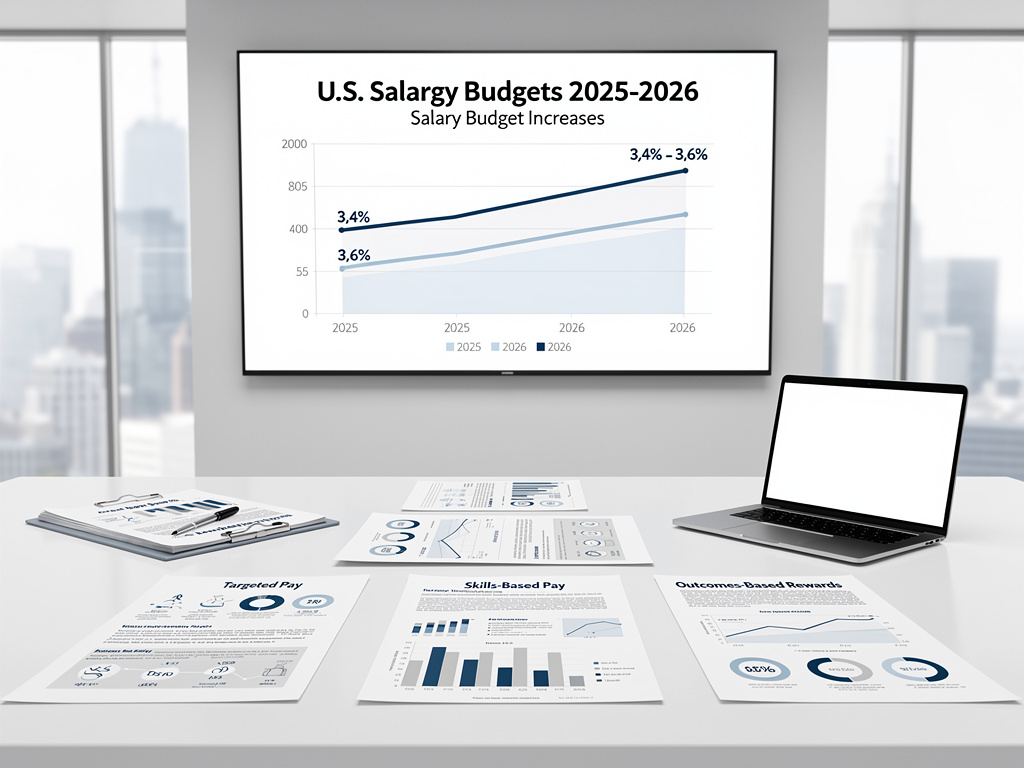
Amid economic steadiness and cooling labor pressures, U.S. employers are locking in salary budgets for 2026 at levels mirroring 2025 actuals, averaging around 3.4% to 3.6%. This plateau marks a departure from post-pandemic surges, as companies pivot from broad raises to targeted investments in high-impact talent. WTW’s latest Salary Budget Planning Survey, drawing from 1,876 U.S. organizations among 36,960 global responses collected September to November 2025, pegs the figure at 3.4%, unchanged from last year’s outlay (TechRseries).
The Conference Board’s 40th annual survey of over 460 compensation leaders echoes this, projecting 3.4% averages and 3.5% medians for both years, with firms diversifying beyond base pay amid uncertainty (The Conference Board). WorldatWork’s poll of 4,250 total rewards leaders from 1,774 organizations forecasts a mean 3.6%, down slightly from 2025’s 3.7% actuals, signaling caution (WorldatWork).
Consensus Emerges Across Surveys
Payscale’s 10th annual survey of 1,551 firms shows 3.5% planned, a tick below 2025’s 3.6% actuals, with technology seeing a 0.5-point drop (Payscale). Mercer’s July poll of 1,157 leaders holds total increases at 3.5%, merit at 3.2%, matching 2025, though 83% plan equal distribution despite skill priorities (Mercer). Gallagher eyes 3.2%-3.3%, emphasizing moderation.
Heather Ryan, WTW’s Rewards Data Intelligence Head of Product, captures the shift: “The traditional approach of spreading around available budget to most employees is being replaced with strategic use of each dollar. Those employees that are growing their skills, contributing to financial outcomes and demonstrating contributions that impact market impressions are poised to receive the larger share of the budget.” This precision reflects voluntary turnover dipping to 10.1%, easing broad retention spends.
Lori Wisper, WTW managing director of Work & Rewards, adds: “The labor market has reached a sort of equilibrium… Since salary increase budgets are a direct reflection of this dynamic, we can expect a period of relative stability for salary increases for the foreseeable future” (HR Dive).
Strategic Shifts Reshape Allocation
Discipline defines planning: WTW notes 62% of employers held mid-year projections steady, 6% raised, 21% cut—driven by cost controls (36%), recession fears (36%), labor tightness (32%), inflation (25%). Firms target pay compression and key talent, boosting governance, market data use, and equity focus. Lauren Mason, Mercer’s U.S. Workforce Solutions Leader, urges: “Employers have a significant opportunity to strategically shape their spending to better align with critical talent goals.”
Retention tactics diversify: 50% enhance experience, 43% training, 42% wellness tweaks, 35% flexibility, 32% comp changes. Promotions slip to 9% of headcount from 10%, averaging 8.7% bumps. “Other” base-pay hikes rise to 59% usage, per Conference Board, blending merit, equity, promotions.
Sixty-one percent anticipate economic drag on decisions, yet prioritize skills (34%), competitiveness (31%), adjustments (24%). Healthcare and retail lag at 2.9%-3.4%; tech holds firmer in some views.
Sector Variations Highlight Pressures
Banking/financial services merits 3.1% but totals 3.7% via variables. Construction eyes gains; tech risks cuts. Salary.com’s 738-firm poll aligns at 3.6%, with 3.3% merit, 1.7% general, 0.7% equity. Pearl Meyer sees 3.3%-3.4% across levels, medians at 3%-3.4%.
Grant Thornton pegs consensus 3.2%-3.5%, above decade norms but contracting. BLS data shows private wages up 3.6% through September 2025, benefits steady. X discussions, like TraderMike’s post on Payscale’s 3.5%, underscore worker calls for more amid stability.
Global echoes: India’s 8.8% leads, but most flatline. U.S. firms balance competitiveness with fiscal restraint, eyeing productivity, capex for growth.
Implications for Talent and Boards
Employers recalibrate: 24% face attraction/retention hurdles. Targeted off-cycles for hot skills, variables (30.5% of exec base), spots rise. Pay equity investments dip slightly but persist at 57% focus. Boards demand alignment: outcomes over inputs.
Inflation’s tame—PCE forecasts 2.6%—preserves real gains. Policies like no-tax tips/overtime loom as boosters. As Wisper notes, equilibrium favors planning over reaction, promising sustained stability if executed sharply.
For insiders, 2026 tests precision: Will equal spreads yield to surgical strikes? Surveys converge on hold-steady budgets, but execution separates winners.


 WebProNews is an iEntry Publication