
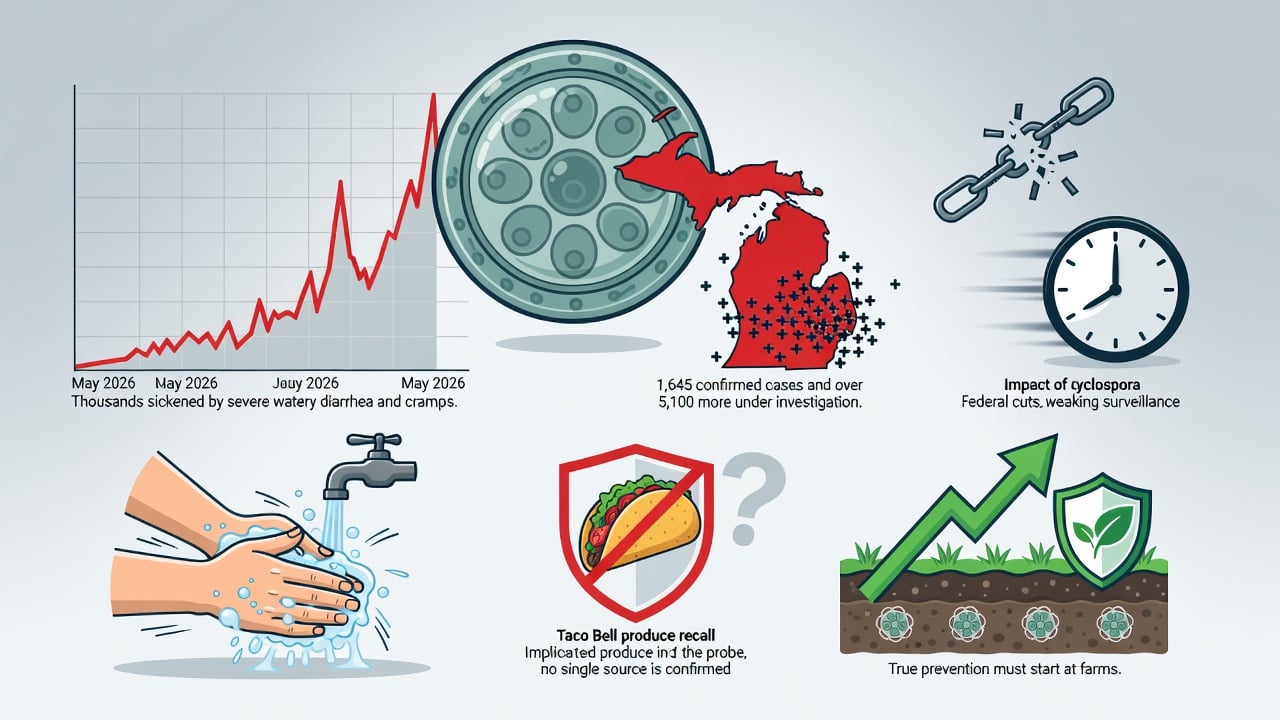
Explosive diarrhea. That’s the phrase many now associate with a microscopic parasite surging across the U.S. this season. Health officials confirm over 1,645 lab-verified infections since May. They track more than 5,100 additional cases still under review. Michigan alone reports 2,640 patients. Hospitals have admitted 141 people. No fatalities so far. But the toll feels heavy.
The Scale of the Current Outbreak
Reports flow in from 34 states. Clusters tie Michigan to Ohio, West Virginia and Kentucky. The Centers for Disease Control and Prevention notes the pattern matches past years in timing. Yet numbers climb higher. USA Today detailed the CDC’s active response just yesterday. Investigators point to fresh produce. Lettuce and salad greens sit high on the suspect list.
Taco Bell took action. The chain recalled lettuce, cilantro, onions, pico de gallo and guacamole from select spots. The move came after FDA and CDC pressure. But officials stop short of naming the restaurant chain as the sole culprit. One patient, a Michigan food broker named Bryan, shared his ordeal. Symptoms struck last Thursday. By Saturday he sought urgent care. “It’s no joke about the explosive diarrhea,” he told The Verge.
Doctors faced delays. Michigan labs ran behind. A nurse practitioner offered Bryan a choice. “We can do one of two things: We can wait until Monday, or I can prescribe you Bactrim immediately.” He took the antibiotic. Relief followed. Yet many suffer longer. The parasite Cyclospora cayetanensis triggers nausea, lost appetite, cramps, bloating and waves of watery diarrhea. Onset hits anywhere from two days to two weeks after exposure. Episodes wax and wane. Fatigue sets in. Weight drops. Dehydration threatens.
And here’s the rub. Standard tests don’t always catch it quickly. Patients must submit stool samples. Confirmation takes time. Underreporting runs rampant. Federal budget cuts hit hard last year. The CDC shed more than 240 consumer safety specialists. Then in July 2025 it scaled back the FoodNet program. States no longer had to track cyclosporiasis uniformly. Gwen Biggerstaff, a CDC epidemiologist, said the data this season looks familiar. “The data that we have for cyclosporiasis for this outbreak is the same as we’ve had for all the other seasons.”
But Janet Hamilton from the Council of State and Territorial Epidemiologists pushed back on that view. She stressed that outbreaks demand patience. “Anytime we have large outbreaks like this, it’s important to remember that they take time to solve, and it’s not uncommon that it can take multiple days, especially if there’s more than one product that is involved.” Her words appear in the same Verge report.
Transmission tells a clear story. The parasite spreads through human feces. Contaminated water or soil touches crops. Once inside a host it multiplies. Produce from Mexico has triggered past events. Cilantro caused several. Raspberries, basil, snow peas and mesclun lettuce also made the list in earlier years. The FDA maintains a page outlining these links. FDA.gov lists historical outbreaks tied to imported goods.
Yet pinning this wave proves tough. Incubation stretches long. Produce spoils fast. Pathogen levels stay low and patchy. Supply chains twist through farms, packers, distributors and restaurants. Rodney E. Rohde, a microbiology expert, calls these events some of the toughest to crack. “Cyclospora outbreaks are among the most challenging foodborne outbreaks to investigate,” he explained in The Verge.
So what now? Federal agencies avoid broad warnings. They do not tell consumers to skip specific items. Instead they urge basic steps. Wash fresh produce. Dry it thoroughly. Those with weak immune systems or in hot spots should think twice about raw greens. Farmer’s markets might carry lower risk if they avoid shared water systems. Still, caution rules.
Tracing the Source and Systemic Gaps
Investigators chase leads. They interview patients. They test leftover food. They map distributions. No single source stands confirmed yet. The voluntary Taco Bell recall bought time. But similar actions happened before. In 2020 a Fresh Express plant in Illinois sickened 640 people across 11 states. That outbreak also involved salad mix.
Experts say prevention starts at the farm. Reduce fecal contamination there. Improve irrigation. Train workers. Test water. Domestic rules tightened over time. Imports face inspection. Still gaps remain. A National Advisory Committee on Microbiological Criteria for Foods report from the USDA examined Cyclospora in produce. It highlighted repeated issues with Mexican cilantro. FSIS.USDA.gov hosts the document.
Recent coverage adds context. The University of Minnesota’s Center for Infectious Disease Research and Policy published analysis yesterday. It notes what experts know and what stays murky about the massive outbreak. CIDRAP stresses ongoing uncertainty around exact vehicles. MedPage Today also reported CDC statements linking multiple states. These pieces echo the surveillance challenges created by earlier program cuts.
Public chatter on X reflects frustration. One user described contracting the parasite from a salad wrap bought at a busy transit hub. Others joke darkly about fast food. A few reference crypto tokens named after the outbreak. Real concern mixes with memes. But the human impact lingers. Bryan recovered after treatment. Thousands wait for answers.
Rohde offers measured advice. “Vegetables and fruits are obviously important to a nutritious diet. But one should be cautious and pay attention to ongoing local, state, and federal health reports for your geographic locale.” He adds that ultimate control lies upstream. “Ultimately, prevention depends most on reducing contamination during production rather than in the home.” Both statements come from his comments to The Verge.
Health departments ramp up testing where possible. Some states restored reporting requirements. The CDC continues to update counts weekly. Cases may peak soon as summer produce season shifts. Or they could stretch into fall. History shows these waves often fade once contaminated batches clear shelves.
Still the episode exposes cracks. Reduced surveillance leaves officials flying partially blind. Budget decisions from 2025 now shape 2026 responses. Lost specialists slow trace-backs. And consumers stay one step behind the data. So wash that lettuce. Dry it well. Skip the raw stuff if symptoms worry you. And watch official channels. The parasite doesn’t care about politics or supply chains. It simply needs a host. This time it found too many.


 WebProNews is an iEntry Publication