
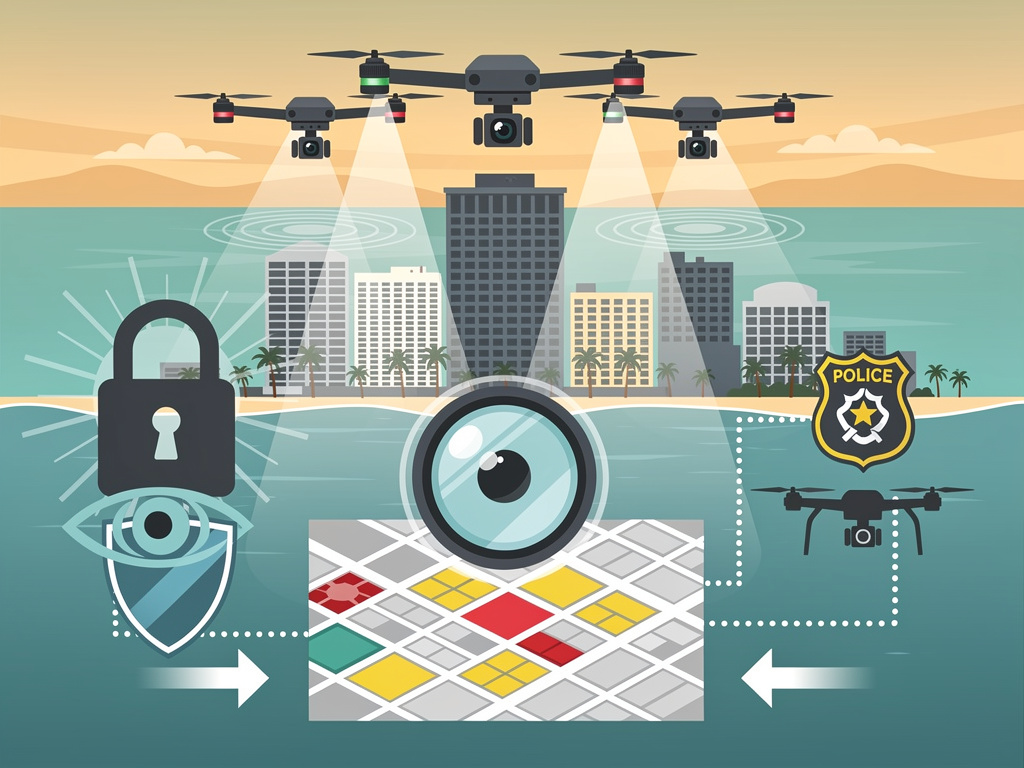
On the sun-drenched shores of Waikiki, where millions of tourists flock each year to enjoy one of the world’s most iconic beach destinations, a new kind of sentinel may soon take to the skies. The Honolulu Police Department’s proposal to deploy surveillance drones over the bustling tourist district has triggered a fierce debate that extends far beyond the Hawaiian Islands — one that pits the promise of cutting-edge public safety technology against deeply held concerns about civil liberties, privacy, and the creeping normalization of aerial surveillance in American cities.
The plan, which has been under discussion in recent months, would see drones equipped with cameras patrolling the Waikiki area to assist law enforcement in monitoring crowds, deterring crime, and responding more rapidly to emergencies. Proponents argue that the technology could be a force multiplier for a police department tasked with protecting a district that sees roughly 100,000 visitors on any given day. But critics — including privacy advocates, civil liberties organizations, and some local residents — warn that the initiative represents a dangerous step toward a surveillance state, with particular implications for communities of color and Native Hawaiian populations.
A Tourist Mecca Confronts 21st-Century Policing
Waikiki is no ordinary neighborhood. Stretching along the southern shore of Honolulu, it is the economic engine of Hawaii’s tourism industry, which accounts for a significant share of the state’s GDP. The area is densely packed with hotels, restaurants, shopping centers, and public beaches, making it both a magnet for visitors and a challenge for law enforcement. According to TechRepublic, the Honolulu Police Department has framed the drone program as a modern solution to the unique security demands of the district, arguing that aerial surveillance could help officers identify threats faster, manage large crowds during events, and reduce response times to incidents ranging from petty theft to medical emergencies.
The appeal of drone technology for urban policing is not difficult to understand. Drones are relatively inexpensive compared to helicopters, can be deployed quickly, and offer real-time aerial perspectives that ground-based officers simply cannot match. Several U.S. cities — including Chula Vista, California, which has been widely cited as a model for drone-assisted policing — have already integrated unmanned aerial vehicles into their law enforcement operations with reported success in reducing response times and improving situational awareness.
The Privacy Pushback: More Than Just a Local Concern
Yet the Waikiki proposal has drawn sharp criticism from a broad coalition of opponents who argue that the benefits of drone surveillance do not outweigh the risks. As TechRepublic reported, privacy advocates have raised alarms about the potential for mass surveillance, the collection and retention of data on individuals who are not suspected of any crime, and the lack of clear policies governing how drone footage would be stored, accessed, and shared.
The American Civil Liberties Union has long warned about the dangers of unchecked drone surveillance by law enforcement agencies. The organization has argued that without robust legal frameworks, drone programs can easily morph from targeted crime-fighting tools into instruments of pervasive monitoring. In Hawaii, where the state constitution explicitly protects the right to privacy — a provision that goes further than the U.S. Constitution — these concerns carry particular legal weight. Critics contend that flying cameras over Waikiki’s beaches, sidewalks, and public spaces would constitute an unreasonable intrusion into the daily lives of residents and visitors alike.
Racial Equity and the Shadow of Disproportionate Enforcement
Adding another layer of complexity to the debate is the question of who, exactly, would bear the brunt of increased surveillance. Civil rights organizations have pointed to well-documented patterns of racial bias in policing technology, from facial recognition software that disproportionately misidentifies people of color to predictive policing algorithms that concentrate enforcement in minority neighborhoods. In Hawaii, where Native Hawaiians and Pacific Islanders already face disproportionate rates of arrest and incarceration, the introduction of drone surveillance raises pointed questions about equity and justice.
Community advocates have argued that the drone program could exacerbate existing disparities, particularly if the technology is used in conjunction with facial recognition or other biometric identification tools. While the Honolulu Police Department has not publicly confirmed whether facial recognition would be integrated into the drone system, the absence of explicit prohibitions has done little to assuage concerns. As privacy researchers have noted, the capabilities of surveillance drones can be expanded after deployment through software updates and new sensor packages, meaning that a program launched with limited capabilities today could become far more invasive tomorrow.
Lessons from Chula Vista and Other Early Adopters
The experience of other cities that have embraced drone policing offers both encouragement and cautionary tales. Chula Vista’s Drone as First Responder program, launched in 2018, has been widely praised for its ability to get eyes on emergency scenes within minutes, often before patrol cars arrive. The program has been credited with improving outcomes in situations ranging from car accidents to violent crimes. However, it has also faced scrutiny over data retention policies, the potential for mission creep, and the broader implications of normalizing constant aerial surveillance in urban areas.
Other jurisdictions have taken a more cautious approach. Several cities and states have enacted laws restricting the use of drones by law enforcement, requiring warrants for surveillance flights, or banning the use of facial recognition technology on drone-captured footage. These legislative efforts reflect a growing recognition that the rapid advancement of surveillance technology has outpaced the development of legal and ethical frameworks to govern its use.
The Regulatory Vacuum and the Need for Guardrails
One of the central criticisms of the Waikiki drone plan is the perceived lack of comprehensive regulations governing the program. According to TechRepublic, opponents have called for clear, enforceable policies addressing key issues such as when and where drones can be flown, how long footage can be retained, who can access the data, and what oversight mechanisms will be in place to prevent abuse. Without such guardrails, critics argue, the program risks becoming a tool of unchecked government surveillance rather than a carefully calibrated public safety measure.
The Federal Aviation Administration regulates the airspace in which drones operate, but its rules are primarily concerned with safety and airspace management rather than privacy. At the state level, Hawaii has some privacy protections, but advocates say they are insufficient to address the specific challenges posed by persistent aerial surveillance. The result is a regulatory patchwork that leaves significant gaps — gaps that law enforcement agencies can exploit, intentionally or otherwise.
Tourism, Trust, and the Image of Aloha
There is also the question of how drone surveillance might affect Waikiki’s image as a welcoming, relaxed destination. Hawaii’s tourism industry depends heavily on the perception of the islands as a paradise — a place where visitors can escape the stresses and surveillance of everyday life. The sight of police drones buzzing overhead could undermine that image, potentially deterring some travelers and generating negative publicity. Industry stakeholders have expressed concern that the program could send the wrong message to the millions of tourists whose spending supports the local economy.
At the same time, supporters of the drone plan argue that enhanced security could actually make Waikiki more attractive to visitors by reducing crime and improving emergency response. They point to surveys suggesting that many travelers prioritize safety when choosing destinations and that visible security measures can be reassuring rather than off-putting. The challenge, as with so many aspects of this debate, lies in finding the right balance.
What Comes Next for Waikiki and Beyond
The Waikiki drone proposal is far from settled. Community meetings, public comment periods, and legislative discussions are expected to continue in the coming months as stakeholders on all sides press their cases. The outcome will likely depend not only on the specifics of the proposed program but also on the broader political and cultural dynamics of Hawaii, where respect for individual rights and community values runs deep.
What is clear is that the debate over drone surveillance in Waikiki is not an isolated episode. It is part of a much larger national — and indeed global — reckoning with the role of technology in policing and public life. As drones become cheaper, more capable, and more widely available, cities across the United States will face similar questions about how to harness their potential while safeguarding the freedoms that define American democracy. The decisions made in Honolulu could set important precedents for communities everywhere, making this a story that extends well beyond the beaches of Waikiki.
For now, the skies over Waikiki remain free of police drones. But the conversation about whether that should change — and on what terms — is only just beginning.


 WebProNews is an iEntry Publication