
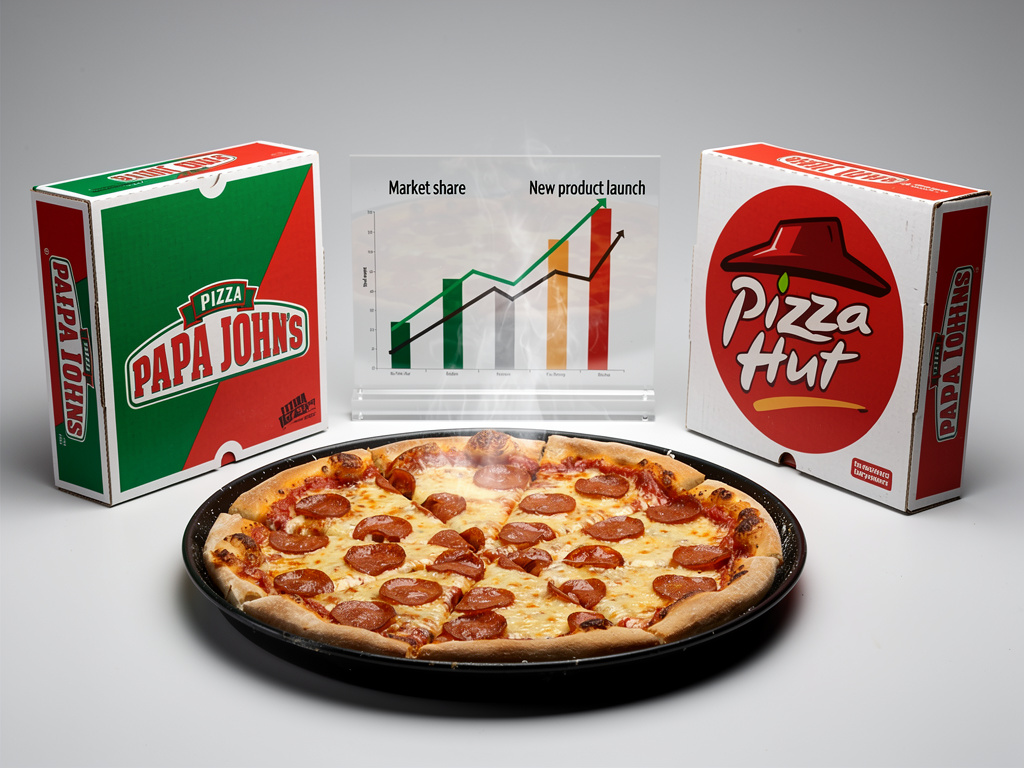
In a strategic move that signals both desperation and determination, Papa John’s International has launched its first-ever pan pizza offering, marking a significant departure from the chain’s traditional thin-crust identity that founder John Schnatter built over four decades. The rollout, announced in late January 2025, represents more than a menu expansion—it’s a calculated gamble by a legacy pizza brand struggling to differentiate itself in an increasingly crowded and competitive quick-service restaurant sector where innovation has become the price of survival.
According to CNN, the new pan pizza features a thick, buttery crust that Papa John’s executives describe as “crispy on the outside, fluffy on the inside.” The product development took approximately 18 months, involving extensive consumer testing across multiple markets before the nationwide debut. This timeline underscores the careful deliberation behind a decision that fundamentally challenges the brand’s core positioning—a risk that reflects the precarious position of mid-tier pizza chains in today’s dining economy.
The timing of this launch is particularly telling. Papa John’s has spent recent years attempting to rebuild its reputation and market share following the tumultuous departure of its controversial founder in 2018. The company’s same-store sales have fluctuated, and while it remains the third-largest pizza chain in the United States, the gap between Papa John’s and its larger rivals—Domino’s and Pizza Hut—has widened in some key metrics. The pan pizza introduction appears designed to recapture customers who have drifted toward competitors offering more diverse menu options and crust varieties.
The Competitive Pressure Cooker: Why Legacy Brands Must Innovate or Perish
The quick-service pizza industry has undergone dramatic transformation over the past decade, with established players facing pressure from multiple directions. Domino’s has successfully reinvented itself through technology investments and delivery innovation, while Pizza Hut has experimented with various menu formats and dining experiences. Meanwhile, fast-casual concepts like Blaze Pizza and MOD Pizza have captured younger consumers with customizable options and perceived quality advantages. In this environment, standing still equals falling behind.
Papa John’s pan pizza entry directly challenges Pizza Hut’s signature product, the Original Pan Pizza, which has been a menu staple since 1980 and remains one of that chain’s most recognizable offerings. By moving into this territory, Papa John’s is essentially declaring that brand loyalty and traditional positioning matter less than meeting consumer demand for variety. This represents a philosophical shift for a company that previously marketed itself on the premise of “Better Ingredients, Better Pizza”—a slogan that implied superiority through consistency rather than diversity.
Industry analysts have noted that pizza chains are increasingly borrowing strategies from each other, creating a homogenization effect that makes differentiation more challenging. When every major chain offers thin crust, hand-tossed, stuffed crust, and now pan varieties, the competitive advantage shifts to execution, price, and convenience rather than unique product offerings. This convergence reflects broader trends in the quick-service restaurant industry, where menu innovation has become both essential and paradoxically less distinctive.
Consumer Behavior Shifts and the Death of Brand Loyalty
The decision to launch pan pizza also reflects fundamental changes in consumer dining behavior, particularly among younger demographics who show significantly less brand loyalty than previous generations. Research consistently demonstrates that Millennials and Gen Z consumers prioritize variety, customization, and value over traditional brand allegiance. They’re more likely to use third-party delivery apps that present multiple restaurant options side-by-side, reducing the psychological barriers to switching between competitors.
This behavioral shift has forced pizza chains to rethink their entire approach to menu development and marketing. Rather than building identity around a single signature product or preparation style, successful chains now emphasize breadth of options and the ability to satisfy diverse preferences within a single order. Papa John’s pan pizza launch acknowledges this reality—the company cannot afford to lose customers simply because it doesn’t offer a crust style that a particular diner prefers on a given occasion.
The economics of this strategy are complex. Introducing new products requires investment in training, equipment, ingredient sourcing, and marketing, all of which pressure already-thin margins in the highly competitive pizza sector. However, the cost of not innovating may be higher: gradual market share erosion as customers develop habits with competitors who offer more comprehensive menus. Papa John’s appears to have calculated that the investment in pan pizza capability will pay dividends through increased transaction frequency and higher average ticket sizes.
Operational Challenges and the Reality of Kitchen Complexity
Behind the marketing fanfare lies a significant operational undertaking. Pan pizza requires different preparation methods, cooking times, and equipment compared to traditional hand-tossed pizza. For Papa John’s franchise operators, this means additional complexity in kitchen operations, inventory management, and staff training. The company must balance the desire for product consistency across thousands of locations with the practical realities of implementation in diverse operational environments.
Franchise economics play a crucial role in these decisions. While corporate leadership may see strategic value in menu expansion, individual franchise owners bear much of the operational burden and financial risk. Successful rollouts require buy-in from franchisees who must invest in any necessary equipment upgrades and absorb the learning curve that accompanies new products. Papa John’s franchise relations have improved since the founder’s departure, but introducing operational complexity always tests these relationships.
The supply chain implications are equally significant. Pan pizza dough requires different formulation and handling compared to traditional pizza dough, potentially necessitating adjustments throughout Papa John’s distribution network. The company’s commissary system, which supplies dough and ingredients to restaurants, must accommodate this additional product line while maintaining quality standards and cost efficiency. These behind-the-scenes challenges rarely receive public attention but often determine whether menu innovations succeed or fail.
Marketing Strategy and the Battle for Consumer Attention
Papa John’s marketing approach for the pan pizza launch emphasizes taste and quality rather than price, positioning the product as a premium offering within the chain’s menu hierarchy. This strategy aligns with the company’s historical brand positioning but faces skepticism in a market where consumers have become increasingly price-sensitive, particularly in the wake of inflation that has significantly impacted food costs over the past several years.
The promotional campaign includes digital advertising, social media engagement, and limited-time offers designed to drive trial among existing customers and attract new ones. However, breaking through the noise in today’s fragmented media environment requires substantial investment, and the return on that investment depends on converting trial into repeat purchases. Early consumer response will be critical in determining whether Papa John’s commits additional resources to promoting the pan pizza or shifts focus to other initiatives.
Brand perception presents another challenge. Papa John’s has worked to rehabilitate its image following the controversies surrounding its founder, but consumer sentiment remains mixed. The company’s ability to generate excitement around new products depends partly on whether consumers view Papa John’s as an innovative brand worth trying or a legacy chain struggling to remain relevant. The pan pizza launch itself becomes a test of the company’s broader brand health and market positioning.
The Broader Industry Context: A Sector in Transition
Papa John’s pan pizza introduction occurs against a backdrop of significant industry evolution. The COVID-19 pandemic accelerated trends toward delivery and digital ordering that were already reshaping the pizza business. Companies that invested heavily in technology and delivery infrastructure—particularly Domino’s—emerged stronger, while those slower to adapt faced challenges. Papa John’s has made progress in digital capabilities but still trails the industry leader in this crucial area.
Third-party delivery platforms have fundamentally altered the competitive dynamics of the pizza industry. While these services expanded market reach, they also increased competition by making it easier for consumers to compare options and try new restaurants. The commission fees charged by delivery platforms pressure already-slim margins, forcing pizza chains to optimize operations and increase average ticket sizes to maintain profitability. Menu expansion through products like pan pizza represents one strategy for driving higher-value orders that can absorb delivery costs.
Labor challenges add another layer of complexity. The restaurant industry continues to face worker shortages and wage pressure, making operational efficiency more important than ever. Introducing menu items that require additional training and preparation time works against efficiency goals, creating tension between the desire for differentiation and the need for streamlined operations. Papa John’s must navigate this tension carefully to avoid overwhelming restaurant teams already stretched thin.
Financial Implications and Investor Expectations
From a financial perspective, Papa John’s needs growth initiatives like the pan pizza launch to satisfy investor expectations and justify its valuation. The company’s stock performance has been volatile, reflecting both the challenges facing legacy restaurant brands and uncertainty about Papa John’s specific strategic direction. Successful menu innovation that drives comparable sales growth would provide tangible evidence of the company’s ability to compete effectively and expand its customer base.
Wall Street analysts will be watching several key metrics in the quarters following the pan pizza launch: same-store sales growth, average ticket size, transaction frequency, and market share trends. If the new product attracts customers without cannibalizing existing sales—a challenging balance to achieve—it could provide meaningful lift to financial performance. However, if pan pizza simply redistributes existing customer preferences without expanding the overall customer base, the initiative may fail to deliver the growth that investors seek and that the company needs to fund future innovation.
The longer-term question is whether product innovation alone can solve the strategic challenges facing mid-tier pizza chains. Papa John’s competes not only with other pizza restaurants but with the entire universe of convenient dining options, from fast-casual concepts to meal kit services to ghost kitchens operating exclusively through delivery apps. In this expanded competitive set, a new crust variety—however well-executed—represents an incremental improvement rather than a transformative advantage. The company’s ultimate success will depend on its ability to combine product innovation with superior execution, technology integration, and brand building that resonates with evolving consumer preferences in a marketplace that shows little mercy to brands that fail to adapt.


 WebProNews is an iEntry Publication