
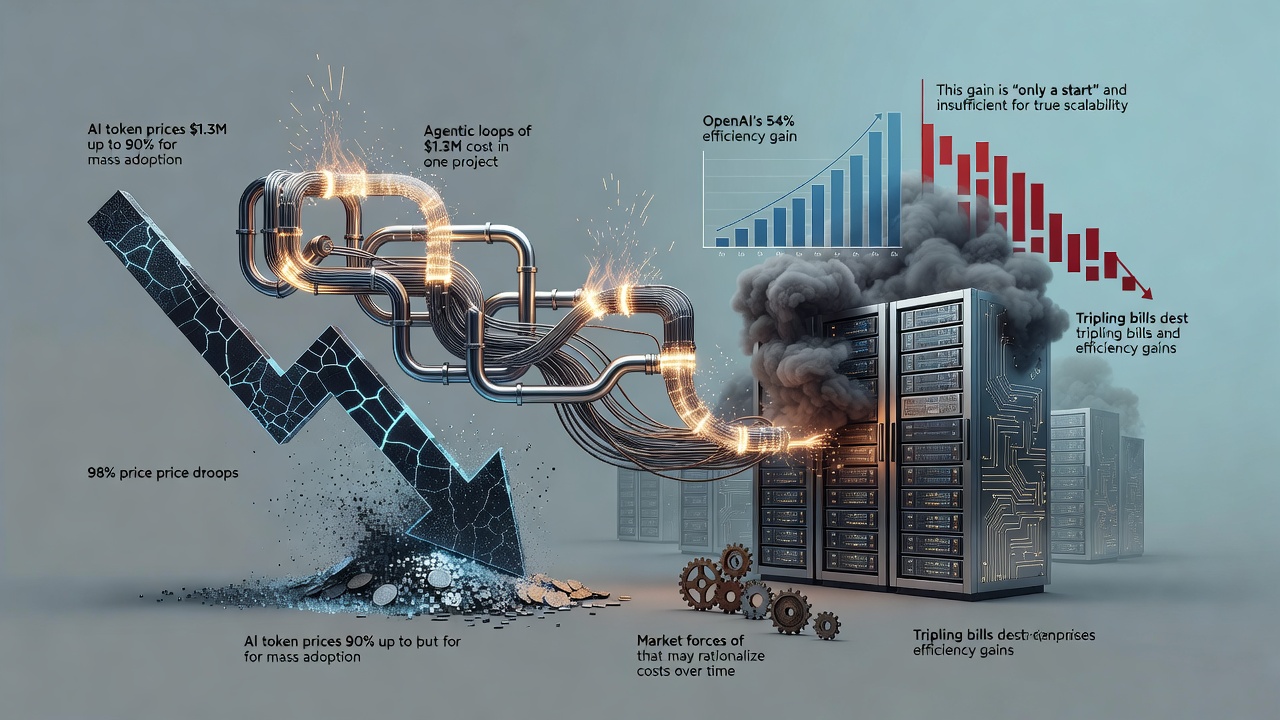
Nikesh Arora doesn’t mince words. The Palo Alto Networks chief executive told CNBC on Thursday that AI token prices must fall as much as 90% before enterprises can deploy the technology at true scale. “I think 54% is a good start,” he said, reacting to OpenAI’s latest efficiency claims. “I think we probably need another turn at it.”
His target? Token costs dropping to 20% of current levels in the next 12 months, then 90% lower the year after. The message lands with force. Arora runs a cybersecurity powerhouse valued near $250 billion that itself consumes massive AI resources. When he speaks, model makers listen.
But the frustration runs deeper than one executive’s complaint. Per-token prices have already plunged 98% since late 2022. A GPT-4-equivalent that once cost $20 per million tokens now runs about 40 cents. Yet average enterprise AI bills tripled from $1.2 million a year in 2024 to $7 million in 2026, according to The Next Web.
Agentic systems explain the gap. These autonomous loops call models repeatedly to review code, fix bugs, scan for vulnerabilities or handle workflows. One simple interaction that cost four cents in 2023 can now run $1.20. Developer consumption jumped 18.6 times in nine months at some firms. The math breaks budgets fast.
Real cases illustrate the pain. Uber exhausted its AI budget by April 2026 and imposed caps. Microsoft revoked some Claude licenses after uncontrolled spending. One company racked up a $500 million Claude bill in a single month after forgetting rate limits. Priceline saw contract renewals cost four to five times more than expected. “It’s like the crack-cocaine epidemic,” one executive told The Next Web.
The most vivid example came from developer Peter Steinberger. While building the open-source OpenClaw project, he deployed 100 AI agents that burned through 603 billion tokens and 7.6 million requests in 30 days. The OpenAI bill hit $1.3 million. OpenAI covered it as research. Steinberger called the ROI “pretty high.” The project became one of GitHub’s fastest-growing, hitting 302,000 stars. Yet the episode underscores how quickly agentic loops consume resources even when results impress.
Executives across industries echo Arora’s call for relief.
Palantir CEO Alex Karp went further last week. He blasted the token model from OpenAI and Anthropic. “I’m not throwing shade at them, but something has gone completely wrong,” Karp said on CNBC. “The basic view among enterprises in this country is I’m going to chillax and waste my time with tokens.” Many companies now turn to cheaper open-weight models, including Chinese offerings that close the performance gap rapidly.
Arora remains optimistic on demand. “The demand continues to be infinite,” he told CNBC. With an infinite demand curve, he argues, costs will come down as efficiency improves and the market adjusts. Budgets will ease. Vendors will compete harder. But that future depends on sustained pressure from large buyers like Palo Alto Networks.
Startups already chase cheaper inference. DeepSeek made a 75% discount permanent. Others raised funds specifically to optimize agentic workloads. Hardware efficiency gains help, yet usage growth often outpaces them. One efficiency improvement gets swallowed by more ambitious agents running longer chains.
This tension matters for cybersecurity too. Palo Alto Networks integrates AI deeply into its platform, from Prisma AIRS to XSIAM, its cloud-delivered security operations center. Arora noted on an earlier earnings call that enterprises seek more consistency across vendors as they adopt AI, driving platformization. Customers adopt these AI security tools faster than previous cloud offerings. Yet the underlying token costs threaten to slow broader rollout.
Investors watch closely. Palo Alto’s stock has soared on AI-driven security demand, hitting records above $300 in June 2026. Analysts rate it a buy with targets near that level. Still, some question valuation at more than 250 times trailing GAAP earnings. The AI cost debate could influence spending forecasts and growth trajectories across the sector.
Arora’s comments arrive as infrastructure spending accelerates. Tech giants issue billions in debt and equity to fund data centers and chips. SpaceX raised $25 billion in bonds last month. Amazon followed with its own $25 billion debt offering. Those capital raises assume AI will deliver returns. High token prices put that assumption under strain.
So what happens next? Model providers face a choice. They can continue aggressive price cuts and efficiency gains. Or enterprises will ration usage, cap employee access, and favor cheaper alternatives. Some already do. The industry may need better visibility tools and standards to measure true business value, as several executives have suggested.
Arora bets on rationalization. Infinite demand meets finite budgets. Something gives. His 90% target sounds extreme today. Two years of steady progress could make it realistic. For now, his blunt assessment from the buyer’s seat carries weight. Large enterprises won’t deploy AI everywhere they want until the economics work. The pressure is on.
And the clock ticks. OpenAI’s GPT-5.6 delivered a 54% gain on agentic coding tasks. Impressive. Not enough, says the CEO of one of tech’s biggest AI customers. The next turns must deliver more. Much more.


 WebProNews is an iEntry Publication