
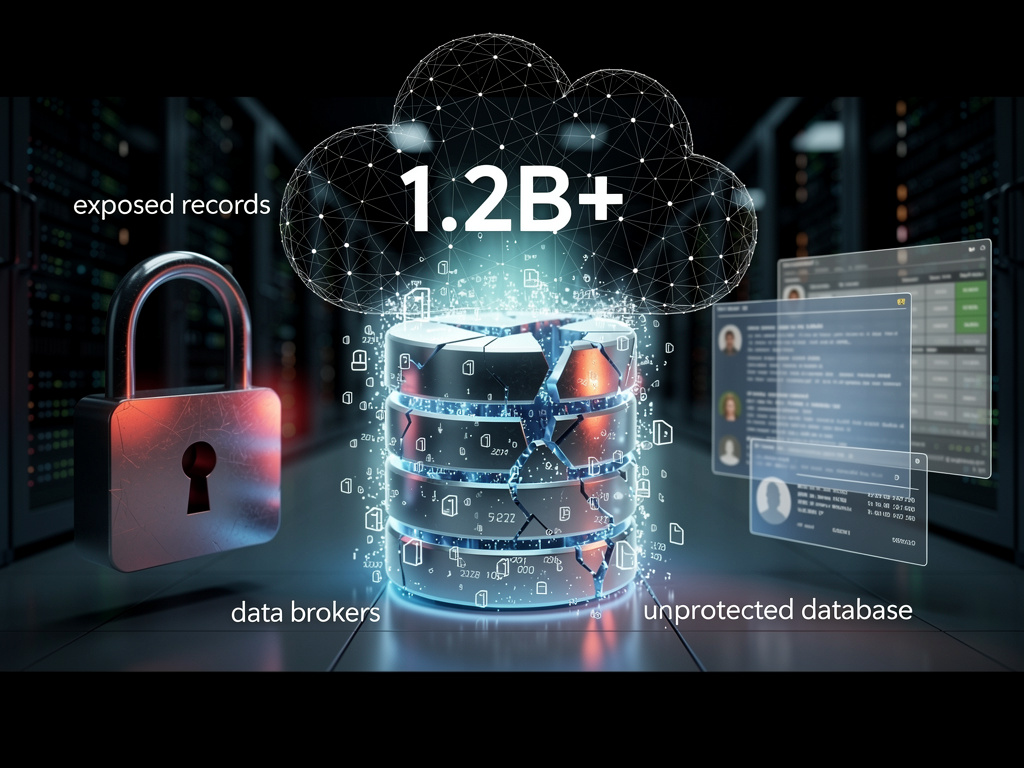
A staggering data breach affecting more than one billion individual records has been uncovered, marking one of the largest exposures of personal and corporate information in recent memory. The breach, which involves an unprotected Elasticsearch database, has sent ripples through the cybersecurity community and raised urgent questions about how organizations store, manage, and protect sensitive data at scale.
The exposed database, which was discovered by cybersecurity researcher Bob Diachenko, contained approximately 1.2 billion records of personal data including names, email addresses, phone numbers, and LinkedIn and Facebook profile information. Unlike many breaches that stem from sophisticated hacking operations, this one resulted from a far more mundane failure: the database was left sitting on the open internet with no password protection or authentication of any kind, according to reporting by TechRadar.
A Treasure Trove of Personal Data Left Wide Open
The exposed records totaled roughly four terabytes of data and were found on a Google Cloud server. The information appears to have originated from two separate data enrichment companies — People Data Labs and OxyData.io — both of which aggregate public and semi-public information from various sources to build detailed profiles of individuals. Data enrichment firms scrape and compile information from social media platforms, public records, and other accessible databases, then sell that compiled intelligence to marketers, recruiters, and other business clients.
People Data Labs alone claims to have data on more than 1.5 billion individuals, offering what it describes as comprehensive datasets for business use. The company acknowledged that the exposed data matched its records but stated that the unsecured server did not belong to them. “The owner of this server likely used one of our enrichment products, along with other data enrichment or licensing services,” a People Data Labs spokesperson said, as reported by TechRadar. OxyData.io similarly confirmed that some of the data appeared to be theirs but denied ownership of the server.
The Troubling Economics of Data Enrichment
This incident throws a harsh spotlight on the data enrichment industry, a sector that operates largely in the shadows despite handling enormous volumes of personal information. These companies function as middlemen, aggregating data from dozens or even hundreds of sources and packaging it for commercial sale. Their clients range from Fortune 500 marketing departments to small recruiting firms, and the data they compile can be remarkably detailed — covering employment history, social media activity, email addresses, phone numbers, and more.
The problem, as this breach illustrates, is that once data leaves the hands of the enrichment company and enters a client’s infrastructure, the enrichment firm has little to no control over how that data is stored or secured. The result is a chain-of-custody problem that multiplies risk at every step. A single careless client can expose the records of over a billion people simply by failing to set a password on a database. Industry analysts have long warned that the data brokerage model creates precisely this kind of systemic vulnerability, where the incentives to collect and distribute data far outweigh the incentives to protect it.
Elasticsearch Misconfigurations: A Recurring Nightmare
The breach is far from an isolated incident when it comes to misconfigured Elasticsearch databases. Elasticsearch is an open-source search and analytics engine widely used by enterprises to store and query large volumes of data. Its popularity, however, has been matched by a persistent pattern of misconfiguration, in which administrators deploy Elasticsearch instances on the public internet without enabling basic security features. Security researchers have discovered hundreds of exposed Elasticsearch databases in recent years, many containing sensitive health records, financial data, and government information.
Bob Diachenko, the researcher who found this particular database, has built a career around identifying these kinds of exposures. He has previously uncovered misconfigured databases belonging to healthcare providers, government agencies, and major corporations. His methodology typically involves scanning the internet for open Elasticsearch and MongoDB instances using tools like Shodan, a search engine that indexes internet-connected devices and services. In this case, Diachenko worked alongside researchers at Vinny Troia’s Night Lion Security to verify the scope and contents of the exposed data.
What the Exposed Data Means for Individuals
For the estimated 1.2 billion individuals whose records were exposed, the practical risks are significant. While the database did not appear to contain passwords, Social Security numbers, or credit card information, the combination of names, phone numbers, email addresses, and social media profiles provides ample ammunition for phishing attacks, social engineering schemes, and identity fraud. Cybercriminals who obtain this kind of enriched data can craft highly targeted spear-phishing emails that reference a victim’s employer, job title, or social connections — dramatically increasing the likelihood that the victim will click a malicious link or divulge further information.
The exposure also raises concerns about the cumulative effect of data breaches. When enriched profile data from one breach is combined with leaked credentials from another, attackers can build comprehensive dossiers on individuals that enable account takeover, financial fraud, and even physical-world crimes like stalking. Security experts have noted that the real danger of breaches like this one is not any single piece of exposed data but the way that data can be cross-referenced and combined with other leaked datasets to create a far more complete — and dangerous — picture of an individual.
Regulatory and Legal Implications Remain Murky
The breach also raises thorny questions about regulatory accountability. Under the European Union’s General Data Protection Regulation, organizations that collect and process personal data are required to implement appropriate technical and organizational measures to protect that data. Failure to do so can result in fines of up to four percent of a company’s global annual revenue. However, the chain of responsibility in this case is unclear. If the enrichment companies sold or licensed the data to a third party, and that third party failed to secure it, determining who bears legal liability becomes a complex exercise.
In the United States, the regulatory picture is even more fragmented. There is no comprehensive federal data privacy law, and the patchwork of state-level regulations — including the California Consumer Privacy Act — varies widely in scope and enforcement mechanisms. Data enrichment companies have historically operated in a legal gray area, arguing that the information they compile is derived from publicly available sources and therefore does not require the same protections as data collected directly from consumers. Critics counter that the aggregation and sale of such data creates privacy risks that far exceed those associated with any individual public record.
Industry Response and the Path Forward
In the wake of the discovery, the exposed server was taken offline, though it remains unclear who owned or operated it. Neither People Data Labs nor OxyData.io has claimed responsibility for the server, and no other entity has come forward. This lack of accountability is itself a telling indicator of the challenges facing regulators and consumers alike. When data passes through multiple hands — from original source to enrichment company to end client — tracing responsibility for a breach becomes extraordinarily difficult.
Cybersecurity professionals have called for stronger baseline security requirements for cloud-hosted databases, including mandatory authentication, encryption at rest, and automated alerts when databases are exposed to the public internet. Cloud providers like Google, Amazon, and Microsoft have introduced tools designed to flag misconfigurations, but adoption remains inconsistent. Some experts have advocated for a model in which cloud providers automatically restrict public access to new database instances by default, requiring administrators to explicitly opt in to public exposure rather than opt out.
A Warning That Should Not Be Ignored
The exposure of 1.2 billion records is a stark reminder that the greatest cybersecurity threats are often not the most technically sophisticated. No zero-day exploit was required. No nation-state hacking group was involved. A database was simply left open on the internet, and the personal information of over a billion people was available for anyone to find and download. The incident underscores a fundamental disconnect between the scale at which personal data is now collected and traded and the rigor with which that data is protected.
For industry leaders, the lesson is clear: data security cannot be treated as someone else’s problem. Whether an organization is collecting data, enriching it, licensing it, or storing it, each link in the chain bears a responsibility to ensure that basic security measures are in place. Until that principle is embedded in both corporate practice and regulatory frameworks, breaches of this magnitude will continue to occur — and the individuals whose data is exposed will continue to bear the consequences.


 WebProNews is an iEntry Publication