
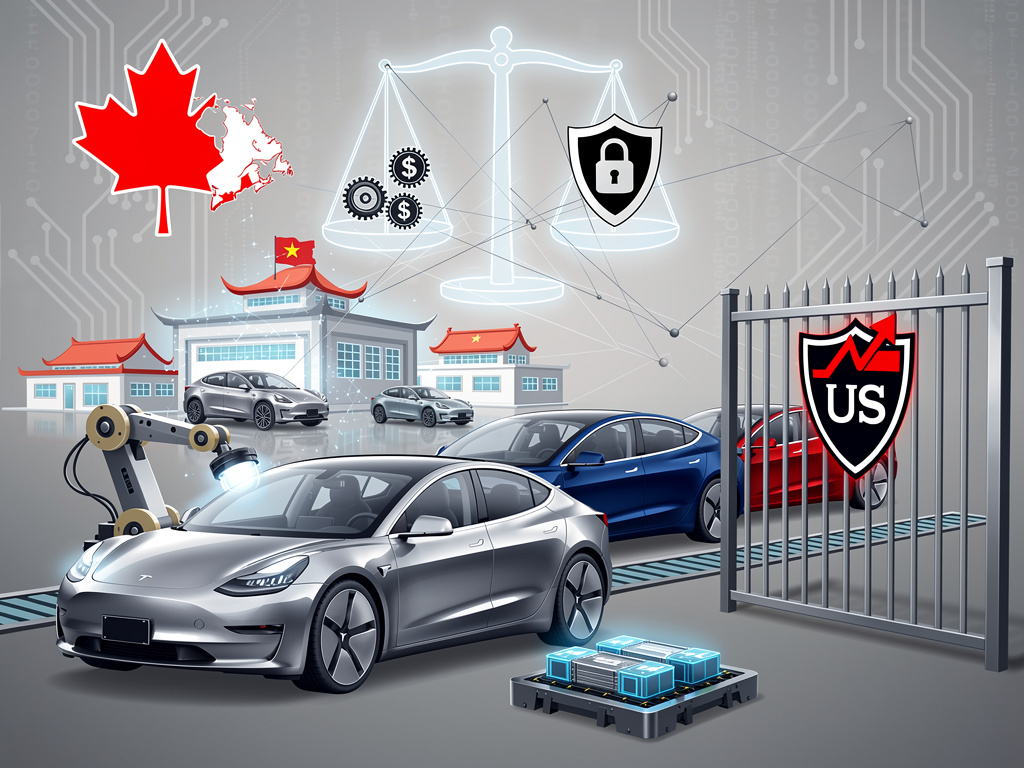
In a striking pivot that would have seemed unthinkable just two years ago, Canada is actively exploring partnerships with Chinese electric vehicle manufacturers as a potential lifeline for its beleaguered automotive industry. The move comes as the country faces mounting pressure from U.S. tariffs, shifting trade alliances, and the urgent need to modernize its manufacturing base for an electrified future.
The courtship represents a dramatic reversal from Canada’s previous posture toward Chinese investment in its auto sector. In 2023, Ottawa imposed its own 100% tariff on Chinese-made electric vehicles, mirroring similar measures taken by the United States and the European Union. Now, facing an existential threat to its auto manufacturing sector from aggressive American trade policies under President Donald Trump, Canadian officials are reconsidering whether Chinese expertise and capital might be exactly what the country needs.
A Trade War Forces Canada to Look East
The catalyst for Canada’s strategic recalculation is unmistakable: the escalating trade conflict with the United States. Since President Trump reimposed and expanded tariffs on Canadian goods — including a punishing 25% levy on automobiles and auto parts — the integrated North American supply chain that sustained Canada’s auto industry for decades has been thrown into disarray. Plants in Ontario, the heartland of Canadian auto manufacturing, have seen production slowdowns and layoffs as the economics of cross-border manufacturing have been upended.
As CNBC reported, Canadian policymakers are now weighing the benefits of inviting Chinese automakers to establish manufacturing operations on Canadian soil. The logic is straightforward: if the United States is going to treat Canada as an adversary in trade, then Ottawa needs to diversify its economic partnerships and find new sources of investment for its industrial base. China, home to the world’s most competitive electric vehicle manufacturers, presents an obvious — if politically complicated — opportunity.
The Scale of China’s EV Dominance
China’s electric vehicle industry has grown at a breathtaking pace. Companies like BYD, which surpassed Tesla in global EV sales in the fourth quarter of 2024, have developed manufacturing capabilities and battery technologies that are among the most advanced in the world. Other Chinese firms, including NIO, Xpeng, and Geely, have also made significant inroads in international markets, particularly in Southeast Asia, Latin America, and parts of Europe.
The appeal for Canada is multifaceted. Chinese automakers bring not only capital investment but also cutting-edge battery technology, supply chain expertise, and the ability to produce vehicles at price points that Western manufacturers have struggled to match. A Chinese EV factory in Ontario or Quebec could create thousands of jobs, anchor new supply chains for batteries and components, and position Canada as a North American hub for affordable electric vehicles — potentially even for export to the United States if trade relations eventually normalize.
Political Risks and National Security Concerns
The strategy is not without significant risks. Canada’s intelligence community has repeatedly flagged concerns about Chinese state influence and espionage, and the political optics of welcoming Chinese manufacturers while simultaneously navigating a tense relationship with Beijing on issues ranging from the detention of Canadian citizens to interference in democratic processes remain fraught. The memory of the diplomatic crisis sparked by the arrest of Huawei executive Meng Wanzhou in Vancouver in 2018 still lingers in Ottawa’s corridors of power.
Moreover, any move to welcome Chinese auto investment would need to be carefully calibrated to avoid triggering retaliatory measures from Washington. The United States has made clear that it views Chinese EV manufacturing as a national security concern, and the Biden and Trump administrations alike have sought to prevent Chinese companies from using third countries as backdoors into the American market. If Canada were seen as facilitating such a strategy, it could further inflame the already volatile trade relationship with its southern neighbor.
Lessons from Europe and Mexico
Canada is not the first Western-aligned nation to grapple with this dilemma. In Europe, countries like Hungary and Spain have attracted Chinese EV investment, with BYD announcing plans for a factory in Hungary and exploring additional sites on the continent. These moves have generated both economic excitement and political controversy, as European policymakers debate whether the benefits of Chinese investment outweigh the strategic risks of deepening dependence on Chinese technology.
Mexico, too, has been the subject of intense speculation about Chinese auto manufacturing. Several Chinese companies have explored building plants in Mexico to take advantage of the United States-Mexico-Canada Agreement (USMCA) and gain preferential access to the American market. The Trump administration has responded by threatening to impose additional tariffs on Mexican-made vehicles with significant Chinese content, effectively attempting to close that route. Canada’s situation differs in important ways — its own trade agreement with the U.S. is under severe strain — but the Mexican experience offers a cautionary tale about the limits of using Chinese investment to circumvent American trade barriers.
Canada’s Auto Industry at a Crossroads
The urgency of the situation for Canada’s auto sector cannot be overstated. The country’s automotive industry directly employs more than 125,000 workers and supports hundreds of thousands of additional jobs in related industries. Ontario alone accounts for the vast majority of Canadian vehicle production, with major assembly plants operated by General Motors, Ford, Stellantis, Toyota, and Honda. But the viability of these operations depends heavily on the free flow of parts and finished vehicles across the U.S.-Canada border — a flow that American tariffs have now severely disrupted.
Several of these manufacturers have already signaled that they may need to restructure their Canadian operations if tariffs persist. Stellantis temporarily idled its Windsor, Ontario, assembly plant in early 2026, citing the impact of U.S. duties on its cost structure. General Motors has reportedly been evaluating whether to shift production from its Oshawa facility to plants in the United States. For Canadian workers and communities that depend on these factories, the stakes could not be higher.
A New Industrial Policy Takes Shape
Against this backdrop, the Canadian government under Prime Minister Mark Carney has begun articulating a more assertive industrial policy. Carney, who took office in 2025 after winning the Liberal leadership, has emphasized the need for Canada to reduce its economic dependence on the United States and build new trade relationships. His government has accelerated trade discussions with the European Union, the United Kingdom, and Indo-Pacific nations, and has signaled openness to foreign direct investment from a wider range of countries — including, cautiously, China.
According to CNBC, Canadian trade officials have held preliminary discussions with representatives of at least two major Chinese automakers about the possibility of establishing manufacturing operations in Canada. These talks are described as exploratory, and no formal agreements have been reached. But the fact that they are happening at all represents a significant shift in Canada’s posture.
The Battery Supply Chain Advantage
One of Canada’s strongest cards in courting Chinese automakers is its abundant supply of critical minerals. The country is a major producer of nickel, cobalt, lithium, and graphite — all essential components of EV batteries. Canada has already attracted billions of dollars in investment for battery manufacturing, including a major Stellantis-LG Energy Solution gigafactory in Windsor and a Volkswagen PowerCo plant in St. Thomas, Ontario. Adding Chinese battery expertise to this growing ecosystem could accelerate Canada’s ambitions to become a global leader in the EV supply chain.
Chinese companies have deep experience in refining and processing critical minerals, an area where Western nations have struggled to build capacity. A partnership that combined Canadian raw materials with Chinese processing technology and manufacturing know-how could be mutually beneficial — and could help Canada reduce its reliance on exporting unprocessed resources, a longstanding economic vulnerability.
What Comes Next for Ottawa’s Auto Strategy
The path forward is fraught with complexity. Canada must balance its desire for economic diversification against legitimate security concerns, manage the expectations of a volatile American trading partner, and navigate the domestic politics of welcoming investment from a country that many Canadians view with suspicion. Any deal with Chinese automakers would likely need to include robust provisions for technology transfer, local content requirements, and security reviews.
But the underlying calculus is clear: Canada’s auto industry, as currently constituted, is unsustainable in a world of American tariffs and rapid technological change. The country needs new investment, new technology, and new markets. Whether Chinese automakers can provide those things — and whether Canada can manage the risks of letting them try — may be one of the defining economic questions of the decade. For an industry that has been the backbone of Canadian manufacturing for more than a century, the answer will shape not just factory floors in Ontario, but the country’s economic identity for generations to come.


 WebProNews is an iEntry Publication