
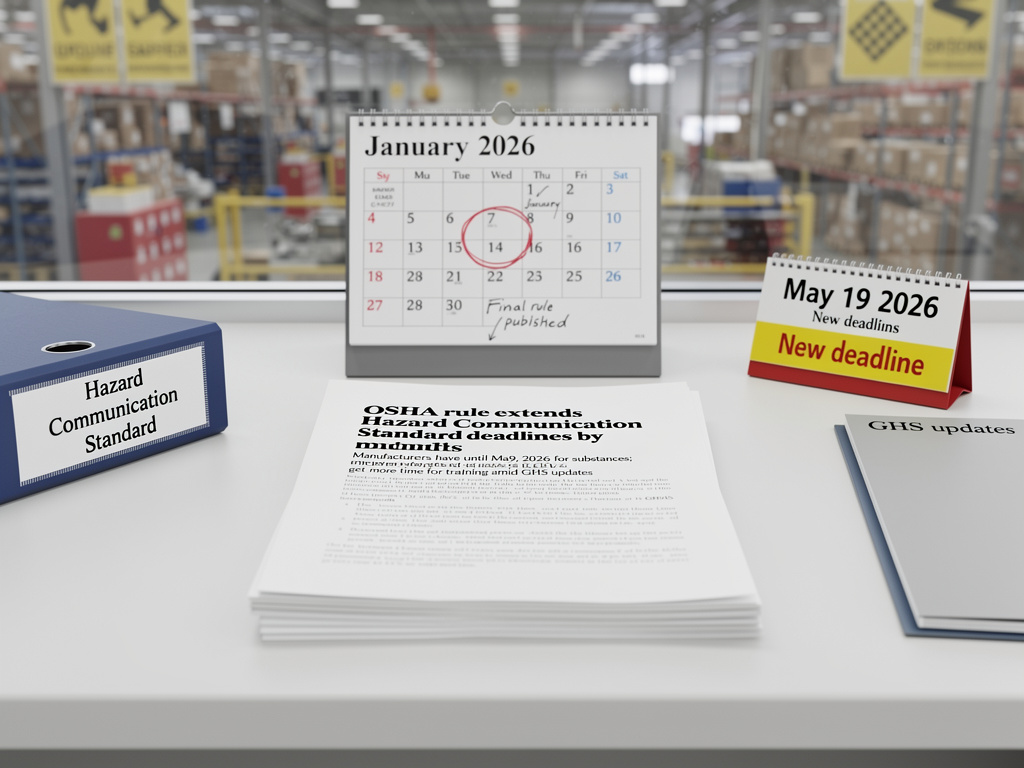
Just days before the first major compliance deadline, the U.S. Occupational Safety and Health Administration delivered a critical reprieve to chemical manufacturers, importers, distributors and employers nationwide. On January 15, 2026, OSHA published a final rule in the Federal Register extending key compliance dates under its revised Hazard Communication Standard (HCS) by four months. The move pushes the initial deadline for evaluating substances from January 19, 2026, to May 19, 2026, averting potential chaos as companies raced to update labels, safety data sheets and training programs.
This extension, effective immediately under a ‘good cause’ exemption bypassing public comment, addresses pleas from industry for more time amid unfinished agency guidance. ‘Members of the regulated community have asked for additional guidance to comply with the updated HCS,’ OSHA stated in the rule, noting it needed time to finalize documents for both regulators and businesses before the original cutoff. The tiered schedule now stretches employer updates for substances to November 20, 2026, mixtures evaluations to November 19, 2027, and final employer mixture compliance to May 19, 2028.
The HCS, codified at 29 CFR 1910.1200, has anchored workplace chemical safety since 1983, mandating hazard classification, labeling, safety data sheets (SDSs) and training. OSHA’s 2024 overhaul, published May 20 in the Federal Register, aligned it primarily with the United Nations’ GHS Revision 7, incorporating refined criteria for flammable gases, small-package labeling and trade secret disclosures to sharpen hazard communication and cut injury rates.
Roots of the Rush: GHS Alignment Imperative
OSHA’s push stems from the 2012 HCS update, which synced with GHS Rev. 3 but lagged as the UN system evolved. The 2024 rule tackles post-2012 gaps, boosting label readability for first responders, clarifying SDS sections on physical properties and toxicology, and harmonizing with Canada and other agencies. ‘This final rule will increase worker protections and reduce the incidences of chemical-related occupational illnesses and injuries,’ the agency explained on its site.
New provisions demand evaluation of hazards under ‘normal conditions of use and foreseeable emergencies,’ adding categories like desensitized explosives and chemicals under pressure. Manufacturers must now list interactive effects in SDS Section 11 and prioritize non-animal test data, easing burdens while enhancing precision. Transitional rules let firms mix 2012 and 2024 HCS elements until deadlines hit, preserving supply chains.
Industry welcomed the original phased rollout—18 months for substances, 42 for mixtures—but flagged complexities in downstream hazard classification. As Morgan Lewis noted post-extension, the changes span ‘revisions to hazard classifications, label elements, and safety data sheet content,’ urging inventories of chemicals for new classes like aerosols.
Tiered Timeline: New Deadlines Decoded
Chemical makers, importers and distributors lead: By May 19, 2026, they comply fully for substances under §1910.1200(j)(2)(i), overhauling SDSs with GHS-ordered properties—physical state before color—and pictograms for pyrophoric gases now folded into flammables. Mixtures follow by November 19, 2027. Employers then update workplace labeling (§f)(6), programs (§h)(1) and training (§h)(3) for substances by November 20, 2026, and mixtures by May 19, 2028.
OSHA invoked 5 U.S.C. 553 exceptions for speed: ‘Seeking public comment here would be impracticable, unnecessary and contrary to the public interest,’ per the rule, given the four-day proximity to January 19. Contact Tiffany DeFoe at OSHA’s Office of Chemical Hazards for technical queries, or Frank Meilinger for press.
CHEMTREC highlighted stakeholder feedback driving the shift: ‘OSHA announced a four-month extension… to digest new guidance.’ It stresses incorporating concentration ranges, small-container flexibility and targeted training on fresh hazards.
Industry Pressures: Why the Extension Happened
The scramble exposed HCS 2024’s scope: Reclassifying thousands of substances demands data reviews, supplier coordination and software tweaks. The National Law Review reported OSHA couldn’t finish guidance on ‘due diligence required to classify downstream known or reasonably anticipated hazards,’ vital for mixtures. Delays risked uneven enforcement and stockpiles of noncompliant goods.
Trade groups like SOCMA had lobbied for longer phases, citing 2012 rollout pains. X posts from CHEMTREC and Bergeson & Campbell echoed relief, with CHEMTREC warning pre-extension: ‘The clock is ticking’ for SDS updates. The reprieve sidesteps bottlenecks but signals no endless delays—guidance drops soon.
Downstream users face ripple effects: Updated supplier SDSs trigger program revisions. Morgan Lewis advises: ‘Inventory hazardous chemicals and confirm applicability of new hazard classes; coordinate with suppliers on updated SDS and labels.’
Strategic Steps: Turning Time into Compliance Wins
Firms should prioritize substance audits now, targeting high-volume items. CHEMTREC recommends: ‘Focus first on pure substances… leverage updated references.’ Revise SDS Section 9 for GHS-aligned properties, Section 11 for interactive effects, and labels with signal words, pictograms and flexible small-package formats.
Training gaps loom large—employees need sessions on new categories like flammable gases Category 1B. Morgan Lewis cautions against complacency: ‘The extension offers welcome breathing room… [but] monitor OSHA guidance materials as they are released in 2026.’
Enforcement ramps post-deadline; citations for willful violations hit $16,550 max. Global traders gain from Canada alignment, but non-U.S. suppliers must adapt. OSHA’s docket OSHA-2019-0001 tracks developments.
Beyond Deadlines: Broader Safety Horizon
The extension underscores HCS’s evolution toward precision hazard info, curbing 30,000+ annual chemical illnesses. Updates fix 2012 inconsistencies—like DOT pictogram conflicts—and bolster first-responder data via clearer labels. As CHEMTREC notes, ‘These extensions are not a grace period; they are a critical opportunity.’
State plans must match or exceed federal rules, amplifying impact. Firms integrating AI for classification eye efficiencies, but human oversight remains key for ‘foreseeable emergencies.’ Watch for 2026 guidance on nuisance particulates and combustible dusts, now defined explicitly.
OSHA’s Tiffany DeFoe leads technical support, signaling commitment. Industry insiders view this as a tactical pause in a decade-long GHS convergence, positioning U.S. workplaces for fewer incidents amid chemical volumes topping billions of pounds yearly.


 WebProNews is an iEntry Publication