
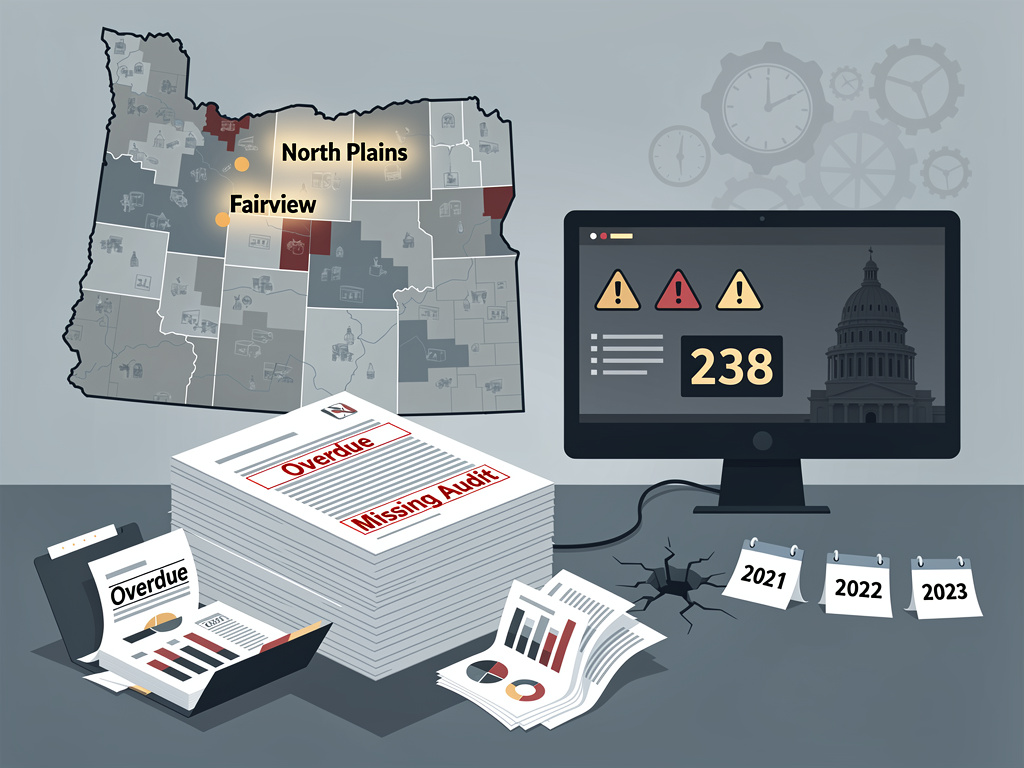
Nearly every city in Oregon must submit annual financial reports to the state under Municipal Audit Law, yet some Portland-area municipalities remain years behind, with state officials powerless to enforce compliance. In December 2025, Oregon Secretary of State Tobias Read revealed 238 delinquent entities statewide, down from 385 in May but still a stark reminder of persistent gaps in accountability. North Plains in Washington County, with its $36 million biennial budget, hasn’t filed an audit since 2021, missing fiscal years 2022 through 2024.
Fairview in east Multnomah County, managing a $43.4 million budget, skipped audits for 2023 and 2024, arriving four years behind when new City Manager Nathan George took over in December 2024. Officials blame staffing shortages, high turnover and resource strains, common hurdles for small, growing cities. “It takes a great deal of staff time and effort to source, hire and onboard replacement staff and consultants critical to audit preparation,” North Plains City Manager Bill Reid told The Oregonian/OregonLive.
Delinquency Deepens in Suburbs
North Plains attributes delays to “growing pains,” including administrative instability and past consultant changes, compounding a history marred by a 2008 embezzlement where a court supervisor stole $211,000. The city pledges to finish its 2022 audit soon and catch up by summer 2026. Fairview has completed 2021 and 2022 audits, with 2023 underway via a new finance director and external auditor. “The city of Fairview has a good City Council and mayor that are supporting a team doing the right thing,” George said to The Oregonian/OregonLive.
State law mandates reports within 180 days of fiscal year-end for transparency and management, covering cities, counties, school districts and special districts. Over two dozen entities, including Depoe Bay and Baker County, missed three straight years, per the Secretary of State’s list at sos.oregon.gov. Four charter schools, two in Sheridan, also lag.
State Power Strips Away
The Secretary of State’s office issues notices and publishes delinquents since 2017, but enforcement evaporated in 2023 when lawmakers axed penalties withholding up to 10% of state funds. Former Secretary Shemia Fagan pushed the change, arguing it didn’t boost compliance and burdened staff; lobbied by League of Oregon Cities and accountants with no opposition. “Beyond publishing the list of entities who haven’t turned over financial records, the Secretary of State has no recourse to penalize delinquent filers,” spokesperson Tess Seger stated to The Oregonian/OregonLive.
“While I’m glad to see some improvement in these numbers, too many municipalities still aren’t meeting their deadlines,” Read said. “Oregonians rely on these financial reports to keep their local governments accountable, and they have every right to expect municipalities to provide this information promptly.” Persistent issues like staffing shortages plague small entities, as noted in state audits.
Law’s Hollow Teeth
Oregon’s Municipal Audit Law requires independent audits by CPAs for larger entities or self-reports for smaller ones, filed via the Audits Division at sos.oregon.gov/audits. Extensions possible up to a year, but chronic delinquents risk only dissolution for special districts by overseers. The 2023 House Bill 2110 removed withholdings for cities and counties, shifting to Agreed-Upon Procedures reporting per sos.oregon.gov.
Beyond Portland suburbs, Baker County missed 2022-2024 audits, Baker City 2024, and irrigation districts reports, raising oversight concerns for residents, as detailed by Prism News. Statewide, delinquencies exceed historical norms despite declines, signaling deeper administrative woes in rural and small governments.
Risks Ripple Outward
Without audits, taxpayers lack visibility into spending, potentially hiding mismanagement like North Plains’ past theft. Officials cite recruitment challenges for accountants amid national shortages. The Grants Pass Tribune reported over 200 delinquents in January 2026, linking issues to turnover and limited capacity in small entities at grantspasstribune.com.
Local Budget Law under ORS Chapter 294 mandates budgets by June 30, encouraging public input, but audit gaps undermine it. No recent X posts or web updates post-January 24 indicate further action; cities claim progress, but state lists persist. Community pressure at meetings may drive fixes where Salem cannot.
Path to Accountability


 WebProNews is an iEntry Publication