
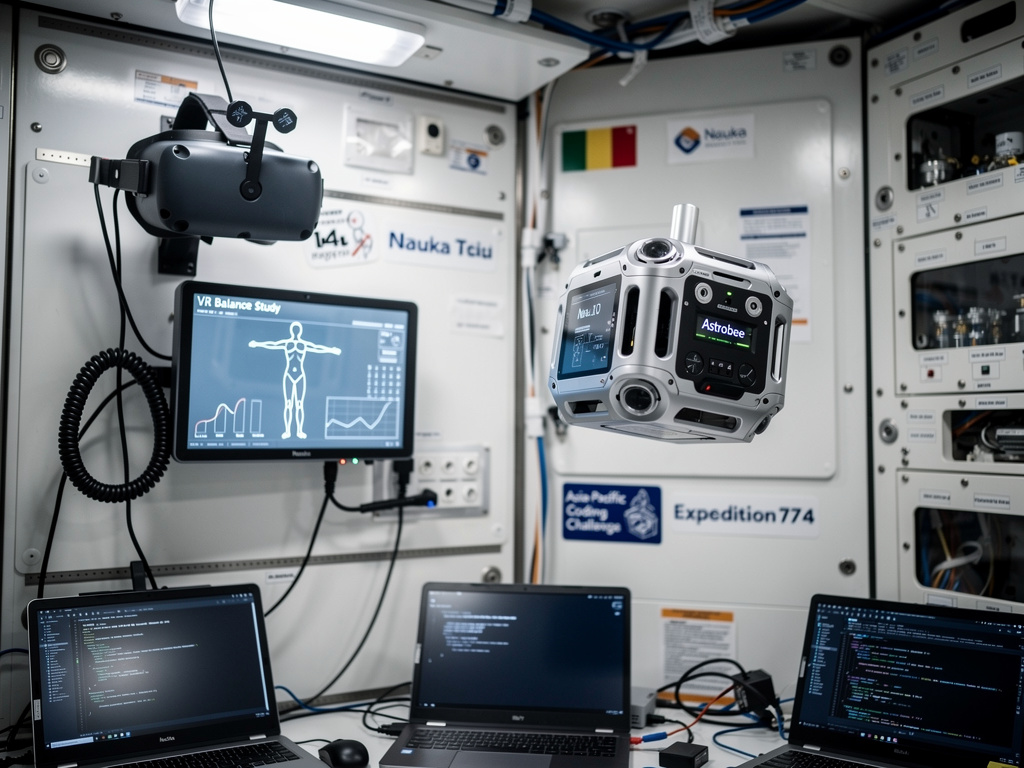
On January 27, 2026, the skeletal crew of Expedition 74 aboard the International Space Station turned to robotics and virtual reality to push the boundaries of space technology, even as they managed routine maintenance with a reduced team of three. NASA Flight Engineer Chris Williams powered up the cube-shaped Astrobee robots in the Kibo laboratory module, preparing for a student-led challenge where Asia-Pacific participants uplink code to hunt hidden objects, fostering STEM skills from afar. This event underscores NASA’s push for autonomous systems to ease astronaut workloads.
Williams, who arrived via Soyuz MS-28 in November 2025 alongside Roscosmos cosmonauts Sergey Kud-Sverchkov and Sergei Mikaev, also scoured the U.S. segment for fire suppression and emergency breathing gear issues like corrosion or leaks. The trio’s efforts highlight the station’s ongoing operations post the early January return of SpaceX Crew-11 due to a medical issue, leaving Williams and the two Russians to helm until summer, as reported by NASA.
Student Coders Take Astrobee Controls
The Astrobee challenge, part of the Kibo Robot Programming Challenge organized with JAXA, deploys the free-flying bots—named Bumble, Honey, and Queen—to navigate Kibo autonomously. Students command the toaster-sized devices via uplinked programs to locate concealed items, building on prior rehearsals where JAXA’s Kimiya Yui tested object detection, according to NASA. Astrobee, developed at NASA’s Ames Research Center, uses fan propulsion, vision-based navigation, and a perching arm for handrails, succeeding the SPHERES orbs that flew for over a decade.
These robots inventory cargo, monitor systems, and stream video, freeing crews for complex tasks. Recent AI enhancements, tested in December 2025, cut navigation planning by 50-60% in cluttered modules, as Stanford researcher Somrita Banerjee noted: “We showed that it’s 50 to 60% faster, especially in more challenging situations,” per Phys.org. The system now supports commercial payloads via Arkisys, signaling a shift to private operations.
The International Space Station’s official X account posted: “Exp 74 prepped Astrobee robotic free-flyers for a student robotics challenge and wore VR goggles to test balance and orientation in microgravity on Tuesday,” linking to NASA’s update at NASA.
VR Probes Microgravity’s Balance Toll
In the Nauka module, Kud-Sverchkov and Mikaev donned VR goggles with facial and head electrodes, reacting to cues to gauge balance and spatial adaptation in weightlessness. The Virtual experiment aims to speed acclimation for long missions and Earth re-entry, part of Expedition 74’s 40 planned studies spanning biotech to Earth observation, as Kud-Sverchkov outlined pre-flight to Izvestia.
Nauka, Russia’s multipurpose lab docked since 2021, hosts such human research amid the station’s Russian segment upgrades. Mikaev, on his first flight, swapped cargo with Progress 92 at Poisk, while Kud-Sverchkov imaged landmarks from the Swiss Alps to Kazakhstan’s Lake Balkhash via Zvezda windows. Their Soyuz ride was a NASA-Roscosmos rideshare, enabling Williams’ eight-month stay despite Crew-11’s exit, detailed by Space.com.
Earlier Virtual sessions during Expedition 74 confirmed its focus on vestibular responses, with cosmonauts alternating goggles for data collection, as noted by Primetimer.
Astrobee’s Evolution from Lab Toy to Mission Ally
Launched in 2018, Astrobees have logged feats like anomaly detection and gecko-inspired adhesion tests. The Kibo-RPC, now in its sixth year under APRSAF’s Kibo-ABC, drew over 2,760 Asia-Pacific students in 2024, with winners running code live on ISS, per NASA technical reports. Philippine teams joined preliminaries to code Astrobee paths in simulations before Kibo finals, via Philippine Space Agency.
Astrobee’s ROS-based software handles localization, docking, and human-robot interfaces via lights and sounds. Ground teams at Johnson Space Center commanded 18 trajectories in AI trials, proving “crew-minimal” ops, as Space.com reported: “This is the first time AI has been used to help control a robot on the ISS.”
With Expedition 74’s lean roster post-Crew-11 splashdown on January 15—leaving Williams solo on U.S. experiments initially—these tools gain urgency. Kud-Sverchkov assumed command January 12, per Primetimer.
Lean Crew, Heavy Research Load
Progress 92 unloads sustain the station amid solar array preps from January spacewalks. Williams’ safety checks ensure habitability, vital with reduced hands. VR data could refine training for Artemis and beyond, countering microgravity’s disorientation that persists months post-flight.
The January 27 activities blend education, autonomy, and physiology, proving ISS resilience. As NASA eyes commercial transitions, Astrobee exemplifies scalable tech for uncrewed outposts like Gateway, where robots maintain solo.
X user @XF7Space added: “Astrobee is such a cool classroom in orbit. Nerdy bonus: in microgravity, astronauts still have inertia, so they keep drifting until they push against a wall, a handrail, or use a fan based thruster system.”


 WebProNews is an iEntry Publication