
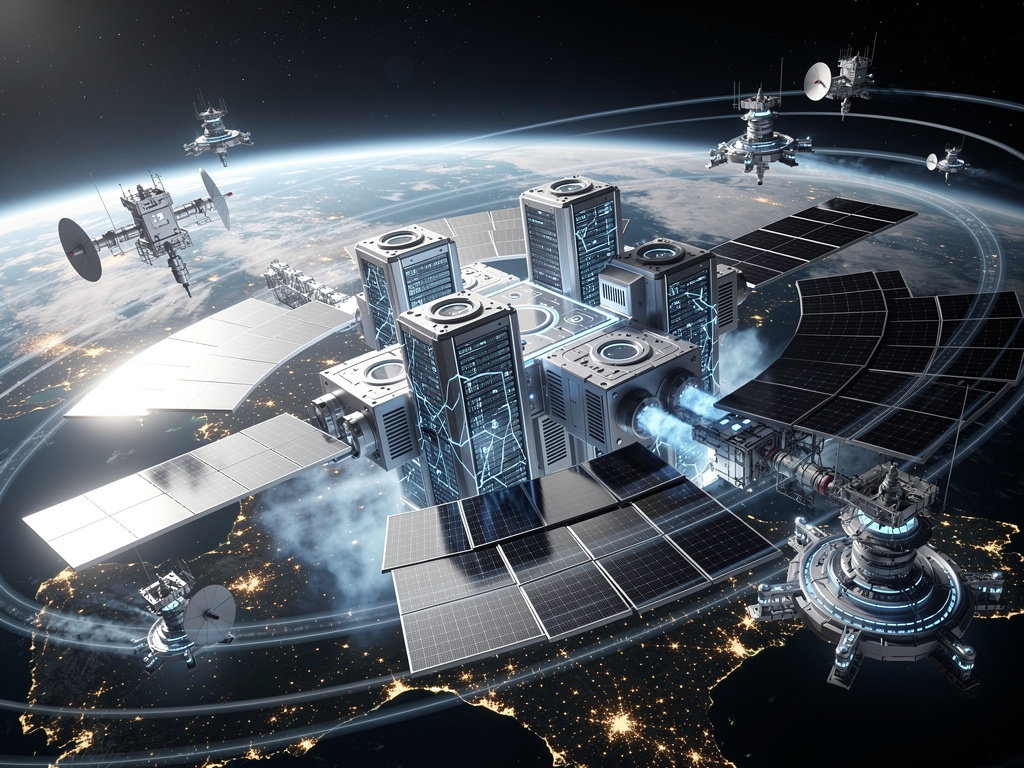
Tech titans are pushing the boundaries of computing beyond Earth, racing to deploy data centers in orbit amid surging artificial intelligence demands. Elon Musk’s SpaceX and Jeff Bezos’s Blue Origin are developing orbital infrastructure to host AI workloads, leveraging space’s endless solar power and vacuum cooling. This emerging competition, fueled by terrestrial energy constraints, could redefine the $1 trillion data center industry.
Wall Street Journal reports that Blue Origin has assembled a team working for over a year on technology for orbital AI data centers, while SpaceX has pitched similar plans during share sales (WSJ). Nvidia-backed startup Starcloud has already trained the first large language model in space aboard its Starcloud-1 satellite using Google’s Gemma model, marking a historic milestone (CNBC).
Google is also exploring space-based facilities, with concepts like the Sunseeker solar array to power massive orbital servers. These initiatives address Earth’s grid strains, where AI training now consumes energy equivalent to small nations.
The Power Crunch Driving Orbital Ambitions
Data centers worldwide guzzle electricity, with AI accelerating the trend. Projections show U.S. data center power demand doubling to 35 gigawatts by 2030, clashing with decarbonization goals. Space offers a solution: constant sunlight in sun-synchronous orbits delivers near-limitless solar energy, slashing costs by up to 10 times, according to Starcloud.
Nvidia’s blog highlights Starcloud’s vision for orbital data centers using H100 GPUs, projecting reduced Earth-side energy burdens through vacuum cooling and solar arrays spanning kilometers (NVIDIA Blog). The Intercept notes space’s cold vacuum eliminates traditional cooling needs, which consume 40% of data center power on Earth (The Intercept).
Environmental scientists warn of challenges, but proponents argue orbital setups minimize planetary impact. Fox Business video features industry experts discussing how off-planet centers could alleviate terrestrial bottlenecks (Fox Business).
Starcloud’s Pioneering Leap
Starcloud, an Nvidia Inception member, launched Starcloud-1 in late 2025, training AI models in orbit for the first time. CEO claims this proves feasibility, with plans for a 5GW facility backed by a 4 square kilometer solar farm. Posts on X from Nvidia Newsroom emphasize 10x lower energy costs and sustainable scaling.
Space.com details the technical hurdles, including radiation hardening and low-latency data relay via laser links. Starcloud’s success with Gemma positions it ahead, but scaling requires reusable rockets like SpaceX’s Starship (Space.com).
CNBC reports Starcloud’s orbital training reduces latency for edge AI applications, like real-time satellite data processing. Industry insiders see this as validation for hybrid Earth-orbit architectures.
SpaceX and Blue Origin Enter the Fray
SpaceX plans to upgrade Starlink satellites with AI payloads, hosting compute directly on orbit. Musk has touted this in investor pitches, per WSJ sources. Blue Origin counters with dedicated data center modules, investing heavily in propulsion for frequent resupply.
The Verge covers backlash from astronomers concerned about light pollution from orbital megastructures, yet tech leaders press on (The Verge). Phys.org outlines the ‘space race 2.0,’ with launches eyed for 2027 (Phys.org).
New York Times notes even former Google CEO Eric Schmidt backs space data centers, warning Earth resources may exhaust amid AI boom (The New York Times).
Engineering the Orbital Backbone
Radiation shielding, thermal management in microgravity, and gigabit laser comms are paramount. Bloomberg details enormous hurdles like component reliability over years in orbit, estimating full deployment post-2030 (Bloomberg).
Data transfer remains key: orbital centers would beam results via optical links to ground stations, achieving sub-millisecond latencies for select workloads. Northeastern experts predict early adopters in remote sensing and defense (Northeastern News).
Cost models show launch prices dropping via Starship to $100/kg, making orbital compute competitive at scale.
Regulatory and Geopolitical Hurdles
FCC spectrum allocation and ITU orbital slots pose barriers. China advances parallel efforts, per reports, sparking U.S. security concerns. DataCenter Knowledge tracks January 2026 announcements of hybrid investments hedging orbital bets (DataCenter Knowledge).
Investors eye public plays like AST SpaceMobile, integrating AI edge compute. X sentiment buzzes with excitement over Starcloud and Blue Origin prototypes.
International treaties limit militarization, but commercial orbital data centers navigate via ITAR compliance.
Investment Surge and Road Ahead
Venture funding pours in: Starcloud raised millions post its space LLM demo. CNBC details creative financing blending satellite and cloud revenues (CNBC).
By 2030, orbital capacity could hit megawatts, per industry forecasts. This shift promises resilient, green computing, transforming AI from Earth-bound to cosmic scale.


 WebProNews is an iEntry Publication