
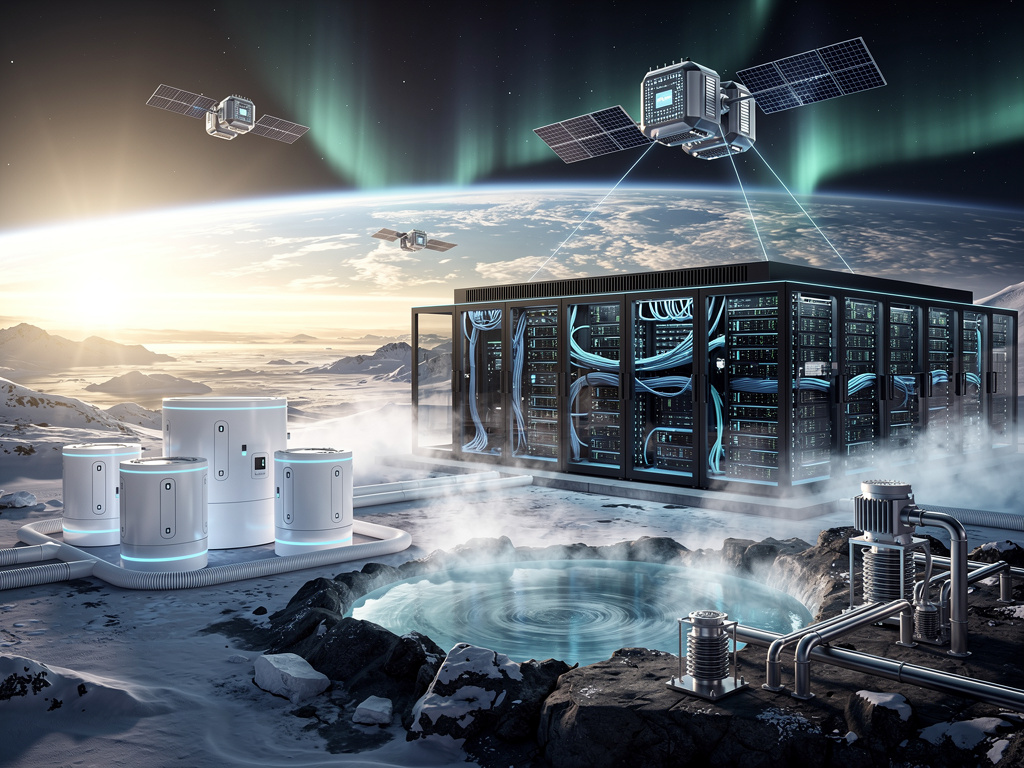
In the race to fuel artificial intelligence’s voracious appetite, data-center operators are eyeing radical escapes from terrestrial constraints. From underwater pods cooled by ocean depths to orbital platforms harnessing endless solar rays, the sector grapples with a power crisis threatening to throttle cloud computing’s expansion. Projections show global data-center electricity demand surging to 1,000 terawatt-hours by 2026, rivaling Japan’s total usage, as AI workloads multiply.
Engineers and executives, squeezed by grid bottlenecks and soaring energy costs, are pioneering unorthodox venues. Northern Virginia, the world’s largest data-center hub, exemplifies the strain: operators there consumed 25% of Dominion Energy’s output in 2024, prompting moratoriums on new connections. Across Europe, similar caps loom as hyperscalers like Microsoft and Google bid aggressively for scarce megawatts.
Terrestrial Innovations Tackle Heat and Power Woes
One audacious concept reimagines cooling: Lenovo, partnering with architecture firm AKT II and designer Mamou-Mani, unveiled a ‘data center spa’ prototype at Dubai’s Design District in November. Submerged servers in geothermal-heated pools leverage natural convection for dissipation, slashing mechanical cooling needs by up to 40%, according to Lenovo’s whitepaper. ‘We’re turning data centers into symbiotic structures with their environments,’ said Mamou-Mani in a CNBC interview (CNBC).
Elsewhere, Microsoft’s Project Natick tested fully submerged pods off Scotland’s coast from 2018 to 2024, yielding failure rates 8 times lower than land-based peers due to stable ocean temperatures. Though discontinued, it inspired Equinix’s marine explorations. On land, Greenland’s ice sheets beckon: Icebreaker One proposes facilities there powered by meltwater hydro and cooled by subzero air, targeting 50% energy savings. ‘Cold climates offer free cooling year-round,’ noted Greenland Ventures CEO Kasper Jensen.
Finland’s Arctic outposts already host Green Mountain’s bunkers, carved into mountainsides with ambient temperatures below 5°C, enabling direct air cooling. These sites draw renewable hydro from nearby rivers, achieving power-usage effectiveness ratios under 1.1—far below the global average of 1.5.
Hyperscalers Bet Big on Extreme Locales
Amazon Web Services eyes Swedish fjords for wind and hydro bounty, while Oracle scouts Iceland’s volcanic geothermal fields. A TechCrunch year-in-review pegs data centers as 2025’s breakout story, with investments topping $200 billion amid AI fervor (TechCrunch). Yet terrestrial limits persist: U.S. grid upgrades lag, with the DOE forecasting a 160% demand spike by 2030.
Direct power-plant hookups emerge as stopgaps. The U.S. Energy Department greenlit deals allowing centers to tap plants before grid transmission, bypassing congested lines. Virginia’s boom underscores stakes: 5,000 megawatts online, another 5,000 queued, per the Northern Virginia Technology Council. ‘We’re at a tipping point,’ warned state Sen. Suhas Subramanyam amid legislative battles over energy costs (The Hill).
Innovators push modular nuclear as salvation. Oklo’s small reactors, backed by OpenAI’s Sam Altman, aim for 15-megawatt deployments by 2027. Microsoft signed the first such pact in October 2024, targeting 837 megawatts across U.S. sites.
Lift-Off: Space Emerges as Ultimate Frontier
The boldest pivot orbits Earth. Starcloud launched an NVIDIA H100-equipped satellite in November, training its first AI model aloft and claiming 10x cheaper energy via vacuum cooling and perpetual sunlight (NVIDIA Blog). ‘Space-based data centers will reduce Earth energy burdens dramatically,’ projected Starcloud CEO in the announcement.
Google’s Project Suncatcher, revealed six weeks ago, deploys solar-powered orbital racks linked by laser comms, promising 95% cost cuts on power. Posts on X buzz with excitement: users highlight 24/7 solar without atmospheric interference. Scientific American warns of space debris risks but concedes unlimited photovoltaics could eclipse ground arrays (Scientific American).
Aetherflux’s ‘Galactic Brain’ follows, announcing four days ago scalable orbital clusters. Falling launch costs—SpaceX’s Starship targets $10/kg—make viability plausible. Analysts at Wired forecast space data centers at parity with Earth ops by mid-2030s (WIRED).
Economic and Environmental Fault Lines
Costs remain prohibitive short-term: $200/kg launch prices must halve repeatedly. Radiation shielding adds mass, hiking expenses, yet proponents tout 90% lower cooling overhead. Starcloud projects a $20 billion market by 2030. Equinix and Digital Realty scout partnerships, per industry whispers.
Regulatory hurdles loom: ITU spectrum allocation for data downlinks and FAA orbital traffic rules. Europe’s Space Resources Strategy eyes sovereignty in off-world computing. WIRED details the ‘billion-dollar footprint’ expanding globally, with AI arms races fueling $500 billion in 2025 capex.
Back on Earth, spas and satellites signal a paradigm shift. Operators blend renewables, immersion cooling and extraterrestrial compute to sustain cloud’s ascent amid the crunch.


 WebProNews is an iEntry Publication