
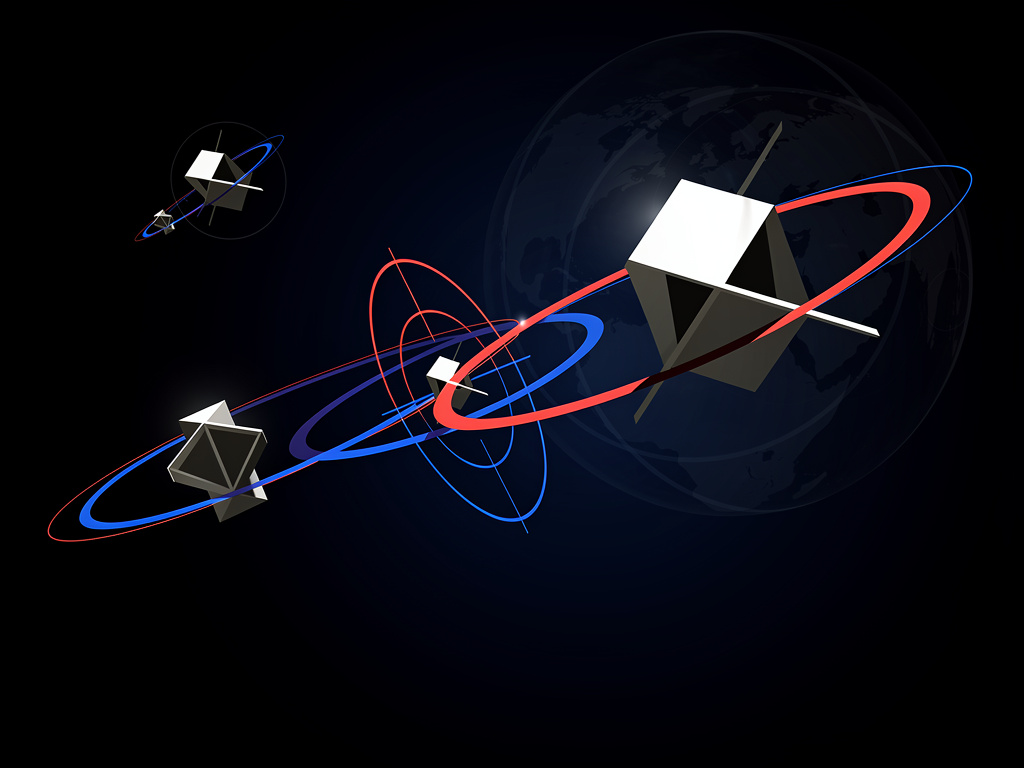
The idea sounds like science fiction. Satellites designed not to observe, communicate, or relay data — but to fight. To maneuver aggressively in orbit, engage adversary spacecraft, and accept the possibility of being destroyed in the process. Yet this is precisely what a growing corner of the American defense-industrial base is now engineering, and the Pentagon is writing the checks.
True Anomaly, a Colorado Springs–based startup founded in 2022 by a pair of Air Force veterans, has emerged as one of the most visible players in what the U.S. military calls “space domain awareness” and, more provocatively, counterspace operations. The company builds satellites explicitly designed for high-tempo orbital engagement — maneuverable spacecraft that can track, approach, inspect, and potentially neutralize threats in orbit. As Ars Technica reported, True Anomaly’s vision isn’t defensive in the passive sense. It’s about building a fleet of relatively inexpensive, expendable spacecraft that can be produced at scale and operated with the kind of tactical tempo more associated with fighter jets than satellites.
That’s a radical departure from how the U.S. has traditionally thought about military space.
For decades, American space assets were designed as exquisite, irreplaceable systems. A single satellite might cost billions, take a decade to develop, and be expected to operate for 15 years or more. The architecture assumed sanctuary — the notion that space was a domain where the U.S. could operate without serious interference. That assumption is now dead. China’s 2007 anti-satellite missile test, Russia’s 2021 destruction of one of its own defunct satellites with a direct-ascent weapon, and both nations’ development of co-orbital inspection and disruption capabilities have made clear that American satellites are targets. The Pentagon’s response has been to diversify, proliferate, and — increasingly — arm.
True Anomaly’s co-founders, Even Rogers and Danil Lunin, both served in the Air Force and came away convinced the military’s approach to space was dangerously slow. Rogers has spoken publicly about the need for a “warfighting mentality” in orbit. The company’s flagship product line, the Jackal autonomous orbital vehicle, is designed to be manufactured quickly, launched in batches, and operated with software-defined mission flexibility. A Jackal can be tasked to surveil a suspicious object in geosynchronous orbit one week and repositioned to shadow a different threat the next. The spacecraft are built to maneuver — repeatedly and aggressively — which distinguishes them from the vast majority of satellites that conserve fuel and minimize orbital changes.
Think of it this way. Most satellites are cargo ships. True Anomaly is building patrol boats.
The company has attracted significant backing. It raised $100 million in a Series B round in 2024, with investors including Riot Ventures and Eclipse Ventures, according to reporting from Ars Technica. The U.S. Space Force has awarded True Anomaly contracts for space domain awareness missions, and the company has been integrating its Mosaic software platform — a command-and-control system for managing orbital operations — into military exercises. In 2023, the company launched two Jackal prototypes aboard a SpaceX rideshare mission, conducting proximity operations demonstrations in low Earth orbit.
But True Anomaly is not operating in a vacuum. Not even close.
The broader push toward what defense planners call “proliferated warfighter space architecture” is reshaping how the Pentagon buys and operates satellites. The Space Development Agency, now folded into the Space Force’s acquisition arm, has been deploying tranches of small satellites in low Earth orbit for missile tracking and data transport. Lockheed Martin, Northrop Grumman, and L3Harris are all competing for counterspace and space domain awareness contracts. And startups like Impulse Space and Atomos are developing orbital transfer vehicles and servicing spacecraft that share technical DNA with the maneuverable platforms True Anomaly is building, even if their stated purposes differ.
The technical challenges are substantial. Maneuvering in orbit consumes propellant, and propellant is mass, and mass costs money to launch. True Anomaly has invested in efficient electric propulsion systems, but the physics impose hard limits. A satellite that maneuvers constantly will exhaust its fuel supply far faster than a conventional asset parked in a stable orbit. This is partly why the company embraces the concept of expendability — if individual Jackals are cheap enough and can be replenished quickly enough, losing one becomes tactically acceptable rather than strategically catastrophic. It’s the same logic that underpins the Air Force’s interest in collaborative combat aircraft, the autonomous drone wingmen being developed for atmospheric operations by companies like Anduril and General Atomics.
The parallel is deliberate. True Anomaly’s leadership has explicitly drawn the analogy between their orbital vehicles and unmanned combat aircraft. The Jackal is designed to operate autonomously or semi-autonomously, making real-time decisions about trajectory adjustments and sensor tasking without waiting for ground-controller input. Latency is the enemy. A signal from a ground station to a satellite in geosynchronous orbit takes roughly a quarter of a second each way — an eternity in a close-approach scenario where relative velocities can be measured in kilometers per second. Onboard autonomy isn’t a luxury. It’s a requirement.
This raises questions that extend well beyond engineering.
The legal and diplomatic frameworks governing military operations in space remain thin. The 1967 Outer Space Treaty prohibits placing nuclear weapons or other weapons of mass destruction in orbit, but it says nothing about conventional weapons or kinetic-kill vehicles. The treaty’s language about “peaceful purposes” has been interpreted by major spacefaring nations to permit military activities short of aggression — reconnaissance, communications, navigation. Whether a satellite designed to physically approach and potentially disable another nation’s spacecraft crosses that line is a matter of active and unresolved debate among international lawyers, diplomats, and defense officials.
The U.S. government has been deliberately vague about the specific capabilities it wants from counterspace programs. Official language tends to emphasize “space domain awareness” — knowing what’s up there — and “defensive counterspace” — protecting American assets. But the line between inspecting a foreign satellite and interfering with one is operationally blurry. A spacecraft capable of maneuvering close to an adversary’s asset for observation is, by definition, also capable of maneuvering close enough to disrupt or destroy it. The dual-use nature of these technologies makes arms control in space extraordinarily difficult.
China, for its part, has been developing its own co-orbital capabilities at an aggressive pace. The Shijian series of satellites has conducted multiple proximity operations and robotic-arm demonstrations in orbit, activities that U.S. Space Command has publicly flagged as concerning. Russia has deployed what Western analysts describe as inspector satellites capable of shadowing American intelligence assets. The competitive dynamic is real and accelerating.
So where does this leave the industry?
The commercial space sector is increasingly entangled with national security in ways that would have been unimaginable a decade ago. SpaceX’s Starshield program provides dedicated military satellite services. Amazon’s Project Kuiper has defense applications. And a constellation of smaller companies — True Anomaly, Slingshot Aerospace, Kayhan Space, ExoAnalytic Solutions — are building the software and hardware that will define how the U.S. military operates in orbit for the next generation. The Space Force’s budget request for fiscal year 2026 includes significant increases for space domain awareness and counterspace research, reflecting a bureaucratic consensus that space superiority can no longer be taken for granted.
True Anomaly’s approach carries risks beyond the technical. Building satellites designed for combat implies a willingness to fight in space, and fighting in space generates debris. A lot of debris. The 2007 Chinese ASAT test created more than 3,000 trackable fragments, many of which remain in orbit nearly two decades later, posing collision risks to every spacecraft in their altitude band. A conflict involving multiple kinetic engagements in orbit could trigger a cascading chain of collisions — the Kessler Syndrome — rendering entire orbital regimes unusable for generations. The company and its Pentagon backers are aware of this concern, and True Anomaly has emphasized non-kinetic approaches to counterspace operations, including electronic warfare and dazzling capabilities. But the physical reality of a maneuverable spacecraft closing on a target at high speed is hard to characterize as anything other than potentially kinetic.
The manufacturing question is equally critical. True Anomaly has stated its ambition to produce Jackal vehicles at a rate and cost that supports a proliferated architecture — dozens or eventually hundreds of spacecraft, refreshed regularly as older units exhaust their propellant or are attrited. Achieving that requires a production model closer to automotive manufacturing than traditional aerospace. The company has been building out its factory in Colorado Springs, investing in standardized components and modular assembly processes. Whether it can actually hit the cost and schedule targets necessary to make expendable combat satellites economically viable remains to be proven at scale.
And then there’s the software. True Anomaly’s Mosaic platform is arguably as important as the hardware. It provides operators with a common picture of the space domain and enables tasking of multiple vehicles simultaneously. The system incorporates machine learning for object identification and trajectory prediction, capabilities that become essential when tracking hundreds of objects in a congested orbital environment. The Space Force has been evaluating Mosaic alongside competing software platforms from other vendors, and the competition for the military’s space command-and-control architecture is fierce.
Rogers has been candid about the company’s philosophy. In public appearances, he’s described the current moment as analogous to the early days of military aviation — a period when the technology existed but doctrine, organization, and industrial capacity hadn’t caught up. The comparison is apt in some ways and strained in others. Early military aviation benefited from the existence of a large commercial aircraft industry that could be mobilized for wartime production. The commercial space industry is booming, but its products — communication satellites, Earth observation platforms, launch vehicles — don’t translate directly to combat spacecraft. True Anomaly is building something that doesn’t have a clear commercial analog, which means the Pentagon is essentially its only customer for the Jackal’s core mission set.
That single-customer dependency is a vulnerability. Defense budgets are subject to political cycles, shifting priorities, and continuing resolutions that delay new programs. True Anomaly has hedged somewhat by marketing its space domain awareness capabilities to allied nations and commercial satellite operators who want to know what’s happening near their assets. But the high-tempo engagement mission — the dogfighting — is a military-only proposition.
The strategic logic, however, is hard to argue with. The U.S. military depends on space for everything from GPS-guided munitions to secure communications to missile warning. An adversary that could degrade or destroy those capabilities in the opening hours of a conflict would gain an enormous advantage. Deterrence requires the ability to defend those assets and, if necessary, to hold adversary space systems at risk. True Anomaly and companies like it are building the tools for that deterrence. Whether those tools will ever be used in anger is a question no one can answer. But the Pentagon is clearly betting that having them is better than not.
The next few years will be telling. True Anomaly is expected to launch additional Jackal vehicles and conduct more complex on-orbit demonstrations. The Space Force is moving toward operational deployment of proliferated satellite constellations. And the geopolitical competition that’s driving all of this — the triangular rivalry among the U.S., China, and Russia for military advantage in orbit — shows no signs of abating. Space, the old saying goes, is the ultimate high ground. The fight for it is no longer theoretical.


 WebProNews is an iEntry Publication