
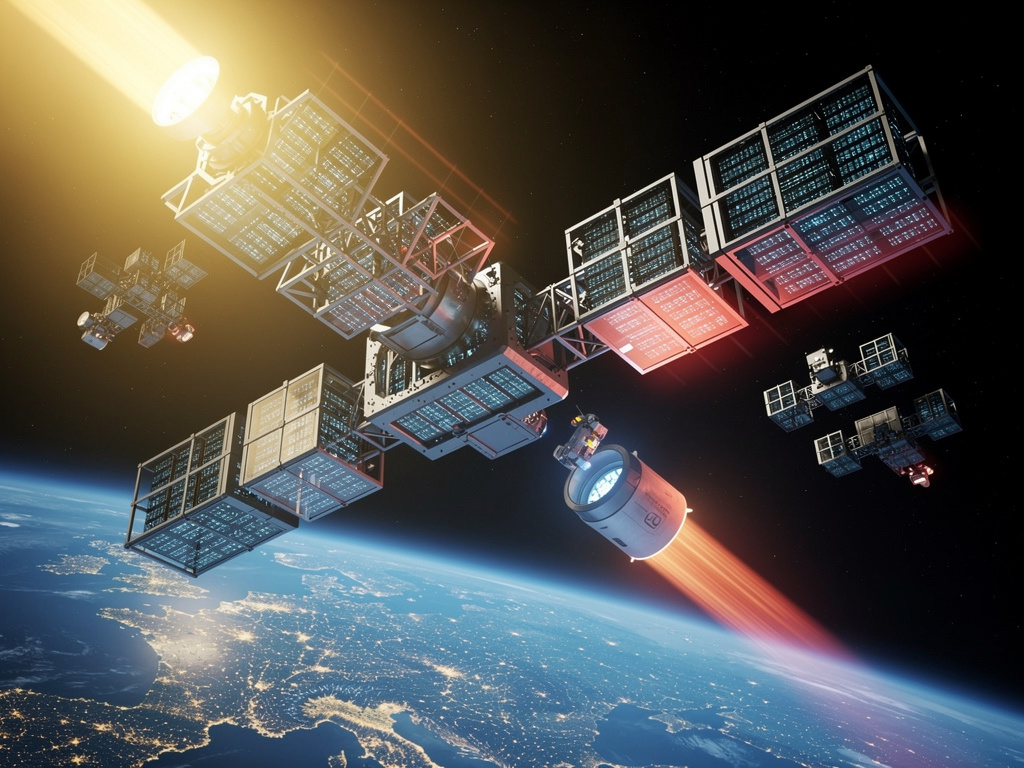
Earth’s data centers guzzle power. They spew heat. And they’re running out of room. So tech titans eye the sky. SpaceX wants up to a million satellites humming as orbital processors. Elon Musk calls it the cheapest AI compute in 36 months. Others follow suit. The push gained steam this year as AI demand strains grids worldwide.
Launch costs plunged. SpaceX’s Falcon Heavy hauls payloads at $1,500 per kilogram, down from $5,400 for Saturn V rockets, per The Motley Fool. Rocket Lab’s Neutron rocket eyes 13,000 kilograms to orbit after 85 Electron flights. Constant solar power in space trumps terrestrial blackouts. Cold vacuum aids cooling—no massive fans needed. AST SpaceMobile proves satellite-to-phone broadband works.
But. Musk merged SpaceX with xAI in February, filing for that million-satellite fleet at 500-2,000 kilometers altitude. It could yield 100 gigawatts of AI capacity yearly, the filing states. President Gwynne Shotwell hedges: maybe not a full million. Still, renderings show beasts longer than the International Space Station, with sprawling solar arrays, as PCMag reports.
Competition heats up. Orbital set a test mission for low-Earth orbit AI centers using solar and radiative cooling, per Yahoo Finance. Lonestar Data Holdings pushes orbital storage; its CEO Steve Eisele calls it a resilient cloud layer. Sophia Space aims for native orbital computing, CEO Rob deMillo told Space Symposium attendees, via Satellite Today.
Starcloud, YC alum once Starcloud, flew an Nvidia H100 in November 2025. It raised $170 million at $1.1 billion valuation, planning multi-GW scale by 2030, TechCrunch notes. Kepler Communications commissioned Nvidia-powered nodes across its constellation in March, shifting to in-situ AI processing, according to SatNews. Axiom Space launched initial nodes in January.
Big Tech joins. Google’s Project Suncatcher targets 81-satellite tests in 2027, CEO Sundar Pichai deeming space data centers the new normal next decade, Fortune says. Blue Origin eyes gigawatt-scale by 2040s. Jeff Bezos backs the premise alongside Musk.
Advantages stack. No land fights. Unlimited sun. Radiation cooling dumps heat efficiently. Global low-latency via laser links—Google demoed 1.6 Tbps. Atomic-6’s ODC.space marketplace lets firms book capacity in 2-3 years, faster than ground builds, Hypepotamus details.
Hurdles loom large. Replicating a 100-megawatt center needs solar arrays 500-1,000 times the ISS’s, NPR warns. No convection in vacuum; infrared radiation only for cooling. Microsoft’s scrapped undersea project echoes risks like maintenance woes, Analysys Mason’s Claude Rousseau tells U.S. News. Astronomers fret: a million bright satellites could streak night skies, ruining observations, Space.com reports.
Power stays key variable. McKinsey pegs $6.7 trillion data center spend by 2030; orbit misses grid strains but demands massive upfront launches, SpaceNews argues. Introl counts eight players live in February, three with orbiting hardware.
Investors watch. SpaceX IPO rumors swirl at $1.5-1.75 trillion valuations, proceeds for orbit builds, TechCrunch debates. Rocket Lab stock cruised on Neutron hype. But skeptics point to physics: space servers fail without convection, as network engineer David Bombal demonstrates.
And yet. Prototypes fly. Funding flows. AI’s thirst pushes boundaries. Orbital compute won’t replace Earth farms soon. It complements. A layer for edge AI, secure storage, remote crunching. mu Space tested ODC-1 in 2020; Voyager runs Space Edge on ISS with IBM.
Short term: tests ramp. Orbital’s trial. Kepler’s cluster. Long term: if costs drop below $1,000 per kilogram—Musk’s goal—space scales. Billionaires bet big. Scientists caution. The race orbits on.


 WebProNews is an iEntry Publication