
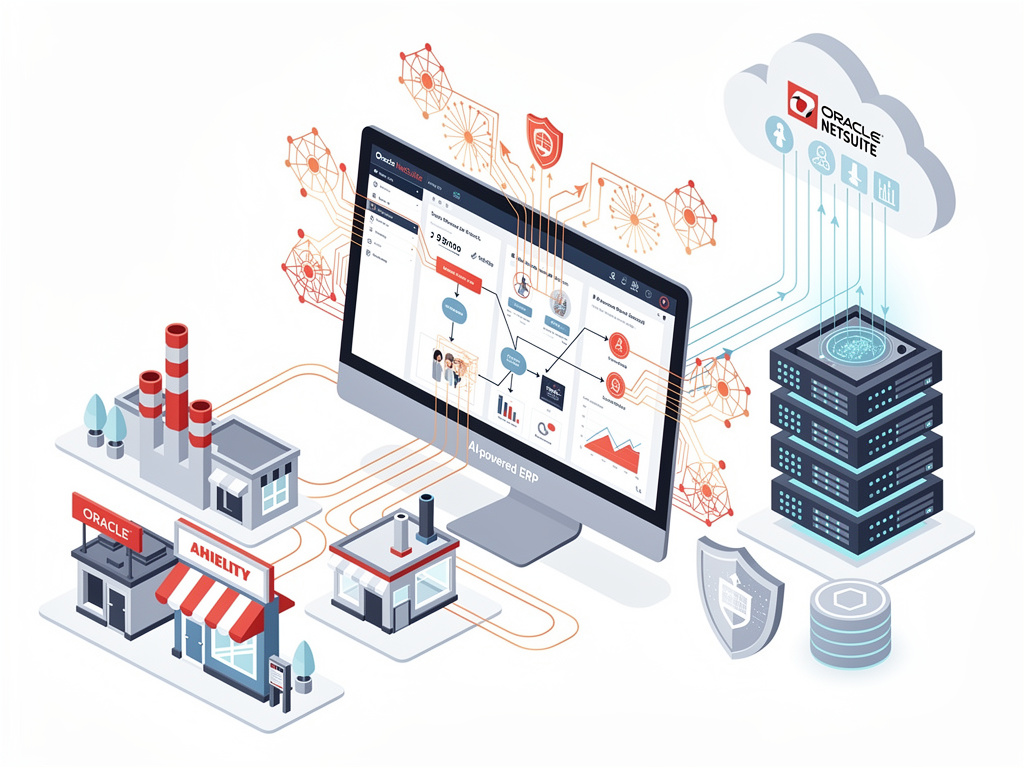
While the technology world fixates on generative AI startups commanding eye-watering valuations and mega-cap companies racing to pour billions into GPU infrastructure, Oracle’s NetSuite division is charting a decidedly different course. Under the steady hand of founder and EVP Evan Goldberg, NetSuite is building an AI strategy that prioritizes practical utility for small and mid-sized businesses over investor-friendly spectacle — a calculated bet that substance will ultimately outpace sizzle in the enterprise software market.
The approach stands in stark contrast to the prevailing mood on Wall Street, where AI has become the magic word that can send stock prices soaring or cratering depending on whether a company’s earnings call includes enough references to large language models. NetSuite’s position is that AI should be embedded, contextual, and genuinely useful — not bolted on as a marketing exercise. It’s a philosophy that Goldberg has been refining for years, and one that is now manifesting in a wave of new product announcements that deserve closer examination.
Goldberg’s Counter-Narrative to the AI Investment Frenzy
In a detailed conversation with diginomica, Goldberg laid out his thinking on why NetSuite’s AI strategy deliberately avoids the breathless hype cycle that has consumed much of the technology sector. His argument is nuanced but ultimately straightforward: the companies that will win with AI in the enterprise are those that understand the specific workflows and pain points of their customers, not those that simply layer a chatbot on top of existing software and call it innovation.
Goldberg has been at this for decades. He founded NetSuite in 1998 — the same year Larry Ellison, Oracle’s co-founder and his longtime collaborator, helped back the venture. The company was a cloud ERP pioneer long before “cloud” became a ubiquitous buzzword. That history gives Goldberg a particular vantage point on technology hype cycles. He has watched trends come and go, and his instinct is to focus on what actually moves the needle for NetSuite’s core constituency: the small and mid-sized businesses that rely on the platform to run their operations.
Where SMBs Actually Stand with Artificial Intelligence
The question of where small and mid-sized businesses go from here with AI is not merely academic. These companies represent the backbone of the global economy, yet they are often underserved by the AI conversation, which tends to center on the needs and budgets of Fortune 500 enterprises. NetSuite’s answer, as reported by diginomica, is to meet these businesses where they are — with AI capabilities that are embedded directly into the ERP workflows they already use, reducing the need for specialized technical talent or expensive implementation projects.
This is a critical distinction. Large enterprises can afford to hire teams of data scientists, build custom models, and experiment with cutting-edge AI architectures. A 200-person manufacturing company or a growing e-commerce brand operating on NetSuite cannot. For these businesses, AI needs to arrive pre-configured, contextually aware, and immediately useful. It needs to reduce the time a controller spends on month-end close, help a supply chain manager anticipate disruptions, or enable a sales team to prioritize leads without requiring anyone to write a prompt or understand how a transformer model works.
NetSuite’s Fresh AI Product Announcements Unpacked
NetSuite has rolled out a substantial slate of AI-powered features that reflect this embedded philosophy. The announcements span multiple functional areas, including financial management, procurement, supply chain operations, and customer relationship management. What ties them together is a consistent design principle: AI should operate within the natural flow of work, surfacing insights and automating tasks without requiring users to switch contexts or learn new interfaces.
Among the most notable additions are AI-driven anomaly detection capabilities in financial transactions, which can flag unusual patterns that might indicate errors or fraud. There are also intelligent recommendations for purchase orders, leveraging historical data and current market conditions to suggest optimal quantities and timing. On the customer-facing side, NetSuite is deploying AI to help businesses better segment their customer bases and personalize outreach — capabilities that were previously the province of expensive, standalone marketing automation platforms.
The Oracle Factor: Infrastructure as Competitive Advantage
NetSuite’s AI ambitions do not exist in a vacuum. They are undergirded by Oracle’s massive investments in cloud infrastructure, including the Oracle Cloud Infrastructure (OCI) platform that has become an increasingly credible competitor to Amazon Web Services, Microsoft Azure, and Google Cloud. Oracle has been investing heavily in GPU capacity and AI-optimized data centers, and NetSuite benefits directly from this infrastructure buildout.
This is a significant structural advantage. While standalone SaaS companies must negotiate with hyperscalers for compute resources — often at premium prices during a period of intense demand for AI infrastructure — NetSuite can tap into Oracle’s own infrastructure stack. That means lower latency, tighter integration, and potentially better economics for the AI features that NetSuite delivers to its customers. It also means that NetSuite can leverage Oracle’s broader AI research and development efforts, including work on large language models and enterprise-specific AI capabilities, without bearing the full cost of that R&D independently.
The Practical Reality of AI Adoption in Mid-Market ERP
Goldberg’s pragmatism extends to how he thinks about AI adoption curves. As he explained to diginomica, the reality is that most SMBs are still in the early stages of understanding what AI can do for them. There is enthusiasm, certainly, but also confusion, skepticism, and legitimate concern about data privacy, accuracy, and the potential for AI-generated errors in mission-critical business processes like financial reporting or inventory management.
NetSuite’s response to these concerns is to build guardrails directly into its AI features. Rather than offering open-ended generative AI tools that could produce unpredictable outputs, the company is focusing on constrained, task-specific AI applications where the inputs and outputs are well-defined and the risk of hallucination or error is minimized. This is AI as a precision tool, not a creative engine — and for the CFO of a mid-market company who needs to trust the numbers in a quarterly report, that distinction matters enormously.
Competitive Pressures and the Broader ERP AI Race
NetSuite is hardly alone in pursuing AI-enhanced ERP. SAP has been aggressively marketing its Joule AI copilot across its product suite, while Microsoft’s Copilot integration with Dynamics 365 represents a formidable competitive threat, particularly given Microsoft’s deep relationship with OpenAI and its dominant position in workplace productivity software. Workday, Sage, and Intuit are all making their own AI plays in adjacent markets.
What differentiates NetSuite’s approach, according to Goldberg, is the depth of its domain-specific data. NetSuite has been collecting and processing transactional data from tens of thousands of businesses for over two decades. That data — encompassing financial transactions, supply chain movements, customer interactions, and operational metrics across a vast array of industries — represents a training corpus that is difficult for competitors to replicate. The company’s ability to build AI models that understand the specific patterns and anomalies of, say, a mid-market wholesale distribution business or a SaaS company scaling from $10 million to $100 million in annual recurring revenue is a genuine competitive moat.
Why the Long Game May Be the Right Game
The tension between Wall Street’s appetite for immediate AI returns and the reality of building durable, trustworthy AI capabilities in enterprise software is one of the defining dynamics of the current technology cycle. Companies that over-promise on AI risk disappointing investors when the revenue impact fails to materialize on schedule. Companies that under-invest risk being left behind as competitors capture market share with more capable products.
Goldberg appears to be threading this needle with characteristic patience. His argument, as articulated to diginomica, is essentially that NetSuite’s AI investments will compound over time. Each new feature generates data on how customers interact with AI recommendations, which in turn improves the models, which in turn drives greater adoption and more data. It is a flywheel effect that takes time to build but becomes increasingly difficult to compete against once it reaches critical mass.
For the tens of thousands of mid-market businesses that run on NetSuite, the practical implications are significant. They are getting access to AI capabilities that would have been unimaginable — or unaffordable — just a few years ago, delivered through the same platform they already use to manage their finances, supply chains, and customer relationships. Whether Wall Street rewards this approach in the near term is an open question. But for the businesses that actually use the software, the value proposition is becoming increasingly difficult to ignore.
Oracle’s next earnings report and NetSuite’s continued product roadmap will provide further signals on whether this patient, embedded approach to AI can deliver the growth that investors demand while simultaneously solving real problems for real businesses. If Goldberg’s track record is any guide — he has, after all, been building NetSuite for more than a quarter century — the smart money may be on patience winning out over spectacle.


 WebProNews is an iEntry Publication