
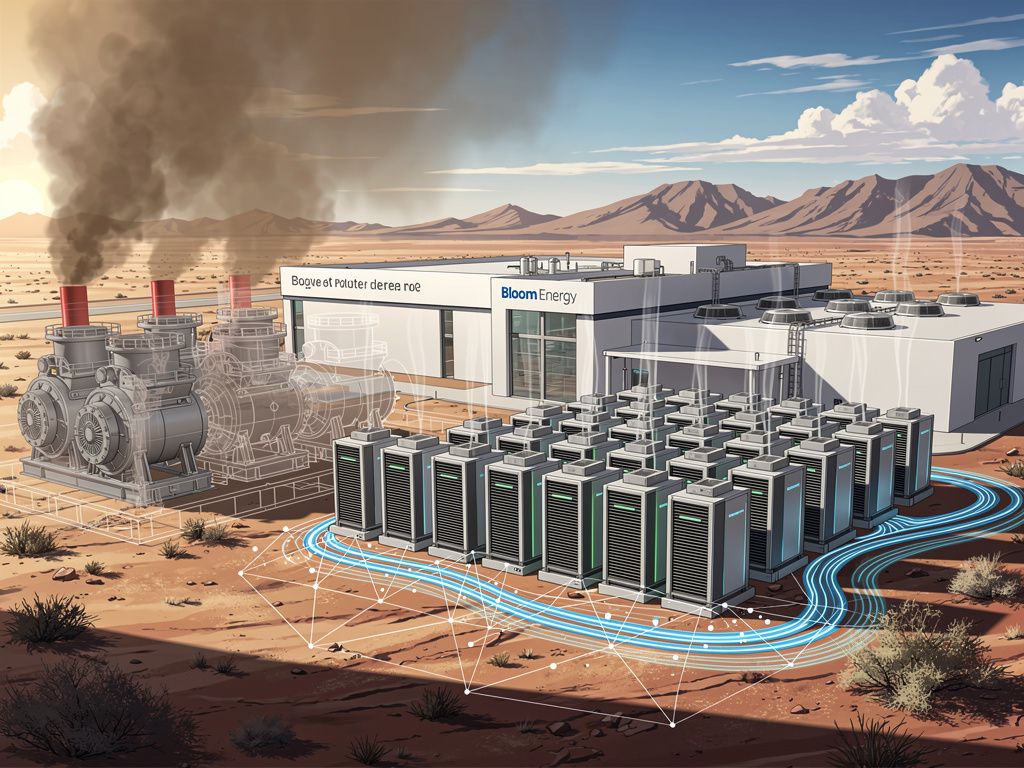
Oracle Corp. once eyed a straightforward fix for the staggering power needs of its artificial intelligence ambitions. Build on-site natural gas generation. Run the turbines hard. Deliver the compute without waiting on strained electric grids. That approach hit a wall in southern New Mexico.
From Turbines to Fuel Cells
Project Jupiter, the codename for a sprawling AI data center campus in Doña Ana County, no longer includes the gas-fired turbines and diesel backups originally planned. Instead Oracle, working with developer BorderPlex Digital Assets and Bloom Energy, will deploy up to 2.45 gigawatts of solid oxide fuel cells. The systems convert natural gas to electricity through an electrochemical process. No combustion occurs inside the cells themselves. The shift came after regulators denied permits for a new natural gas pipeline and thousands of local residents voiced concerns about air quality and water consumption. (Business Insider)
The announcement landed April 27. Construction continues on schedule. Oracle will foot the entire energy bill so residential electricity rates stay untouched. The company also pledged $360 million for local schools, infrastructure and services plus another $50 million to upgrade regional water systems. Yet the pivot raises fresh questions about how tech giants balance breakneck AI growth against community and environmental limits. And whether fuel cells truly solve the emissions puzzle or simply recast it.
Futurism first detailed the original proposal’s scale. Early estimates pegged on-site greenhouse gas emissions above 14 million tons per year. That figure exceeded the combined output of Albuquerque and Las Cruces. The fuel cell redesign cuts those emissions by roughly 30 percent to around 10 million tons annually, according to the report. Nitrogen oxide, a key smog precursor, drops far more sharply. Oracle claims a 92 percent reduction in NOₓ compared with the turbine plan. Water use falls to negligible levels. (Futurism)
Mahesh Thiagarajan, executive vice president of Oracle Cloud Infrastructure, framed the change as responsive. “We are excited to move forward with this updated energy solution, which reflects our commitment to both the latest innovation and community priorities as we advance the next generation of AI infrastructure,” he said in the official release. “Bloom’s fuel cell technology enables us to deliver highly reliable on-site power with a lower environmental footprint.” (Oracle)
Critics remain unconvinced. Kacey Hovden, staff attorney at the New Mexico Environmental Law Center, noted the company had heard objections for nearly a year before altering course. “They say they’re responding to community concerns, but these have been things that have been voiced now for almost a year. Why didn’t they do this in the beginning?” She added that the fuel cell approach, while improved, still relies on natural gas. “I don’t want to be misconstrued. This isn’t a smart choice for public health either.” The center has two ongoing lawsuits challenging the project’s approvals. A scheduled public hearing on air quality permits was canceled after Oracle withdrew its applications. (Business Insider)
The numbers tell part of the story. Two-point-four-five gigawatts rivals the output of two or three nuclear reactors. Enough, in theory, to supply more than two million average homes. Bloom Energy positions the installation as one of the largest dedicated data center microgrids in the country once complete. Aman Joshi, Bloom’s chief commercial officer, called the technology “the platform of choice for powering AI data centers responsibly.” He highlighted its quiet operation, low water draw and ability to shield local ratepayers. “This is a model that can be replicated across America,” Joshi said. (Oracle)
But replication faces real constraints. Gas turbines remain in tight supply. Grid interconnection queues stretch for years in many regions. Data center operators increasingly adopt a bring-your-own-power mindset. Oracle itself pursues similar on-site generation at two other AI campuses in Texas developed with OpenAI. Those sites stick with natural gas generation for now. The $300 billion cloud computing partnership between Oracle and OpenAI underpins much of this expansion. One Texas project alone could cost the company more than $1 billion a year in fuel. (Business Insider)
Lanham Napier, chairman of BorderPlex Digital Assets, cast the New Mexico site as an economic catalyst. “Project Jupiter started with a belief that Doña Ana County could become a Tier 1 industrial engine for New Mexico,” he explained. The project promises 4,000 construction jobs and 1,500 permanent positions. Local hiring receives priority. Closed-loop cooling systems further limit water consumption beyond the fuel cells’ own negligible needs. (Oracle)
Still, the broader pattern persists. AI training clusters devour electricity at scales once reserved for entire cities. Hyperscalers cannot wait for utilities to catch up. So they finance pipelines, turbines, fuel cells and sometimes even small modular reactors. Each choice carries trade-offs. Combustion-based generation delivers quick ramping and high reliability but produces criteria pollutants. Fuel cells run cleaner on the same fuel yet depend on that fuel’s upstream methane leaks and carbon dioxide output. Neither fully escapes the carbon equation without carbon capture or renewable offsets at massive scale.
Patrick Hughes, senior vice president of industry affairs at the National Electrical Manufacturers Association, captured the frenzy. “Everybody’s trying to build capacity to meet this demand,” he observed. He likened the AI race and accompanying power scramble to the Wild West. The pace feels unprecedented. (Business Insider)
Oracle’s retreat from the original Jupiter gas plant marks more than a single project tweak. It signals that even well-capitalized operators must bend to local politics, regulatory reality and public scrutiny. The fuel cell microgrid buys time and reduces certain harms. It does not erase the fundamental tension between exponential compute demand and finite environmental tolerance. Communities from Memphis to rural Texas voice similar alarms over noise, emissions, water draw and rising power costs. Tech executives counter with job numbers, tax revenue and promises of cleaner technology tomorrow.
Whether Bloom’s largest deployment yet sets a genuine precedent or simply buys Oracle breathing room remains unclear. The company continues to expand its partnership with Bloom toward a potential 2.8 gigawatts total. Project Jupiter itself consolidates into one microgrid campus, eliminating scattered diesel backups. That consolidation alone simplifies operations and potentially cuts costs over time. Yet the natural gas feedstock still flows. The upstream supply chain still emits. And the AI models keep scaling.
Recent coverage underscores the shift’s significance. Data Center Knowledge reported the move as a decisive turn from turbines to a fuel-cell microgrid tailored for high-density AI workloads. The Register noted the 2.45 gigawatts approximates two or three nuclear reactors, highlighting both the ambition and the engineering challenge. (Data Center Knowledge) (The Register)
Industry watchers now track whether other developers follow Oracle’s lead or double down on straight gas generation where permits allow. The answer will shape power markets, emissions trajectories and political battles over data center siting for years ahead. For now, one fact stands clear. The era of quietly plugging hyperscale AI into the existing grid has ended. Companies must build their own energy future. Sometimes they must redesign it on the fly when locals push back. Oracle just did exactly that in New Mexico.


 WebProNews is an iEntry Publication