
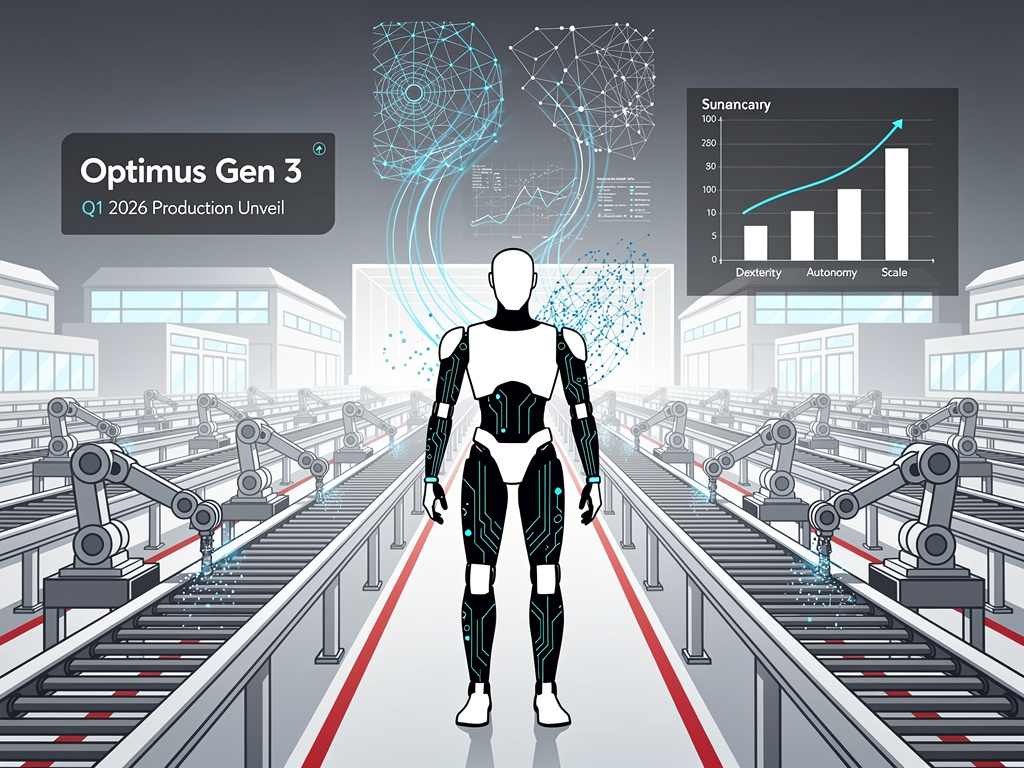
Tesla Inc. is poised to redefine manufacturing and labor markets with its Optimus humanoid robot, as CEO Elon Musk outlined aggressive timelines during the company’s Q4 2025 earnings call. The third-generation Optimus, designed for volume production, will be unveiled in the first quarter of 2026, with the initial production line starting before year-end and scaling to one million units annually at the Fremont factory. This shift includes reallocating capacity from Model S and Model X assembly, set to end in Q2 2026, to robot manufacturing.
Musk emphasized that Tesla has cracked the core challenges of humanoid robotics: dexterous hands rivaling human capability, real-world AI for autonomous operation, and scalable production. "Tesla is the only company that actually has an answer to each of them," Musk stated, claiming Optimus will surpass all competitors in capability. The Gen 3 features major upgrades from version 2.5, including a redesigned hand for precise manipulation.
Earnings Call Breakthroughs
During the January 28, 2026, earnings discussion, Tesla reported Q4 revenue of $24.90 billion, beating estimates of $24.79 billion, with adjusted EPS at $0.50 versus $0.45 expected. Optimus remains in R&D but is performing basic factory tasks like pick-and-place operations at Giga Texas, transitioning from teleoperation to vision-based autonomy with failure rates below human trainees, according to FinancialContent.
Production lines for first-generation Optimus are being installed ahead of volume ramp, with deployments of 1,000 units already at Giga Texas for logistics and kitting. Musk reiterated that Optimus could represent 80% of Tesla’s long-term value, tying into his performance-based pay package requiring one million robots built.
Investor Jason Calacanis, after viewing Gen 3 prototypes, declared on X: "Nobody will remember that Tesla ever made a car. They will only remember Optimus… It’s going to be the most transformative technology product ever made." He predicted a one-to-one human-to-Optimus ratio globally.
Factory Floor Deployments
Over 1,000 Gen 2 and Gen 3 Optimus units are now active at Giga Texas, handling delicate components autonomously. Tesla plans to scale to 100,000 units yearly by late 2026-2027 via a dedicated facility there. At Fremont, mass production of Gen 3 commenced in January 2026, targeting thousands deployed internally by year-end to cut costs and boost safety, per FinancialContent.
Early units focus on reliability over speed, performing tasks like sorting parts with high accuracy. Musk noted during the call that Gen 3 "is going to be quite capable," with public sales eyed for 2027 at $20,000-$30,000 per unit, akin to a budget car. Internal use precedes external sales to industrial partners.
Challenges persist: 2025’s 5,000-unit goal went unmet due to supply chain hurdles and engineering complexities, especially hands, which Musk called "an incredibly difficult engineering challenge." Recent departures like robotics head Milan Kovac add caution, as reported by The Verge.
Technical Leaps Forward
Optimus Gen 3 boasts a lighter frame for sustained medium-load carrying, compact electric joints with pressure sensors for stability on varied surfaces, and AI drawing from Tesla’s Full Self-Driving neural nets. Demos show independent task execution, unlike prior teleoperated videos criticized by rivals.
Tesla selected seven Chinese Tier 1 suppliers post-mass production audit, enabling 50,000-100,000 units by end-2026. Musk projects Optimus handling factory work, home assistance, and even surgery, predicting robots will outnumber humans and multiply global GDP by 10-100 times.
At Davos in January 2026, Musk said Optimus performs "simple tasks" in factories now, expanding to complex ones by year-end, with public sales by end-2027 for "very high reliability, very high safety."
Competitive Pressures Mount
Hyundai’s Boston Dynamics unveiled Electric Atlas, trialed in Georgia plants and CES 2026 award-winner. Figure AI and others vie in the $2-3 billion market, projected to $40-200 billion by 2035 per Barclays. Tesla’s edge: vertical integration, real-world AI data from vehicles, and manufacturing scale no rival matches, Musk asserts in MarketWatch.
UAW President Shawn Fain warned of job threats, calling for a "robot tax." Tesla counters with abundance vision: "AI and robots will replace all jobs… Working will be optional."
Q4 filings confirm Fremont’s pivot, with Model S/X ending to free space. Giga Texas sees pilot lines; Nevada and Houston prep for related ramps like Semi and Megapack.
Financial Stakes and Horizons
Tesla’s $44 billion cash hoard funds $2 billion xAI investment and 2026 CapEx surge for robotics infrastructure. Optimus ties to Musk’s $1 trillion package via milestones like one million units. Analysts see it driving margins via labor replacement, compounding advantages.
Public unveil likely February-March 2026, per Musk’s Q3 2025 call: "So real that you’ll need to poke it to believe it’s an actual robot." Home editions via lease-to-own eyed for late 2026-2027.
Barron’s notes Optimus still R&D-focused but converting California lines signals commitment, as in Barron’s. With deployments proving viability, Tesla positions as humanoid leader amid intensifying rivalry.


 WebProNews is an iEntry Publication