
For years, Linux users who wanted Opera’s gaming-flavored browser had exactly one option: wait. That wait is over.
Opera GX, the company’s browser tailored specifically for gamers, has officially launched on Linux — making it available across every major desktop operating system for the first time. The release, which came as a native Debian package, marks a notable expansion for a product that has carved out a surprisingly durable niche in a browser market most assumed was a two-horse race between Chrome and everything else.
As Phoronix reported, the Linux version of Opera GX is now available as an early access build, packaged as a .deb installer targeting Debian and Ubuntu-based distributions. That covers a massive portion of the Linux desktop user base, though RPM-based distributions like Fedora are not yet directly supported through official packaging. Users on those systems can likely extract and adapt the package, but it’s not a turnkey experience — a familiar friction point for Linux software distribution.
The timing isn’t accidental. Linux’s share of the desktop market, while still modest in absolute terms, has been climbing steadily. Steam’s monthly hardware surveys have consistently shown Linux gaming growing, fueled in large part by the success of Valve’s Steam Deck, which runs a custom Arch-based Linux distribution. Where gamers go, gaming-adjacent software follows.
What Opera GX Actually Brings to the Table
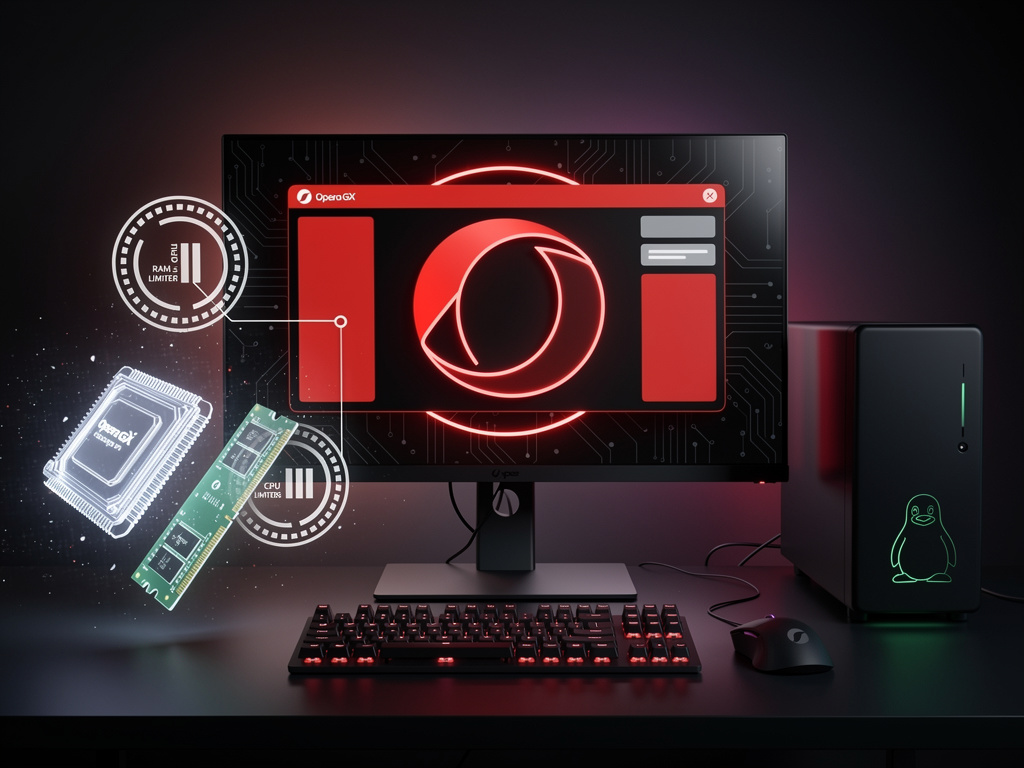
Opera GX isn’t just a skin over the standard Opera browser, though skeptics have long dismissed it as such. The browser includes CPU, RAM, and network bandwidth limiters — tools that let users throttle the browser’s resource consumption so it doesn’t compete with a running game for system resources. On a platform like Linux, where users tend to be more hands-on with system management, these controls arguably matter more than they do on Windows.
There’s also the aesthetic dimension. Opera GX ships with a customizable dark-themed interface, RGB color effects, and integration with services like Twitch and Discord. It features a “GX Corner” — a news feed focused on gaming deals, releases, and industry headlines. Whether you find this useful or garish likely depends on your tolerance for gamer branding, but the feature set has found a genuine audience. Opera reported that GX had surpassed 25 million monthly active users across platforms as of mid-2024.
The Linux build appears to carry over the full feature set from the Windows and macOS versions, according to the initial release. That’s not always a given — Linux ports of commercial software frequently ship with reduced functionality or delayed feature parity. Opera seems to have avoided that trap here, though the “early access” label suggests rough edges remain.
And there will be rough edges. Linux audio stacks, display server differences between X11 and Wayland, and distribution-specific quirks have historically made browser development on the platform a headache. Even Chromium-based browsers — which Opera GX is, running on the same Blink engine as Chrome and Edge — sometimes stumble on Linux-specific issues like hardware video acceleration and screen tearing. Opera’s track record with its standard browser on Linux has been generally solid, which bodes well, but GX’s additional features add complexity.
The competitive picture is worth examining. On Linux, the browser market is dominated by Firefox, which ships as the default on most major distributions, and various Chromium-based options including Google Chrome, Brave, and Vivaldi. None of these competitors offer the resource-limiting tools that Opera GX does. For a Linux user running games through Steam, Lutris, or native clients while keeping a browser open for guides, streams, or voice chat, the ability to cap browser resource usage is a practical differentiator — not just marketing.
But Opera itself carries baggage. The company’s ownership by a Chinese consortium led by Kunlun Tech has drawn scrutiny over the years, with privacy-conscious users — a demographic that overlaps heavily with Linux users — expressing wariness. Opera has also faced criticism for its built-in VPN service, which functions more as a proxy than a true VPN and has raised questions about data handling. These concerns won’t vanish with a Linux release, and they may be amplified given the platform’s user base tends to be more technically demanding and privacy-aware than average.
There’s also the question of whether Opera GX’s gamer-centric branding will resonate with Linux users, who often prefer minimalism and utility over flash. The browser’s neon-drenched interface stands in sharp contrast to the stripped-down aesthetic favored by many in the Linux community. Then again, the Steam Deck’s success has brought a wave of users to Linux who don’t fit the traditional mold — people who want their machines to play games first and everything else second.
So the audience is there. Whether Opera can capture it depends on execution. The early access label gives the company room to iterate based on community feedback, and Linux users tend to be vocal and detailed in their bug reporting. If Opera engages seriously with that feedback loop, GX could establish a real foothold.
For now, the .deb package is available directly from Opera’s website. No Snap, no Flatpak — just a traditional package install. A small detail, but one that will matter to the audience Opera is trying to reach. Linux users have opinions about software distribution, and Opera chose the least controversial path.
The broader significance here isn’t really about one browser on one platform. It’s about the continuing maturation of Linux as a gaming platform and the willingness of commercial software vendors to treat it as a first-class target rather than an afterthought. Opera GX on Linux won’t topple Chrome’s market dominance. That’s not the point. The point is that the competitive field is widening, and Linux users are finally getting options that used to be reserved for everyone else.


 WebProNews is an iEntry Publication