
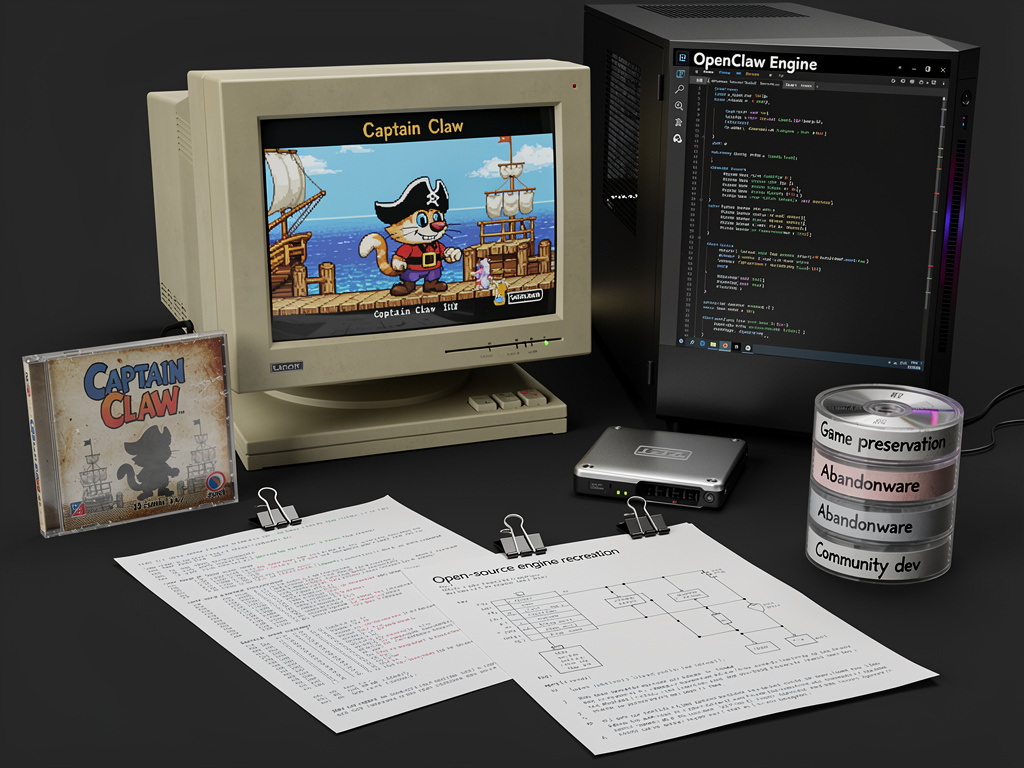
Somewhere between the nostalgia-driven remasters of classic games and the thriving open-source development community lies OpenClaw, a faithful recreation of the 1997 side-scrolling platformer Captain Claw that has quietly been gaining traction among retro gaming enthusiasts and open-source advocates alike. While major studios pour millions into reimagining old franchises, a small band of volunteer developers has been keeping alive a game that many in the industry had long forgotten — and doing so with impressive technical fidelity.
The original Captain Claw, developed by Monolith Productions and published by Cavedog Entertainment, was a 2D platformer that cast players as Captain Nathaniel Joseph Claw, an anthropomorphic cat pirate on a quest for a magical amulet. The game featured 14 levels of increasingly difficult platforming action, boss fights, and treasure collection. Despite solid reviews at the time of its release, it was overshadowed by the industry’s aggressive pivot toward 3D gaming and never achieved the commercial success of contemporaries like Rayman or Crash Bandicoot. The game’s original publisher has long since ceased operations, leaving Captain Claw in a state of commercial limbo that makes it difficult to legally acquire through modern storefronts.
An Open-Source Answer to Abandonware Frustrations
OpenClaw emerged as a response to a common problem in retro gaming: what happens when a beloved title becomes effectively unavailable? As MakeUseOf reported in its detailed review, OpenClaw is an open-source reimplementation of the Captain Claw engine, built from the ground up to run the original game’s assets on modern hardware. The project doesn’t distribute the original game files — players must supply their own — but it provides a modern engine capable of running the classic title without the compatibility headaches that plague attempts to run 1990s Windows software on contemporary operating systems.
The project is hosted on GitHub, where its source code is freely available for inspection, modification, and contribution. This transparency is a hallmark of the open-source approach and stands in contrast to the proprietary nature of most game engine recreations. According to MakeUseOf, OpenClaw supports the full original campaign, including all 14 levels, enemy AI behaviors, boss encounters, and the treasure-collecting mechanics that defined the original experience. The engine also adds quality-of-life improvements that the 1997 release lacked, including support for modern screen resolutions and more stable frame rates.
Technical Architecture and What Makes OpenClaw Work
Under the hood, OpenClaw is built using C++ and the SDL2 (Simple DirectMedia Layer) library, a well-established framework for cross-platform multimedia applications. This choice of technology means the engine can theoretically run on Windows, Linux, and macOS, though the level of support and stability varies across platforms. The use of SDL2 is a pragmatic decision — it provides hardware-accelerated 2D rendering, audio playback, and input handling without tying the project to any single operating system’s proprietary APIs.
One of the more technically interesting aspects of OpenClaw is how it handles the original game’s data files. Rather than attempting to reverse-engineer and redistribute copyrighted assets, the engine reads the original .REZ resource files that shipped with the 1997 release. This approach keeps the project on firmer legal ground while still delivering an authentic experience. Players who own original copies of Captain Claw — whether from old CD-ROMs or through other means — can point OpenClaw at these files and begin playing immediately. As MakeUseOf noted, the setup process is relatively straightforward, though it does require some comfort with file management that casual users might find mildly intimidating.
Gameplay Fidelity and the Challenge of Faithful Recreation
Recreating a game engine from scratch without access to original source code is an enormously complex undertaking. Every enemy behavior pattern, physics interaction, and level trigger must be painstakingly analyzed and reimplemented. OpenClaw’s developers have achieved a remarkable degree of accuracy in this regard. The platforming physics — always the most critical element in a side-scroller — feel consistent with the original game. Captain Claw’s jump arcs, attack animations, and movement speed all appear to match the 1997 release closely, though hardcore speedrunners and frame-counting enthusiasts may notice subtle differences in edge cases.
The game’s difficulty, which was notably punishing even by 1990s standards, remains intact. Later levels feature precise platforming sequences over bottomless pits, enemies with aggressive attack patterns, and boss fights that demand pattern recognition and quick reflexes. OpenClaw preserves this challenge without artificial difficulty spikes introduced by engine bugs or compatibility issues — problems that frequently plagued attempts to run the original executable through compatibility layers like Wine or Windows XP compatibility mode. MakeUseOf’s review highlighted that the experience feels remarkably close to the original, which is both the project’s greatest strength and a potential barrier for newcomers unfamiliar with the unforgiving design philosophy of late-1990s platformers.
The Broader Movement of Open-Source Game Engine Recreation
OpenClaw exists within a broader tradition of open-source engine reimplementations that have preserved games their original publishers abandoned. OpenMW, which recreates the engine for The Elder Scrolls III: Morrowind, is perhaps the most prominent example, but similar projects exist for titles ranging from Doom (via numerous source ports) to Star Wars Jedi Knight: Dark Forces II (via OpenJKDF2). These projects share a common philosophy: the original game’s creative content — its art, music, level design, and writing — belongs to its rights holders, but the technical means of running that content can be independently developed and freely shared.
This model has proven remarkably durable, both legally and practically. By requiring users to supply original game assets, open-source engine projects avoid the copyright infringement issues that plague ROM distribution sites and unauthorized remasters. At the same time, they provide genuine preservation value. When original executables stop functioning on modern hardware — as inevitably happens with software designed for long-obsolete operating systems — these reimplemented engines become the only viable way to experience the games as their creators intended. The Internet Archive and various digital preservation organizations have increasingly recognized the importance of such efforts, even as the legal frameworks surrounding software preservation remain frustratingly ambiguous in many jurisdictions.
Community Contributions and the Road Ahead
Like most open-source projects, OpenClaw’s development has been driven by a small core of contributors supplemented by occasional patches and bug reports from the wider community. The project’s GitHub repository shows periods of active development interspersed with quieter stretches — a common pattern for volunteer-driven software projects where contributors must balance their passion work against professional and personal obligations. Feature requests on the repository include modding support, custom level creation tools, and networked multiplayer — ambitious goals that would significantly expand the project’s scope but would also require substantial development effort.
The modding angle is particularly interesting. The original Captain Claw had a small but dedicated modding community that created custom levels and modifications, some of which are still circulated on fan forums. If OpenClaw were to implement comprehensive modding support, it could serve not just as a preservation tool but as a platform for new creative work built on the foundation of the original game. This would mirror the trajectory of projects like GZDoom, which started as a way to play classic Doom levels but evolved into a platform supporting thousands of community-created modifications and total conversions.
Why This Matters Beyond Nostalgia
It would be easy to dismiss OpenClaw as a niche curiosity — a passion project for a small audience of fans who remember a mid-tier 1990s platformer. But the project raises questions that matter to the broader gaming industry. Who is responsible for preserving games when their original publishers no longer exist? What legal frameworks should govern the recreation of abandoned software? And how should the industry think about the long-term accessibility of its creative output?
These are not abstract concerns. The Video Game History Foundation has estimated that the vast majority of games released before 2010 are no longer commercially available through any legal channel. Projects like OpenClaw represent one answer to this problem — imperfect, labor-intensive, and dependent on the goodwill of volunteer developers, but functional. For anyone who remembers Captain Claw’s adventures or who simply appreciates well-crafted 2D platforming, OpenClaw offers something increasingly rare in the modern gaming market: a way to experience a piece of history exactly as it was, running reliably on the hardware of today. The project stands as a testament to what dedicated communities can accomplish when commercial interests have moved on, and it deserves recognition far beyond the small circle of enthusiasts currently aware of its existence.


 WebProNews is an iEntry Publication