
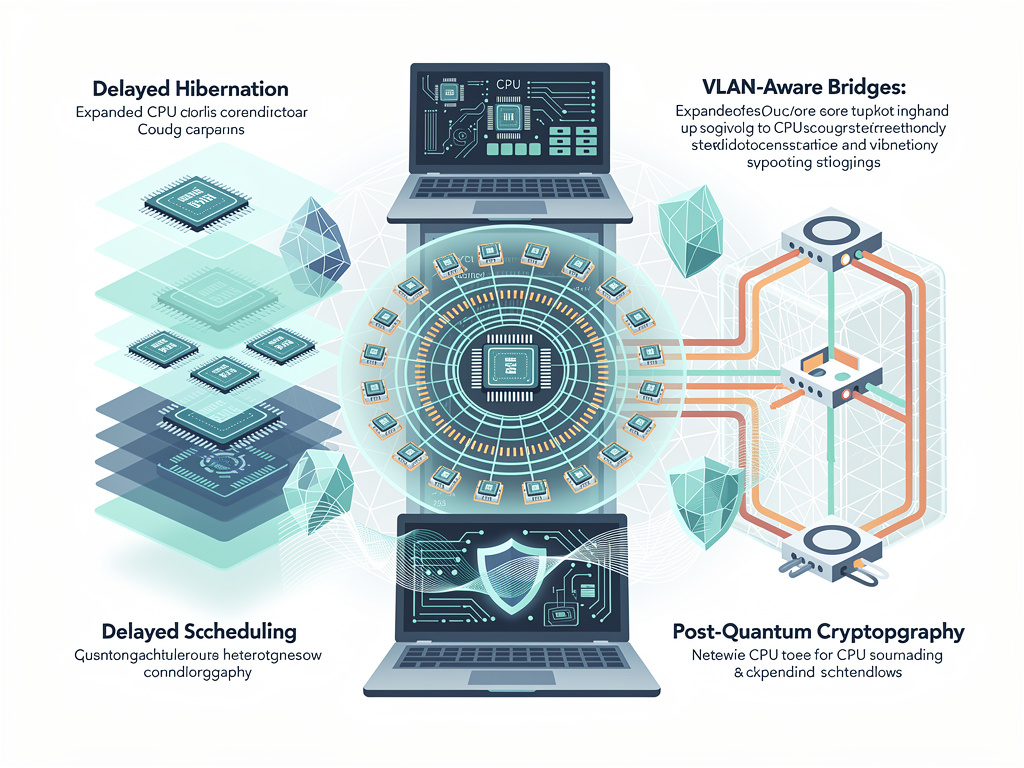
OpenBSD arrived at version 7.9 on May 19, 2026. This marks the project’s 60th release. Project lead Theo de Raadt marked the occasion just days after his own birthday. The team shipped improvements across kernel scheduling, hardware enablement, networking, and core utilities. Yet the OS retains its uncompromising focus on correctness and minimalism.
Support now stretches to 255 CPU cores on amd64 systems. The kernel handles machines with more than 512GB of RAM without the previous bug. And administrators gain fine control over heterogeneous cores through a new sysctl. But these gains come wrapped in the same ascetic approach that has defined the project for decades.
Hardware and Platform Advances Build on Proven Foundations
The release adds delayed hibernation on amd64. Laptops can wake briefly when battery levels drop critically low, then drop straight into hibernation and power off completely. This guards against the corruption risks that linger without a journaling filesystem. The Register noted how this small change addresses a practical pain point while the project avoids broader complexity. (The Register)
ARM64 platforms see new drivers for the ice(4) networking device. Rockchip RK3588 and RK3576 SoCs gain support. The Genesys Logic GL9755 SDHC controller works on certain Apple Silicon laptops via sdmmc(4). RISC-V receives extensive work on the SpacemiT K1, including drivers for smtclock(4), dwpcie(4), and extensions like Zicbom and Svpbmt. OpenBSD now runs as a guest under Apple’s hypervisor on M-series Macs.
Graphics stack updates pull from Linux 6.18.22. Sound drivers receive further low-latency tweaks. USB4 controllers gain the nhi(4) driver. AMD systems benefit from SMU integration in amdpmc(4) for deeper power states and floating-point state leakage mitigation on early Zen cores. These changes reflect years of steady driver work rather than sudden leaps.
Phoronix highlighted the jump to 255 x86_64 cores and initial WiFi 6 support. (Phoronix) Notebookcheck pointed to scheduling improvements for CPUs with varying core speeds alongside the hibernation feature. (Notebookcheck)
The official release page lists these platform additions in detail. It credits volunteer contributors for every line. (OpenBSD.org)
So the hardware story feels evolutionary. OpenBSD refuses to chase every new device. It adds support only when the code meets project standards. That caution explains both the sharp edges users encounter and the trust administrators place in production systems.
Security Hardening and Network Controls Tighten Further
LibreSSL 4.3.0 arrives with MLKEM post-quantum support, assembly optimizations, and numerous bug fixes. OpenSSH 10.3 patches critical issues including late validation of shell metacharacters in usernames and improvements to agent forwarding. The project fixed a 27-year-old TCP Selective Acknowledgement bug that an Anthropic LLM had surfaced. Developers had already patched it in 7.8.
Packet Filter gains source and state limiters. Administrators can now act when limits trigger. The veb(4) virtual Ethernet bridge becomes VLAN-aware with PVID and hybrid mode support. IPv6 SLAAC turns on by default. BPF sees XOR, MOD, and VLAN filters. These updates strengthen OpenBSD’s firewall reputation without adding bloat.
The kernel replaces CAS spinlocks with parking locks in mutexes. A new hw.blockcpu sysctl lets operators exclude SMT, performance, efficiency, or low-power cores from scheduling. Schedulers now distinguish four classes: S, P, E, L. Such controls matter on modern heterogeneous silicon from AMD, Intel, and ARM.
Installer and upgrade paths improve. Sysupgrade handles low /usr space more gracefully. The process still demands attention. No automatic partition resizing. Nine separate filesystems appear by default for security isolation. Users must plan storage manually. The Register’s hands-on test on a Lenovo ThinkPad X220 showed the text-based installer works cleanly once Ethernet provides firmware. WiFi activation followed reboot after firmware download. (The Register)
Desktop options expanded. GNOME 49, KDE Plasma 6.6, Xfce 4.20, and LXQt 2.2 sit alongside Xenocara. Yet the project never positions itself as a daily desktop competitor. Ports and packages exceed 13,000 titles. Over 13,000 prebuilt binaries await on major architectures. OSNews observed that VA-API and Widevine support reach Chromium derivatives. (OSNews)
FOSS Linux tested the scheduler, VLAN bridging, and OpenSSH 10.3 penalties in production-like conditions. The release delivers immediate isolation and performance wins for security-critical services. (FOSS Linux)
And the aesthetic continues. Artwork by Lyra Henderson. Theme song “Diamond in the Rough,” a jazz instrumental by Bob Kitella. The release page links both. Users who buy physical media support the volunteer effort and gain the tangible artifact.
Critics still point to missing features. No Bluetooth. Wireless remains secondary. Nvidia support stays absent by design. The installer feels dated to some. Partition limits and manual tuning deter newcomers. These choices form the rough edges. They also produce an OS that survives audits and powers infrastructure where compromise carries heavy cost.
Recent discussions on X reflect steady adoption. Package builds completed for riscv64 and macppc shortly after launch. Live variants like FuguIta moved toward 7.9 support. Administrators report smooth sysupgrade paths from 7.8.
OpenBSD 7.9 does not chase trends. It refines what already works. Scheduler awareness of core classes. Stronger limits in pf. Expanded ARM and RISC-V enablement. Post-quantum readiness in crypto libraries. Each piece fits the long-term vision of secure, auditable, portable Unix.
That vision has carried the project through 60 releases. Volunteers maintain it without corporate backing. The code stays small, clean, and focused. For operators who value those traits above convenience, 7.9 offers another solid step forward.


 WebProNews is an iEntry Publication