
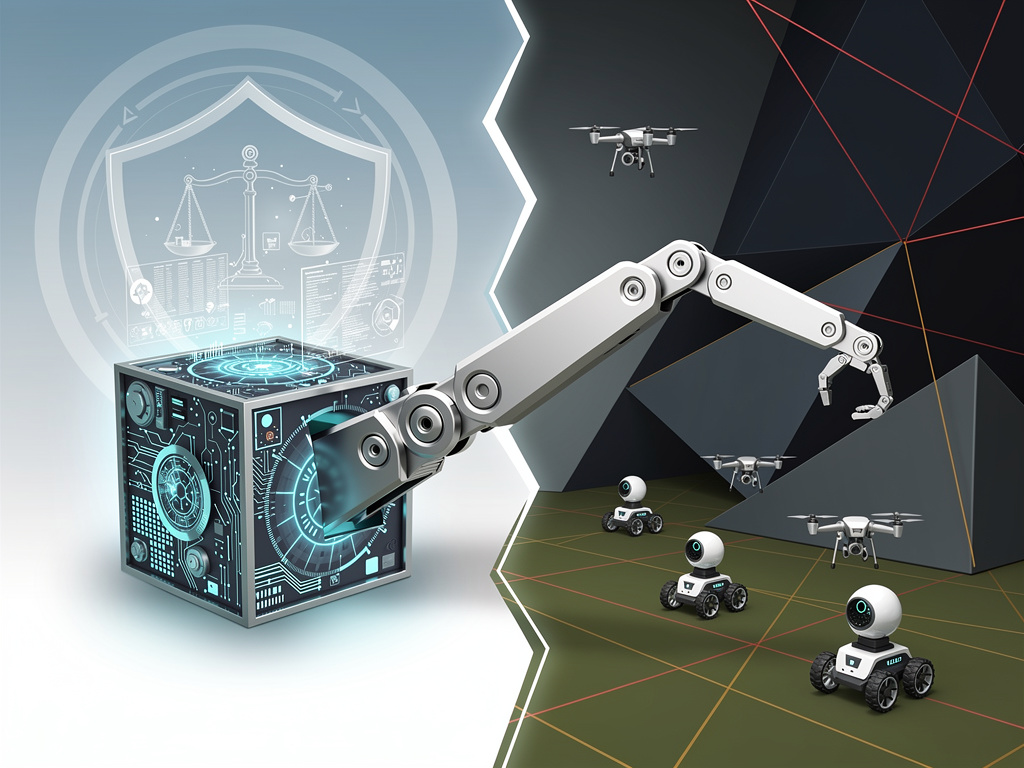
OpenAI is sprinting toward physical AI and military contracts at the same time — and the friction is becoming impossible to ignore. The latest signal: a post from tech analyst Adrian Kalinowski on X highlighting the accelerating tension between OpenAI’s robotics ambitions and the departure of senior talent who built those efforts from the ground up.
The timing here is sharp. As WebProNews previously reported, OpenAI’s head of robotics recently left the company just as it was deepening its engagement with the U.S. Department of Defense and pushing hard into embodied intelligence — AI that doesn’t just think, but moves and acts in the physical world. That departure wasn’t a quiet retirement. It was a loud signal that internal disagreements about the company’s direction have reached a breaking point.
OpenAI’s pivot toward defense work has been building for months. The company quietly revised its usage policies in early 2024 to remove a blanket prohibition on military applications. That policy shift opened the door to Pentagon partnerships, and OpenAI walked right through it. The company has since engaged with defense and national security agencies, positioning its models as tools for logistics, planning, and intelligence analysis. But the move toward robotics — physical systems powered by OpenAI’s foundation models — adds an entirely new dimension to that relationship.
And that’s where the discomfort starts.
Robotics isn’t chatbots. It’s not summarizing documents or generating code. When you put advanced AI into a physical body capable of manipulating objects, navigating environments, and potentially operating in contested spaces, the ethical calculus changes dramatically. Several OpenAI employees and former staffers have expressed concern — some publicly, some through back channels — that the company’s nonprofit origins and stated mission of ensuring AI “benefits all of humanity” sit uneasily next to defense procurement timelines and classified project requirements.
The departure of the robotics chief crystallizes this tension. Here was someone who understood both the technical frontier and the organizational culture, and they chose to leave rather than steer the ship in a direction they apparently couldn’t endorse. That’s not a minor personnel shuffle. It’s a philosophical rupture.
OpenAI CEO Sam Altman has been characteristically forward-looking about the company’s military engagement, framing it as responsible participation in national security rather than weapons development. The company has maintained that it won’t build weapons or surveillance tools, drawing a line that it says separates its work from the more controversial applications of AI in warfare. But critics argue that line is thinner than OpenAI admits — and that once models are deployed inside defense infrastructure, the company loses meaningful control over how they’re used downstream.
So what does this mean for the robotics program specifically? OpenAI has been investing heavily in physical AI research, exploring how its large language models and multimodal systems can be extended to control robots, drones, and other autonomous platforms. The company sees this as a natural extension of its core mission: building general-purpose AI that can operate across domains. Robotics is the ultimate test of that vision. If your model can reason about the physical world well enough to manipulate it, you’re closer to artificial general intelligence than any benchmark can measure.
But building robots that can act autonomously in unstructured environments is also exactly the kind of capability the Pentagon wants. The dual-use problem isn’t theoretical here. It’s immediate and concrete.
The broader industry is watching closely. Competitors like Google DeepMind, Tesla, and Figure AI are all racing toward humanoid robots and embodied intelligence, but none of them carry OpenAI’s particular baggage — the nonprofit charter, the public promises about safety, the high-profile departures of co-founders and senior researchers who felt the company was drifting from its founding principles. Every new defense contract and every departing leader adds another data point to a pattern that’s becoming hard to explain away as normal corporate evolution.
For industry professionals, the practical takeaway is this: OpenAI’s robotics work isn’t slowing down. If anything, the defense angle may accelerate it by providing funding, real-world deployment scenarios, and urgency that pure research can’t match. But the talent pipeline is a real concern. Losing your robotics chief during a critical scaling phase creates gaps that aren’t easily filled, especially when the reason for leaving is ideological rather than financial. The people who care most about safety and mission alignment are often the ones you can least afford to lose.
Whether OpenAI can hold together its commercial ambitions, its defense partnerships, and its stated values simultaneously remains an open question. The evidence so far suggests the seams are showing.


 WebProNews is an iEntry Publication