
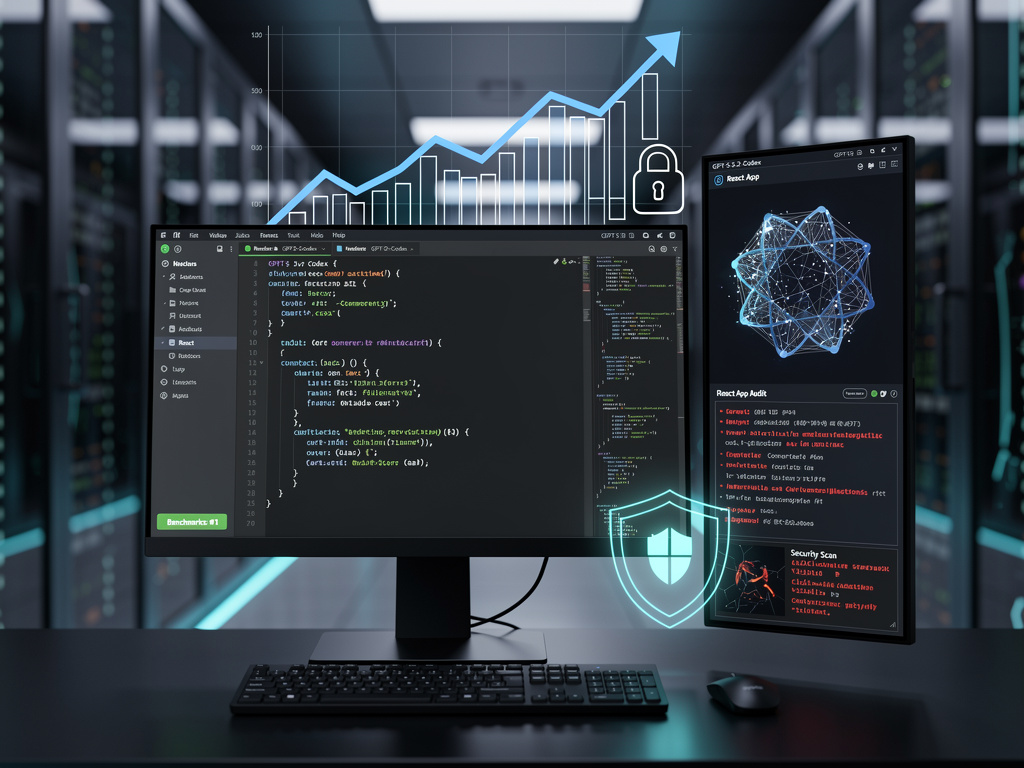
OpenAI has unleashed GPT-5.2-Codex, positioning it as the pinnacle of agentic coding models tailored for demanding software engineering and defensive cybersecurity tasks. Released on December 18, 2025, this iteration builds on GPT-5.2’s foundation with enhancements in context compaction for extended sessions, superior handling of massive code refactors and migrations, better Windows environment compatibility, and markedly improved cybersecurity prowess, according to the company’s announcement on its official blog (OpenAI).
The model arrives amid intensifying competition, following OpenAI’s internal “code red” response to Google’s Gemini 3 advances. It powers Codex across CLI, IDE extensions, web, mobile, and GitHub code reviews, accessible immediately to paid ChatGPT users with API rollout pending safety checks. OpenAI is also launching an invite-only trusted access pilot for vetted cybersecurity professionals to harness unrestricted capabilities ethically.
These developments mark a pivot toward specialized AI agents that tackle real-world complexities, from sprawling repositories to vulnerability hunts, while navigating dual-use dilemmas in cyber domains.
Engineering Benchmarks Shatter Records
GPT-5.2-Codex dominates SWE-Bench Pro at 56.4% accuracy, edging out GPT-5.2’s 55.6% and GPT-5.1’s 50.8%, testing patch generation for authentic software issues in repositories. On Terminal-Bench 2.0, it hits 64.0%, surpassing GPT-5.2’s 62.2% and GPT-5.1-Codex-Max’s 58.1%, evaluating agents in live terminal setups for compiling, training, and server configurations (OpenAI).
Upgraded vision capabilities sharpen screenshot, diagram, chart, and UI interpretation, enabling seamless mock-to-prototype conversions. Native compaction preserves full context over marathon tasks, boosting reliability when plans shift or failures occur, making it ideal for feature builds in vast codebases.
Investing.com reports the model excels in context handling for large-scale changes, with Windows optimizations addressing prior pain points in enterprise settings (Investing.com).
Cybersecurity Leap in Action
Capabilities have surged across evaluations, with GPT-5.2-Codex topping Professional Capture-the-Flag challenges at pass@12 rates far exceeding predecessors like o3, GPT-5, and GPT-5.1-Codex-Max. A chart tracking from April to January 2026 shows exponential gains, though it stays below OpenAI’s ‘High’ Preparedness Framework threshold, prompting layered safeguards detailed in its system card.
Real-world proof emerged when Privy engineer Andrew MacPherson, using GPT-5.1-Codex-Max via Codex CLI, uncovered three React Server Components vulnerabilities (CVEs including 2025-55183) during React2Shell reproduction. Iterative workflows—zero-shot analysis, fuzzing, harness building—exposed source code risks, responsibly disclosed on December 11, accelerating patches (OpenAI).
This workflow, from repo scan to proof-of-concept, underscores AI’s role in proactive defense for banking, healthcare, and infrastructure software.
Navigating Dual-Use Risks
While empowering defenders, these tools risk misuse by adversaries. OpenAI counters with model-level safeguards, product restrictions, and the trusted access pilot for ethical researchers and teams handling malware analysis or red-teaming. Participants gain frontier access, vetted by disclosure history.
Posts on X from OpenAI highlight the release: “GPT-5.2-Codex is now available in Codex. It sets a new standard for agentic coding in real-world software development and defensive cybersecurity,” emphasizing scalability for projects.
Ars Technica notes OpenAI employs GPT-5 Codex internally to refine its own tools, creating a feedback loop where AI builds AI (Ars Technica).
Competitive Pressures Fuel Speed
TechCrunch details OpenAI’s December 1 “code red” memo spurred GPT-5.2’s rapid launch against Google’s Gemini 3, prioritizing reasoning and coding despite compute strains (TechCrunch). WIRED covers the rollout amid rivalry, calling it OpenAI’s “best model yet” (WIRED).
Simon Willison’s analysis praises incremental gains in instruction-following and extended tasks, though without groundbreaking surprises (Simon Willison). Every.to echoes this as a solid upgrade for professionals.
GPT-5.2-Codex integrates into GPT-5.1-Codex-Max’s terminal prowess, per OpenAI’s November update for project-scale efficiency (OpenAI).
Broader Implications for Pros
For insiders, the model’s token efficiency and factuality shine in production pipelines. Geeky Gadgets benchmarks pit it against Gemini 3 Pro, noting superior coding and reasoning for business outputs like research and prototypes (Geeky Gadgets).
Reddit’s r/singularity buzzes with excitement over its cybersecurity edge, calling it the most capable agent yet. OpenAI’s phased rollout—ChatGPT now, API soon—prioritizes safety amid capability trajectories.
This release signals AI’s maturation into indispensable engineering ally, fortifying codebases while challenging security paradigms with controlled potency.


 WebProNews is an iEntry Publication