
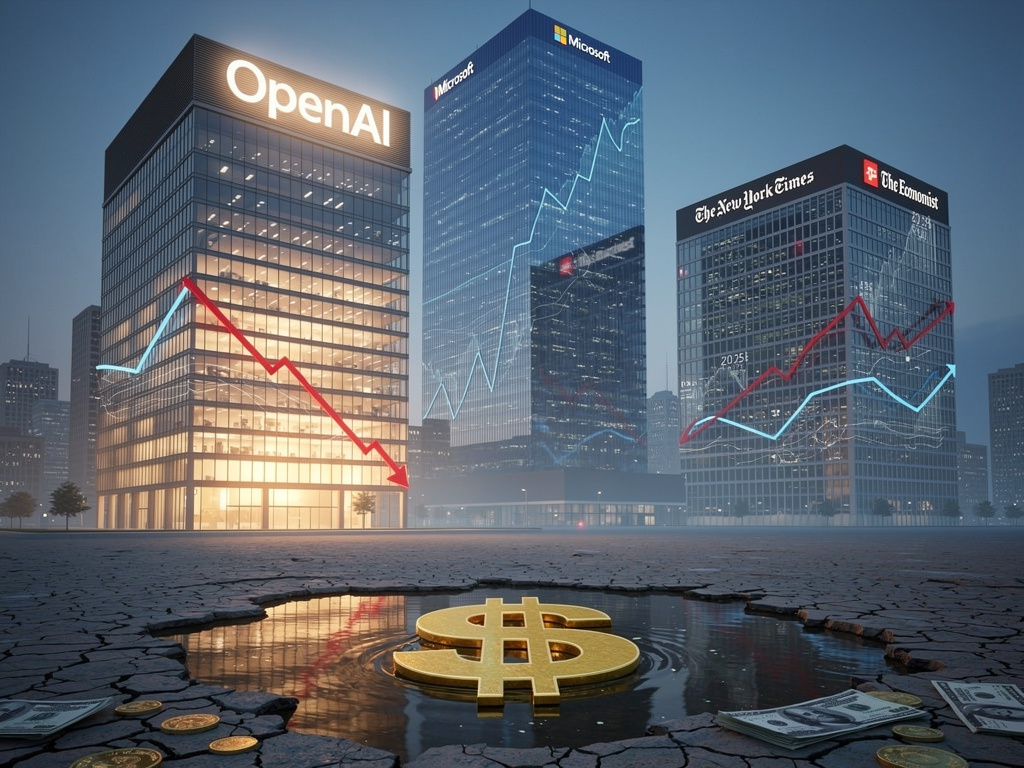
Sam Altman’s OpenAI is sprinting toward a financial cliff, with a prominent economist warning the AI pioneer could exhaust its funds within 18 months. In a stark New York Times essay, Sebastian Mallaby, senior fellow at the Council on Foreign Relations, forecasts that OpenAI’s voracious spending on compute and talent will outpace its fundraising prowess, potentially forcing a sale to a deeper-pocketed rival like Microsoft.
Mallaby, no skeptic of artificial intelligence’s transformative potential, highlights the company’s plight amid a sector-wide spending spree. OpenAI burned through more than $8 billion in 2025 alone, per reports, while committing to infrastructure outlays that could top $1 trillion by decade’s end. Revenue from ChatGPT subscriptions, though growing, remains dwarfed by inference costs that Altman himself admitted are bleeding red ink on premium tiers, as noted in his X posts.
The firm’s path echoes WeWork’s spectacular implosion, with venture capitalists drawing parallels to the coworking firm’s real-estate binge. “This is the WeWork story on steroids,” a VC invested in an OpenAI competitor told The Economist.
OpenAI’s Runway Shrinks Fast
OpenAI’s 2025 cash burn exceeded $8 billion, fueled by data-center builds and GPU acquisitions essential for training frontier models. Mallaby calculates that even slashing planned expenditures and leaning on inflated equity would still demand billions more from wary capital markets. The company’s revenue, while hitting milestones, lags: Users show tepid willingness to pay for subscriptions, prompting Altman to declare a “code red” and pivot harder toward enterprise deals.
Posts on X from Altman underscore the strain. In January 2025, he revealed OpenAI was losing money on Pro subscriptions due to unexpectedly high usage. Recent acquisitions like healthcare startup Torch signal diversification, but critics argue these are Band-Aids on a hemorrhaging balance sheet, as covered in Futurism.
Microsoft’s $13 billion investment provides a lifeline, but Mallaby contends it won’t suffice against rivals subsidized by ad empires. Google and Meta, with billions in free cash flow from search and social, can sustain losses OpenAI cannot.
Rivals’ Legacy Moats Hold Firm
Google’s Gemini and Meta’s Llama models benefit from parental cash cows, allowing relentless scaling without OpenAI’s fundraising desperation. The Economist warns 2026 as OpenAI’s pivotal year, with cash burn emerging as the sector’s defining risk. An economist told Bloomberg outright: OpenAI is “definitely not” too big to fail.
Altman’s ambitions compound the pressure. He’s outlined goals for an AI research intern by September 2026 and a full researcher by 2028, per his October 2025 X livestream recap. Yet, projected 2026 shortfalls hit $17 billion, pitting OpenAI against Google’s counteroffensive, according to 36Kr.
Fundraising feats—record sums for a private outfit—may falter as valuations face scrutiny. Mallaby predicts capital markets won’t deliver the needed trillions, even if AI’s prize proves real.
Altman’s High-Stakes Gambit
Altman has rebuffed bailout talk, clarifying on X in November 2025 that OpenAI seeks no government guarantees for data centers. Instead, he’s chasing hundreds of billions via unconventional financing, including chip deals and sovereign funds. A new preparedness role offering $555,000 signals internal jitters over AI risks, per The Guardian.
Sentiment on X reflects divide: Enthusiasm for OpenAI’s healthcare push clashes with bankruptcy murmurs tied to Mallaby’s essay. The New York Times noted pushback after an executive floated aid, amid bubble fears (November 2025).
Altman told Times of India he has “zero percent interest” in leading a public OpenAI, hinting at an exit strategy as IPO pressures loom.
Bankruptcy Paths and Bailouts
Exhaustion could trigger absorption by Microsoft or Amazon, Mallaby posits, preserving AI momentum without indicting the technology. “An OpenAI failure wouldn’t be an indictment of AI. It would be merely the end of the most hype-driven builder of it,” he wrote in the Times.
The Economist pegs 2026 as make-or-break, with Altman juggling unprecedented financing amid inference costs eclipsing revenue. Gary Marcus’s Substack laments OpenAI’s eroding lead post-Apple news, fueling decline narratives (January 2026).
Yet Mallaby remains bullish: AI’s three-year strides outpace historical tech adoption, ensuring survivors thrive even if OpenAI stumbles.
Legacy Beyond the Balance Sheet
OpenAI’s ChatGPT ignited the boom, but sustaining dominance demands profitability rivals can ignore. As 2026 dawns, Altman’s “code red” bets on scale face Mallaby’s timeline: Cash could vanish by mid-2027 absent miracles. Investors watch, weighing if OpenAI footnotes or anchors AI’s future.


 WebProNews is an iEntry Publication