
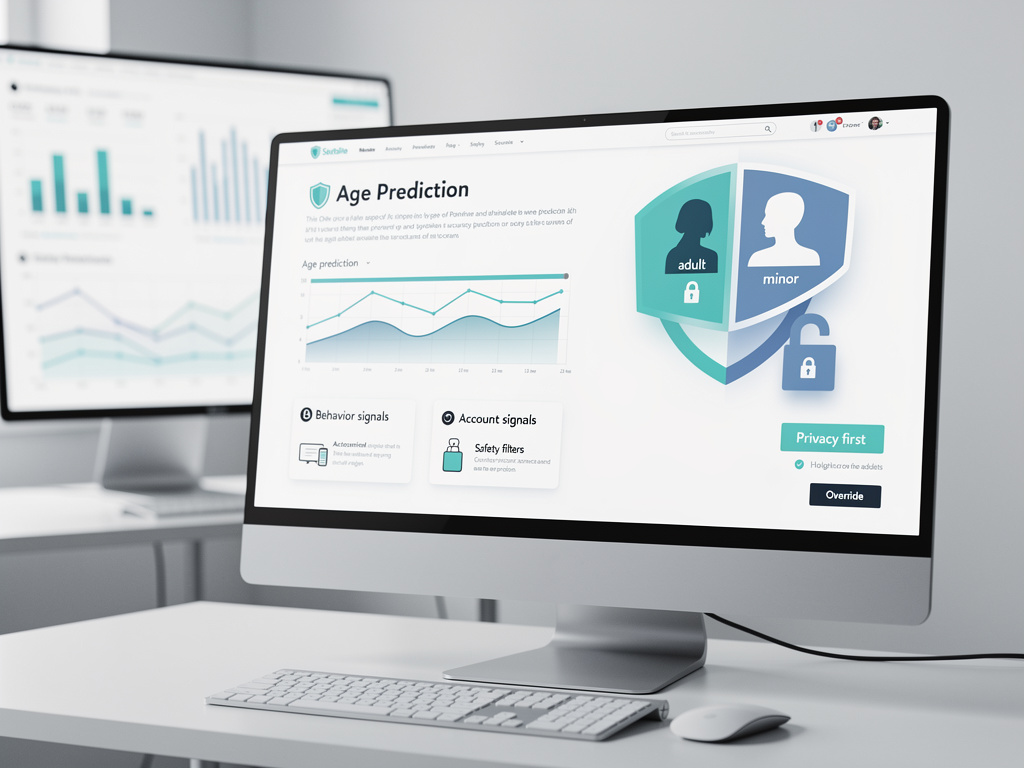
OpenAI has launched a global age-prediction system for ChatGPT, deploying machine-learning models to estimate user ages and shield minors from sensitive material ahead of planned adult-content features. The rollout, announced Tuesday, uses account data and behavioral patterns to classify users under 18, triggering automatic safeguards like restricted image generation and limited search results.
The system analyzes signals such as signup timestamps, usage frequency, query types and interaction styles without accessing personal identifiers or external data, according to OpenAI’s official explanation on its approach page. Adults flagged incorrectly can verify their age through account settings, restoring full access.
Model Mechanics and Signal Analysis
The age-prediction model combines dozens of features into a binary classifier outputting probabilities of underage status. OpenAI trained it on anonymized data from verified teen and adult accounts, achieving over 95% accuracy in internal tests, as detailed in its help center article. Precision exceeds 98% for under-18 predictions, minimizing false positives that could block adults.
Behavioral cues include conversation length, topic diversity and response times, while account-level inputs cover creation date and device type. OpenAI emphasizes no biometric data, IP addresses or third-party info enters the model, addressing privacy worries raised in early reactions.
Teen Safeguards in Action
Under-18 accounts face curbs on explicit image creation, mature web searches and partner integrations. File uploads remain allowed, but outputs avoid sensitive topics. OpenAI’s X post states: “We’re rolling out age prediction on ChatGPT to help determine when an account likely belongs to someone under 18, so we can apply the right experience and safeguards for teens.”
This builds on September 2025 parental controls linking teen and parent accounts for oversight. CEO of applications Fidji Simo noted in December expectations for an “adult mode” debut in early 2026, per Reuters.
Global Rollout and Accuracy Benchmarks
Deployment spans all ChatGPT consumer plans worldwide, starting with free and paid tiers. CNBC reports the model relies on account-level and behavioral signals. Internal benchmarks show low error rates, but real-world performance awaits scrutiny as billions of interactions unfold.
OpenAI claims the system outperforms self-reported ages, which users often misstate. False negatives—missing actual minors—stay below 5%, prioritizing child protection over perfect recall.
Privacy Design Choices
Predictions generate on-device where possible, with server-side fallback for complex cases. Results store transiently, deleted post-application unless age disputes arise. No training on prediction outputs occurs, per OpenAI’s methodology.
Transparency includes audit logs for flagged accounts and appeal paths. Industry watchers note similarities to Apple’s device-side age estimation but tailored for cloud AI services.
Industry Reactions and Concerns
TechCrunch frames it as protection for young users amid adult features. On X, AI researcher Rohan Paul highlighted potential for refinement: “OpenAI’s age prediction uses behavioral signals—smart, but accuracy will evolve with data.”
Mark Kassen questioned edge cases: “What about young-sounding adults or mature teens? False positives could frustrate users.” OpenAI invites feedback to iterate.
Strategic Timing Amid Adult Push
The move precedes broader mature content, including spicier conversations and images for verified adults. Sam Altman teased age-appropriate experiences last year. Revenue pressures mount with $20 billion annualized run rate, per recent CFO disclosures.
Competitors like Anthropic and Google eye similar classifiers amid regulatory heat from EU AI Act and U.S. Kids Online Safety Act mandating minor protections.
Technical Underpinnings Exposed
Model architecture mirrors fraud detection ensembles: gradient-boosted trees atop embeddings from interaction histories. Training involved millions of labeled sessions, stratified by demographics. Ablation studies confirmed behavioral signals dominate over metadata.
Edge deployment cuts latency, vital for ChatGPT’s real-time feel. Updates retrain quarterly on fresh anonymized data, balancing drift and privacy.
Regulatory Alignment and Future Iterations
Design complies with COPPA and GDPR by avoiding direct age queries. OpenAI plans public system cards detailing risks like demographic biases, echoing GPT-4o voice evaluations.
Longer term, multimodal signals from voice or images could boost precision, though privacy hurdles loom. For now, this binary gatekeeper sets the pace for age-aware AI.


 WebProNews is an iEntry Publication