
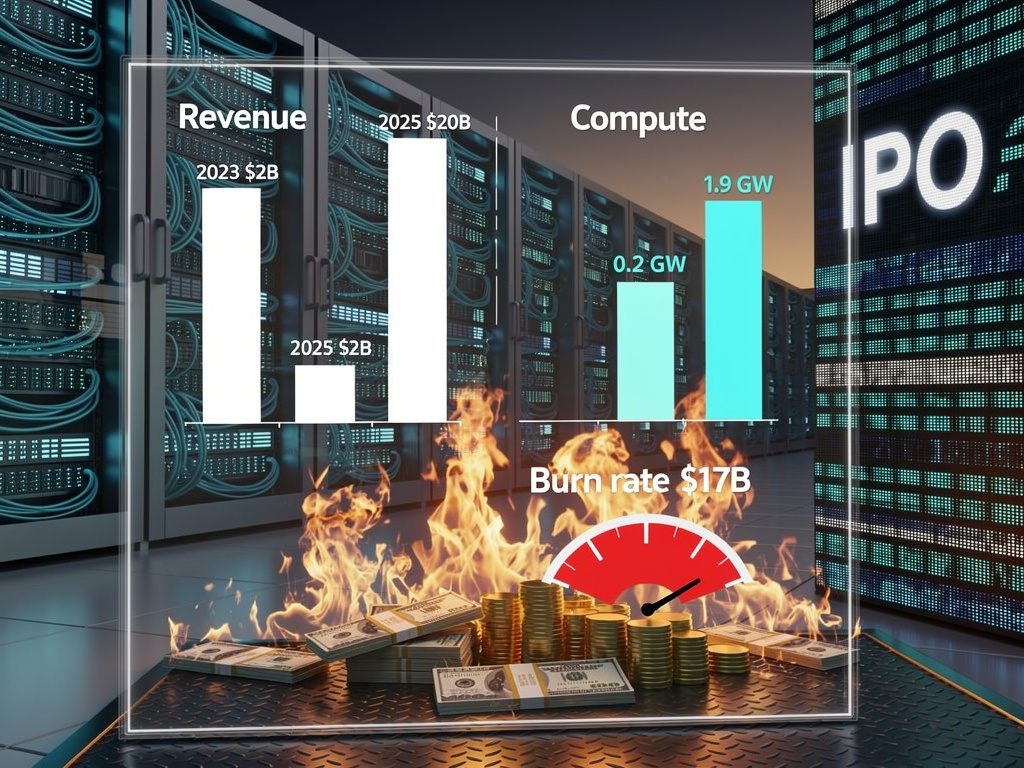
OpenAI’s financial trajectory has accelerated into overdrive, with Chief Financial Officer Sarah Friar disclosing that annualized revenue rocketed from $2 billion in 2023 to more than $20 billion in 2025, paralleling a massive expansion in computing power from 0.2 gigawatts to nearly 1.9 gigawatts over the same period. This surge, detailed in recent disclosures, underscores the company’s bet on scaling artificial intelligence infrastructure to capture explosive demand for its products like ChatGPT.
The numbers paint a picture of hypergrowth rarely seen in tech history. Friar, who joined OpenAI in mid-2024 from her role at Nextdoor, highlighted this in comments to industry outlets, defending the firm’s voracious spending amid investor scrutiny. Revenue jumped 233% in 2025 alone, propelled by enterprise subscriptions, API usage, and consumer tiers, according to Benzinga.
Yet this expansion comes at a steep cost. OpenAI’s annual burn rate has hit $17 billion, largely devoured by compute infrastructure, raising questions about sustainability as the company eyes a potential IPO in late 2026 at valuations approaching $1 trillion, per Reuters.
From Research Preview to Revenue Juggernaut
ChatGPT’s launch as a research preview in late 2022 marked the inflection point. ‘We launched ChatGPT as a research preview to understand what would happen if we put frontier intelligence directly in people’s hands,’ OpenAI stated in its business update. What followed was unprecedented adoption, evolving into a commercial powerhouse with monthly revenue hitting $1 billion by July 2025, as noted in SaaStr analysis.
Enterprise deals and API integrations drove much of the growth. By 2025, OpenAI inked over $1.4 trillion in infrastructure commitments with partners like Microsoft and Oracle, fueling model training and inference at scale, according to CNBC. Sam Altman projected hundreds of billions in revenue by 2030, betting on AI’s productivity multiplier effect.
Friar’s oversight has been pivotal. In addressing spend concerns, she revealed revenue grew roughly 10x alongside compute tripling in capacity, per Neowin and Analytics India Magazine.
Compute Hunger Drives Ninefold Expansion
The jump from 0.2 GW to 1.9 GW reflects OpenAI’s aggressive data center buildout. Posts on X from industry watchers like Rohan Paul emphasized Friar’s stats: compute capacity scaling in lockstep with revenue, from $2B ARR in 2023 to over $20B in 2025. This aligns with OpenAI’s push into U.S. facilities, including a water-positive data center in Wisconsin creating thousands of jobs.
Power demands have sparked debates. Calcalistech reported the 233% sales surge masks ‘immense expense of powering the AI boom,’ with GPU clusters from Nvidia consuming vast energy. Alternate Jones on X noted the parallel growth curves, while Ben Bajarin highlighted enterprise shift as key to $20B milestone.
Such scaling enables frontier models like GPT-5, but costs are ballooning. Benzinga detailed how infrastructure expenses now dominate, with $17B yearly burn threatening cash reserves by mid-2027 absent new funding, echoing Tom’s Hardware analysis.
Burn Rate Pressures Mount
OpenAI’s path to profitability hinges on monetization tweaks. Recent moves include ChatGPT Go, a low-cost tier with 10x free limits, and ad tests in free tiers, as announced on OpenAI’s X account. ‘We’re sharing our principles early on how we’ll approach ads–guided by putting user trust and transparency first,’ the company posted.
New hires bolster commercialization: Denise Dresser as Chief Revenue Officer from Slack, and acquisitions like healthcare startup Torch for ChatGPT Health. These expand beyond consumer chat into enterprise and verticals, per OpenAI updates.
Investor patience wanes amid projections. The Economist warned of a ‘perilous position’ in 2026, with Sacra estimating prior-year figures at $12B ARR by mid-2025. Friar’s defense: growth justifies spend, with revenue matching compute outlays.
IPO Horizons and AGI Bets
Preparations for public markets are underway. Reuters reported filings possible by H2 2026, targeting trillion-dollar status on AI dominance. Altman’s vision ties revenue to ‘capability overhang,’ where model advances unlock user value.
Risks persist: regulatory hurdles, competition from Anthropic and Google, and energy constraints. Yet, with $20B+ ARR, OpenAI redefined software scaling—from $500M monthly early 2025 to $1B+ peaks, per SaaStr.
Friar’s tenure stabilizes finances post-turmoil. As OpenAI navigates 2026 make-or-break dynamics, its compute-revenue symbiosis positions it at tech’s vanguard, though burn rate discipline will prove decisive.


 WebProNews is an iEntry Publication