
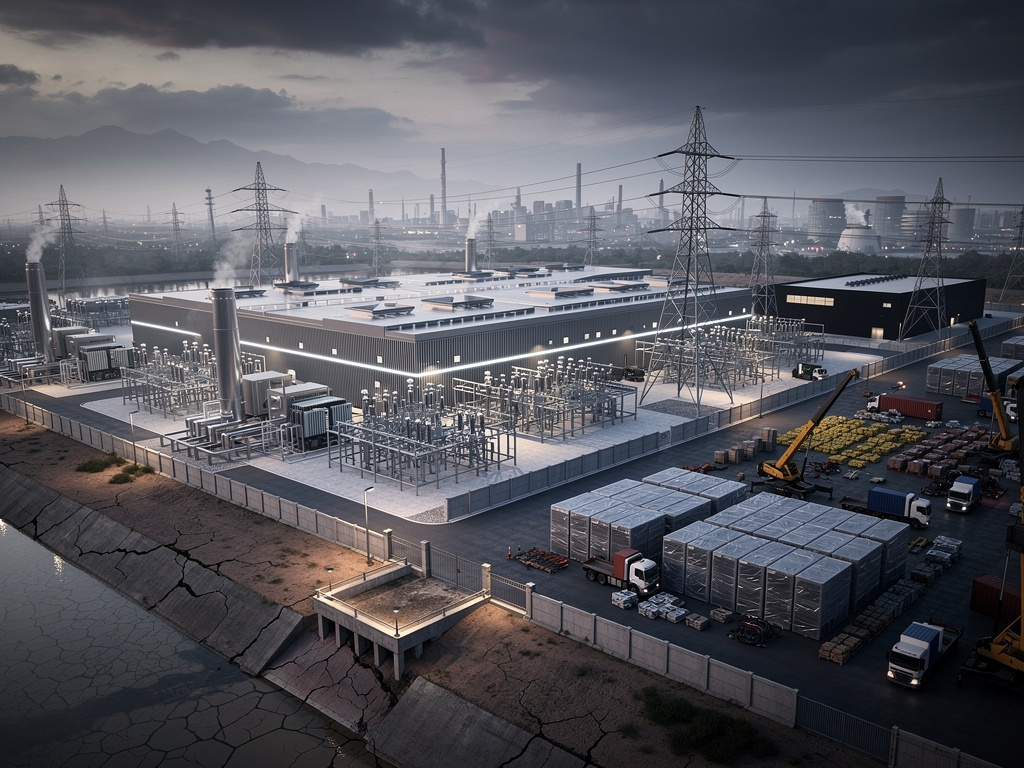
OpenAI wants to build the infrastructure backbone of the artificial intelligence age. It has pledged roughly $100 billion toward a sprawling network of data centers across the United States, a vision so enormous it drew a White House announcement and comparisons to the great industrial buildouts of the twentieth century. But between the grand pronouncements and the ground-level reality, a growing list of obstacles is threatening to slow — or fundamentally reshape — those plans.
The trouble isn’t hypothetical. It’s already here.
As Futurism reported, OpenAI’s data center strategy is running into serious headwinds on multiple fronts: power supply constraints, water scarcity concerns, local political resistance, and questions about whether the sheer scale of what’s being proposed is physically achievable within the timelines the company has laid out. These aren’t minor permitting hiccups. They represent structural challenges that could define whether OpenAI — and by extension, the broader AI industry — can deliver on promises that have attracted hundreds of billions of dollars in investment capital.
Start with electricity. A single large-scale AI data center can consume as much power as a small city. OpenAI’s plans, announced under the Stargate joint venture with SoftBank and Oracle, call for facilities that would collectively require gigawatts of new generation capacity. The United States hasn’t added that kind of power infrastructure quickly in decades. Grid operators across the country are already warning that demand from data centers is outpacing their ability to supply it. PJM Interconnection, the regional grid operator covering much of the eastern United States, has a queue of power interconnection requests stretching years into the future. New natural gas plants take years to permit and build. Nuclear is even slower. Renewables can be deployed faster but come with intermittency problems that don’t pair well with data centers requiring 24/7 uptime.
And it isn’t just about generation. Transmission infrastructure — the high-voltage lines that carry electricity from where it’s produced to where it’s consumed — is woefully underdeveloped relative to what these projects demand. Building new transmission lines involves navigating a thicket of federal, state, and local approvals that can take a decade or more.
Then there’s water. AI data centers generate enormous amounts of heat, and the most common cooling method uses vast quantities of water. In parts of the American West and Southwest, where several proposed sites are located, water is already a fiercely contested resource. Local communities have pushed back hard against projects they see as threatening municipal water supplies. According to Futurism, some of the locations OpenAI and its partners have targeted are in regions where drought conditions and declining aquifer levels make large-scale water consumption politically and practically untenable.
Community opposition is intensifying. Not everywhere. But in enough places to matter.
Residents near proposed data center sites in Texas, Wisconsin, and other states have organized against the projects, citing concerns about noise, water usage, property values, and the perception that massive tech infrastructure benefits distant shareholders while imposing costs on local populations. Town councils and county boards that initially welcomed the economic development pitch have in some cases reversed course after constituents showed up at public meetings. This pattern — initial enthusiasm followed by grassroots resistance — has become familiar enough that developers now factor community opposition into their risk models.
OpenAI’s Stargate project, announced in January 2025 with an initial $100 billion commitment and aspirations to reach $500 billion, was framed as a national competitiveness initiative. President Trump appeared at the announcement alongside OpenAI CEO Sam Altman, SoftBank CEO Masayoshi Son, and Oracle chairman Larry Ellison. The message was clear: this was about American dominance in AI, and the federal government would be a willing partner. But federal enthusiasm doesn’t automatically translate into local permits, state-level water rights, or available power capacity.
The financial architecture of the project has also drawn scrutiny. Shortly after the Stargate announcement, questions emerged about how much of the $100 billion was actually committed versus aspirational. Elon Musk publicly accused SoftBank of not having the money, a claim SoftBank disputed. Regardless of the corporate balance sheets involved, the capital requirements are staggering. Building data centers at this scale means not just constructing the facilities themselves but also financing the power plants, substations, cooling systems, and fiber-optic networks that support them. The total cost of the supporting infrastructure could rival or exceed the cost of the data centers.
Supply chain constraints add another layer of difficulty. The specialized chips that power AI workloads — primarily Nvidia’s GPUs — remain in tight supply despite the company’s efforts to ramp production. Transformers, switchgear, and other electrical equipment needed for data center construction face lead times that have stretched from months to years. Skilled labor is scarce in many of the regions where facilities are planned. Construction timelines that look reasonable on a spreadsheet often prove optimistic when crews can’t be hired and components can’t be delivered.
So what does OpenAI actually have operational today? Far less than the announcements suggest. The company currently relies heavily on Microsoft’s Azure cloud infrastructure to run its models. Microsoft has its own massive data center expansion underway, but even that program — backed by one of the world’s largest and most operationally experienced technology companies — has encountered delays and cost overruns. OpenAI’s independent infrastructure buildout is still largely in the planning and early construction phases.
The competitive pressure is real, though. Google, Meta, Amazon, and xAI are all racing to build or expand data center capacity. Meta alone has said it plans to spend more than $60 billion on infrastructure in 2025. Google’s parent Alphabet has signaled similar levels of capital expenditure. The fear driving all of these companies is the same: whoever has the most compute capacity will be able to train and deploy the most powerful AI models, and falling behind on infrastructure means falling behind on everything else.
But the race is producing its own distortions. When every major tech company is simultaneously trying to secure power contracts, buy the same equipment, and hire from the same labor pool, prices rise and timelines extend. It’s a classic boom dynamic, and it carries the risk of a classic bust if AI revenue growth doesn’t materialize fast enough to justify the spending. Wall Street analysts have begun asking pointed questions about return on investment during earnings calls. The market’s patience isn’t infinite.
Environmental considerations compound the political challenges. Data centers are significant sources of carbon emissions, both from the electricity they consume and from the backup diesel generators most facilities maintain. The water consumption issue intersects with broader climate concerns, particularly in drought-prone regions. Environmental groups have begun targeting AI infrastructure projects with the same intensity they’ve previously directed at pipelines and power plants. Permitting battles that were once confined to fossil fuel projects are now showing up at data center sites.
None of this means OpenAI’s plans will fail entirely. Some facilities will get built. Some power contracts will be secured. Some communities will welcome the jobs and tax revenue. But the gap between the announced vision and the achievable reality appears substantial and growing. The company’s leadership has acknowledged, at least implicitly, that the buildout will take longer and cost more than initial projections suggested.
There’s a deeper question embedded in all of this. Can any single company — even one backed by the world’s richest investors and the explicit support of the U.S. government — build infrastructure at this pace without running into the physical, political, and financial limits that constrain every large-scale construction project? History suggests the answer is no, or at least not on the timeline being advertised. The Hoover Dam took five years. The Interstate Highway System took thirty-five. The U.S. hasn’t built a new nuclear power plant from scratch in decades.
AI infrastructure may ultimately get built at massive scale. The demand signals are strong, the capital is available, and the strategic imperative is clear. But the path from announcement to operation runs through county planning boards, state utility commissions, federal environmental reviews, equipment manufacturers with limited capacity, and communities that have their own priorities. OpenAI and its partners are discovering what every ambitious builder eventually learns: the hardest part isn’t deciding what to build. It’s actually building it.


 WebProNews is an iEntry Publication