
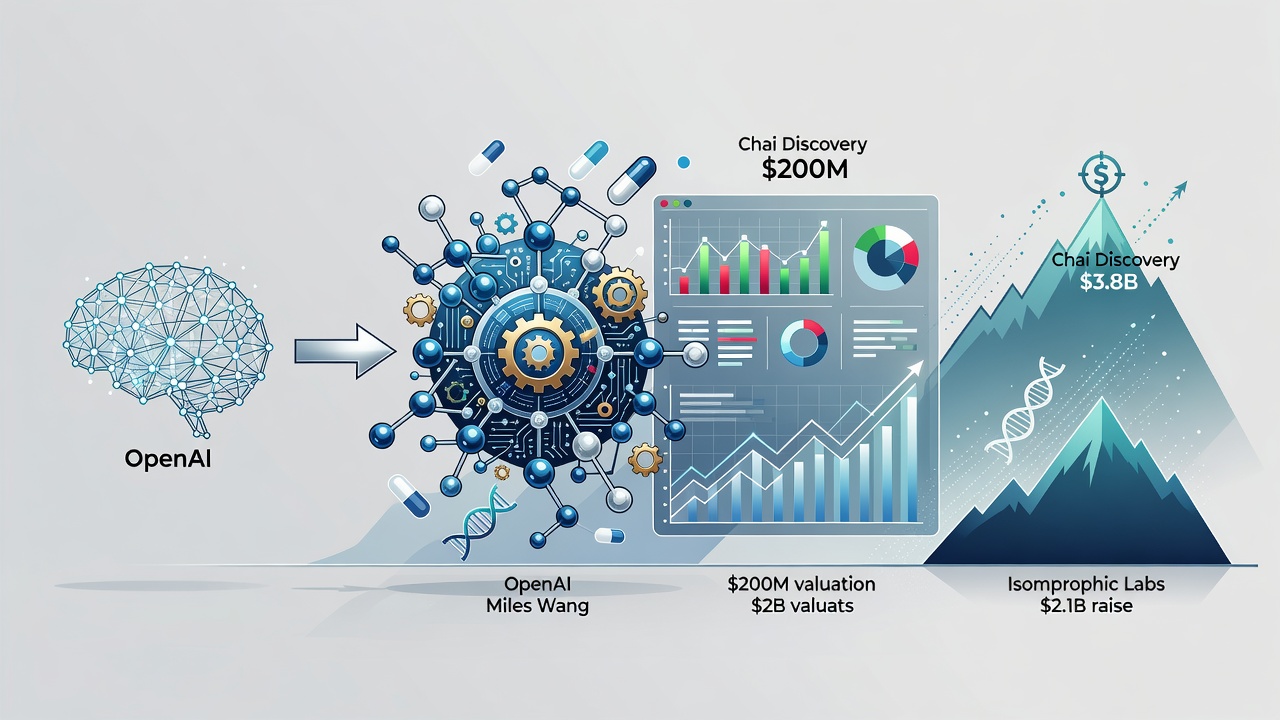
Miles Wang spent two years at OpenAI co-authoring papers on how artificial intelligence could speed up wet-lab biology. Now he plans to test those ideas in the market. Four people familiar with his plans told TechCrunch that the researcher is leaving to start a company developing AI models for drug discovery. Several other OpenAI researchers are expected to follow.
Wang is in talks to raise roughly $200 million at a $2 billion valuation. Lightspeed Venture Partners has discussed leading the round. But those numbers remain fluid. Talks continue. Details could shift. Wang himself pushed back on the reported figures and the company’s described focus. He offered no alternative numbers.
Investor Frenzy Meets Scientific Reality
The reported terms reflect a sector on fire. On the same day the TechCrunch story appeared, Chai Discovery announced it raised $400 million in a Series C that values the two-year-old startup at $3.8 billion, according to The New York Times. Chai’s models predict molecular interactions and already power work at Eli Lilly, Novartis and Pfizer, Fierce Biotech reported. One of Chai’s co-founders, Josh Meier, also spent time as a researcher at OpenAI.
Google DeepMind’s spinout Isomorphic Labs closed a $2.1 billion Series B in May. The pattern is clear. Capital flows toward any team that can credibly claim AI will shrink the time and cost of bringing medicines to patients. Yet the path from model to approved drug still runs through years of clinical testing. Safety data, regulatory hurdles and manufacturing scale don’t vanish because an algorithm ranks molecules faster.
Wang’s venture may sidestep some of that timeline. Sources told TechCrunch the startup could focus on identifying new therapeutic uses for drugs already approved by the FDA or those that failed earlier trials for different indications. Repurposing offers a quicker route to revenue. Those compounds have passed safety studies. The AI task narrows to matching existing chemistry to fresh biology. Smart. And still difficult.
Wang joined OpenAI in 2024. He had dropped out of Harvard before finishing his computer science degree. Investors no longer flinch at such pedigrees. Recent years show them backing young technical founders who leave elite programs early. Wang’s published work at OpenAI examined AI systems that automate and accelerate biological experiments. One paper, hosted on OpenAI’s site, explores models that could run wet-lab protocols with less human oversight.
But leaving one of the world’s best-funded AI labs to build in biotech brings new pressures. Data access changes. Compute budgets shrink. Regulatory conversations begin. Partners in pharma expect proof that the models generalize beyond benchmark datasets. Early hype collides with the reality that most drug candidates still fail.
And yet money pours in. The same week Chai tripled its valuation from seven months earlier, according to Endpoints News, industry watchers noted the same surge in interest. Big pharma wants tools that improve hit rates in discovery. Venture firms want equity in the companies supplying those tools. The combination produces nine- and ten-figure checks at eye-watering pre-money numbers.
Wang’s dispute with the initial reporting adds a layer of uncertainty that insiders say is common at this stage. Founders often push back on details leaked before a formal announcement. Lightspeed declined to comment. The startup itself has no public name or website yet. Its exact approach remains under wraps. What is known comes from anonymous sources and one researcher’s public track record.
So the market bets on talent migration. OpenAI alumni carry deep knowledge of scaling models, curating training data and evaluating performance. Those skills transfer. Whether they transfer into reliable predictions about protein binding or disease pathways is the multibillion-dollar question. History in biotech shows many high-profile AI entrants have delivered interesting papers but fewer approved drugs.
Wang and his team will face that test soon enough. They must demonstrate that their systems can surface genuinely novel uses for shelved compounds or extend patents on existing ones. They will compete with Chai, Isomorphic and a growing list of well-capitalized players. They will negotiate with pharmaceutical companies that guard their data closely. And they will do it all while the broader AI investment climate remains frothy but watchful for any sign of overreach.
The departure signals something larger. Top AI researchers see opportunity in vertical applications where data is structured, outcomes are measurable and customers have deep pockets. Drug discovery checks every box. The valuations show investors agree. The real work begins when the term sheet is signed and the models meet the lab. Success will be measured not in funding announcements but in molecules that reach patients faster and cheaper than before. That bar remains high. The race is on.


 WebProNews is an iEntry Publication