
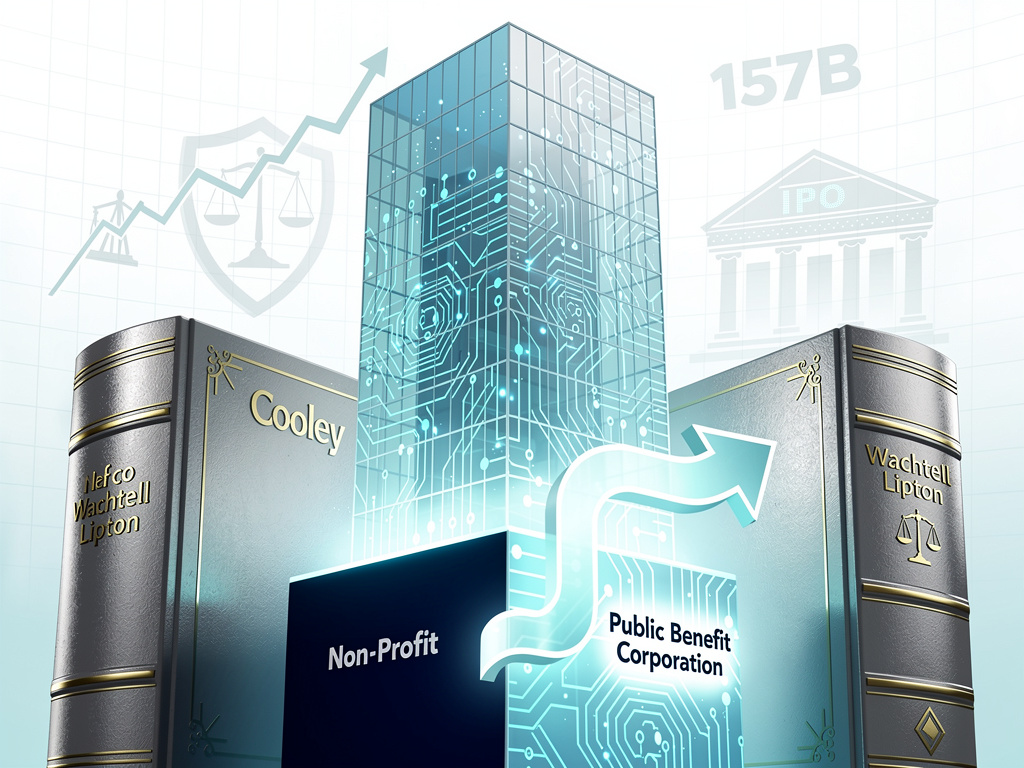
The artificial intelligence sector’s most prominent player is initiating a complex legal maneuver to reshape its corporate identity, a move that signals the end of its experimental governance era and the beginning of its life as a traditional financial powerhouse. OpenAI has retained two of the legal industry’s most formidable firms, Cooley and Wachtell, Lipton, Rosen & Katz, to orchestrate a transition from its non-profit roots toward a for-profit structure capable of sustaining its massive capital requirements. According to a report by The Information, the retention of these firms marks the first concrete step toward a potential initial public offering, although such a listing remains a distant prospect compared to the immediate necessity of corporate restructuring.
This legal mobilization arrives as the company faces mounting pressure from its financial backers to secure a structure that protects their investments. Following a historic funding round that valued the San Francisco-based AI developer at $157 billion, investors including Microsoft and Thrive Capital have reportedly stipulated that the company must convert to a Public Benefit Corporation (PBC) within two years. Failure to execute this transition could trigger clauses allowing investors to reclaim their capital, a scenario the company is keen to avoid. The selection of Cooley, a Silicon Valley staple known for guiding technology companies to the public markets, alongside Wachtell, a Wall Street titan famous for complex mergers and defense against hostile takeovers, suggests OpenAI is preparing for a transformation that is both structurally intricate and defensively fortified.
The Strategic Bifurcation of Legal Counsel Between Silicon Valley Innovation and Wall Street Defense
The choice of counsel reveals the dual nature of the challenge facing CEO Sam Altman and his board. Cooley has long served as the standard-bearer for venture-backed technology firms navigating the path to an IPO. Their involvement indicates that OpenAI is standardizing its equity compensation, governance, and reporting structures to align with public market expectations. Cooley’s expertise lies in the operational mechanics of taking a high-growth tech firm public, ensuring that the internal plumbing of the organization can withstand the scrutiny of the Securities and Exchange Commission (SEC) and institutional shareholders.
Conversely, the engagement of Wachtell Lipton signals a different priority: invulnerability. Wachtell is less known for routine IPO filings and more for its role in high-stakes corporate warfare, including its representation of Twitter during Elon Musk’s acquisition attempt. By bringing in Wachtell, OpenAI is likely seeking to design a governance framework that creates an impenetrable barrier around the company’s intellectual property and management control. This is particularly pertinent given the company’s history of boardroom volatility. The firm’s remit likely involves disentangling the convoluted relationship between the controlling non-profit entity and the for-profit subsidiary, a unique arrangement that precipitated the leadership crisis in November 2023.
Unwinding the Non-Profit Governance Knot Under Intense Investor Pressure and Valuation Demands
The current governance structure of OpenAI is an anomaly in the modern business world. Founded as a non-profit in 2015, the organization later created a capped-profit subsidiary to raise capital. However, the non-profit board retained ultimate control, a mechanism designed to prioritize safety over shareholder returns. This structure was tested to its breaking point when the previous board ousted Mr. Altman, only to reinstate him days later following an employee revolt and pressure from Microsoft. The new restructuring plan aims to convert the core entity into a Public Benefit Corporation, a legal status that mandates the pursuit of social good alongside fiduciary duty to shareholders, effectively removing the non-profit board’s absolute veto power over business operations.
Recent reporting from Bloomberg highlights that the $6.6 billion raised in October came with explicit contingencies regarding this restructuring. The involvement of heavyweight legal teams suggests that the process of decoupling the non-profit from the for-profit arm is fraught with tax implications and regulatory hurdles. The non-profit is expected to retain a minority stake in the new PBC, ensuring it continues to benefit from the technology’s success, but it will no longer hold the kill switch that unnerved investors during the 2023 crisis.
Navigating the Complexities of Executive Equity and the Shift in Incentive Structures
A critical component of the restructuring involves the compensation of Sam Altman himself. Historically, Mr. Altman has taken no equity in OpenAI, a stance intended to underscore his commitment to the mission over profit. However, discussions are now underway to grant him a significant equity stake, potentially around 7%, which would align his financial interests directly with those of the new shareholders. This shift is standardizing the company’s executive compensation in preparation for public scrutiny, but it also fundamentally alters the philosophical underpinnings of the organization’s leadership.
Legal experts note that granting equity to the CEO of a company transitioning out of non-profit control requires careful navigation of IRS regulations regarding “private inurement,” which prohibits non-profit assets from unduly benefiting insiders. Wachtell’s role will likely involve structuring this equity grant to withstand regulatory challenges. Furthermore, as reported by Reuters, the move to a PBC structure brings OpenAI in line with competitors like Anthropic and xAI, which have adopted similar models to balance safety commitments with the need to attract venture capital.
The Public Benefit Corporation Model as a Mechanism for Balancing Profit and Safety
The transition to a Public Benefit Corporation is not merely a financial decision but a strategic governance choice that offers a middle ground between pure capitalism and altruism. Under Delaware law, a PBC requires directors to balance the pecuniary interests of stockholders, the best interests of those materially affected by the corporation’s conduct, and a specific public benefit identified in its certificate of incorporation. For OpenAI, this allows the company to legally deprioritize short-term profits if safety concerns regarding Artificial General Intelligence (AGI) arise, providing a statutory shield that a standard C-Corporation lacks.
However, the efficacy of the PBC model in restraining corporate ambition remains a subject of debate. While it offers legal cover for ethical decision-making, it does not provide the same hard check on power that the non-profit board possessed. The legal teams at Cooley and Wachtell are tasked with drafting a charter that satisfies the safety mandates of the original mission while providing enough commercial predictability to satisfy Wall Street. This drafting process is critical; if the language is too vague, it opens the door to shareholder lawsuits; if it is too restrictive, it could hamper the company’s ability to compete with Google and Meta.
Preparing for the Scrutiny of Public Markets While Managing Regulatory Headwinds
While an IPO is not imminent, the retention of Cooley suggests that the internal machinery is being built to support one. This involves establishing Sarbanes-Oxley compliant financial controls, independent audit committees, and rigorous disclosure protocols. The timeline for such a listing is likely years away, as the company must first complete the restructuring and prove the stability of the new governance model. Nevertheless, the signal to the market is clear: OpenAI is maturing into an entity that can be traded, analyzed, and regulated like any other major technology firm.
This maturation comes at a time of heightened regulatory interest. The Federal Trade Commission (FTC) and the Department of Justice are actively investigating the AI sector for antitrust violations. By restructuring into a more traditional corporate form, OpenAI may find itself subject to standard merger review processes and competitive analysis. The sophisticated counsel of Wachtell Lipton will be instrumental in navigating these antitrust waters, ensuring that the company’s relationship with Microsoft—which holds a massive economic interest but no traditional control—does not fall afoul of regulators looking to prevent monopolistic consolidation in the generative AI market.
The Broader Implications for the Artificial Intelligence Sector and Venture Capital
OpenAI’s restructuring sets a precedent for the entire generative AI industry. It demonstrates that the capital intensity of training frontier models—requiring tens of billions of dollars in compute infrastructure—is fundamentally incompatible with non-profit governance. As OpenAI sheds its idealistic skin for a more pragmatic carapace, it forces other players in the space to evaluate their own structures. The involvement of top-tier legal firms validates the sector as a serious component of the global economy, moving beyond the phase of unchecked experimentation.
The outcome of this legal re-engineering will determine whether a company can successfully serve two masters: the relentless demand for growth from public markets and the existential imperative of AI safety. With Cooley and Wachtell steering the ship, OpenAI is betting that sophisticated legal architecture can bridge the gap between these opposing forces, securing its future as the defining industrial titan of the 21st century.


 WebProNews is an iEntry Publication