
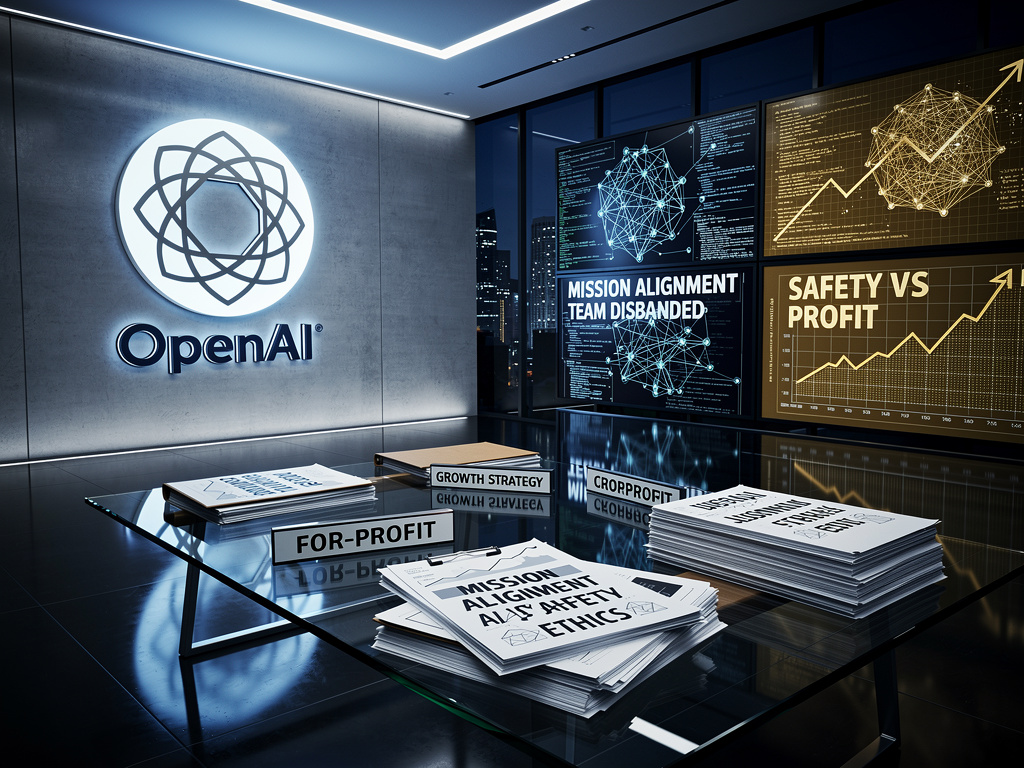
In a move that has sent ripples through the artificial intelligence community, OpenAI has disbanded its Mission Alignment team — the internal group specifically tasked with ensuring the company’s products and research remained consistent with its stated goal of building safe and trustworthy AI. The restructuring, first reported by TechCrunch, sees the team’s leader elevated to a newly created role of “chief futurist,” while remaining team members have been scattered across other divisions within the organization.
The dissolution marks the latest chapter in OpenAI’s turbulent relationship with its own safety infrastructure — a tension that has defined much of the company’s trajectory since the explosive launch of ChatGPT in late 2022 and the subsequent boardroom crisis that nearly toppled CEO Sam Altman in November 2023. For industry observers and AI safety researchers, the decision raises uncomfortable questions about whether the world’s most prominent AI company is systematically deprioritizing the guardrails it once championed as central to its identity.
A Pattern of Safety Team Departures and Restructurings That Has Defined OpenAI’s Recent History
The disbanding of the Mission Alignment team does not exist in a vacuum. It follows a well-documented series of departures and reorganizations involving OpenAI’s safety-focused personnel that stretches back years. In May 2024, the company’s Superalignment team — co-led by co-founder Ilya Sutskever and researcher Jan Leike — was effectively dissolved when both leaders departed the company. Leike, who left for rival Anthropic, publicly criticized OpenAI at the time, writing on social media that “safety culture and processes have taken a backseat to shiny products.”
Sutskever, who had been instrumental in the board’s brief ouster of Altman in 2023, went on to found his own AI safety startup, Safe Superintelligence Inc. The Superalignment team had been allocated 20% of OpenAI’s computing resources to study the long-term risks of superintelligent AI systems, a commitment that insiders said was never fully honored. The Mission Alignment team was, in many respects, a successor effort — an attempt to reconstitute some of the safety-focused work that had been lost in the Superalignment team’s collapse, though with a broader mandate that encompassed near-term product safety as well as longer-horizon concerns.
The Chief Futurist Role: Promotion or Sidelining?
According to TechCrunch’s reporting, the Mission Alignment team’s leader has been given the title of chief futurist — a position that, on its surface, sounds prestigious but whose actual authority and responsibilities remain opaque. The creation of such a role is a well-known corporate maneuver, one that critics in the AI safety community have already begun comparing to a “kick upstairs” — a promotion in title that effectively removes an executive from operational decision-making.
The chief futurist designation carries echoes of similar roles at other technology companies, where forward-looking titles have sometimes served as golden parachutes for leaders whose teams or priorities no longer align with the company’s commercial direction. At OpenAI, where the competitive pressure to ship products and maintain its lead over rivals like Google DeepMind, Anthropic, Meta, and a surging cohort of Chinese AI labs has intensified dramatically, the repositioning suggests that alignment work — at least in its previous form — is no longer considered a standalone organizational priority.
Reassigned, Not Fired: What Happens to the Team Members
OpenAI has been careful to note that the Mission Alignment team’s members have not been laid off but rather reassigned to other teams throughout the company. The framing suggests that alignment and safety considerations will be integrated into the work of existing product and research groups rather than siloed in a dedicated unit. This “embed” model of safety work has both proponents and detractors within the AI research community.
Proponents argue that distributing safety expertise across an organization can be more effective than concentrating it in a single team, because it ensures that safety considerations are present at every stage of development rather than applied as an afterthought or external review. This is the approach that some other major AI labs, including portions of Google DeepMind’s operations, have adopted. However, critics counter that without a dedicated team with its own budget, headcount, and organizational authority, safety work inevitably loses out to product deadlines and revenue targets. The history of technology companies — from Boeing’s engineering culture to Facebook’s integrity team — is littered with examples of embedded safety functions being gradually marginalized when they conflicted with business imperatives.
The Broader Context: OpenAI’s Transformation From Nonprofit to AI Juggernaut
The Mission Alignment team’s dissolution arrives at a moment of profound structural change at OpenAI. The company has been in the process of converting from its unusual capped-profit structure — in which a nonprofit board maintained ultimate control — to a more conventional for-profit corporation. That transition, which has drawn scrutiny from state attorneys general, former board members, and co-founder Elon Musk (who has filed multiple legal challenges), fundamentally alters the governance dynamics that were originally designed to keep OpenAI’s commercial ambitions in check.
Under the original structure, the nonprofit board had a fiduciary duty to humanity rather than to shareholders — a framework that, at least in theory, gave safety-focused teams significant leverage. As OpenAI moves toward a traditional corporate model, with billions of dollars in venture capital from Microsoft and other investors demanding returns, the incentive structures shift accordingly. A dedicated mission alignment function, empowered to slow down or redirect product development in the name of safety, becomes a harder sell to investors expecting rapid growth and market dominance.
Industry Reaction: Alarm From Safety Researchers, Shrugs From Competitors
The reaction from the AI safety research community has been swift and largely critical. Researchers and advocates who have long warned about the risks of advanced AI systems see the disbanding as further evidence that commercial pressures are overwhelming safety commitments across the industry. Several prominent voices on X (formerly Twitter) drew direct lines between this latest restructuring and the earlier departures of Sutskever, Leike, and other safety-focused personnel, arguing that OpenAI is engaged in a systematic pattern of dismantling internal checks.
Competitors, meanwhile, have been more measured in their public responses — though some have used the moment to highlight their own safety investments. Anthropic, which was founded in 2021 by former OpenAI researchers specifically over concerns about the company’s safety direction, has positioned its Responsible Scaling Policy and interpretability research as differentiators. Dario Amodei, Anthropic’s CEO, has repeatedly argued that safety and capability research are complementary rather than competing priorities — a framing that implicitly critiques OpenAI’s apparent decision to fold alignment work into its broader operations.
What This Means for the Future of AI Governance and Regulation
The timing of OpenAI’s decision also intersects with an intensifying global debate over AI regulation. In the United States, federal efforts to establish comprehensive AI safety legislation remain fragmented, with Congress still deliberating over competing proposals. The European Union’s AI Act has begun to take effect, imposing obligations on developers of high-risk AI systems, but its enforcement mechanisms are still being tested. In this environment, the internal safety structures of leading AI companies serve as a de facto first line of defense — making their dissolution all the more consequential.
Regulators and policymakers who have relied on voluntary commitments from companies like OpenAI — including the White House’s 2023 AI safety pledges — may find that those commitments ring hollow when the organizational infrastructure designed to fulfill them is quietly dismantled. The Mission Alignment team’s disbanding could accelerate calls for binding regulatory requirements rather than industry self-governance, particularly among lawmakers who were already skeptical of the voluntary approach.
The Road Ahead for OpenAI and the AI Safety Movement
For OpenAI, the immediate question is whether the redistribution of alignment personnel throughout the company will result in genuinely integrated safety practices or whether it will lead to the gradual erosion of safety work as commercial priorities take precedence. The company’s track record on this front is, at best, mixed. Each successive reorganization of its safety apparatus has been accompanied by assurances that the work will continue in a new and improved form — assurances that have been undercut by the departure of key personnel and the apparent reduction in resources devoted to the effort.
The broader AI safety movement, meanwhile, faces its own reckoning. The field has grown significantly in recent years, attracting talent, funding, and institutional support. But the repeated dismantling of safety teams at the industry’s most prominent company suggests that the movement’s influence within corporate settings remains fragile. Whether the answer lies in stronger external regulation, new institutional models for safety research, or a fundamental shift in how AI companies are governed, the disbanding of OpenAI’s Mission Alignment team is a stark reminder that good intentions and organizational charts are no substitute for durable, enforceable commitments to safety.
As one former OpenAI safety researcher noted on X in the wake of the announcement: the question was never whether OpenAI had the right words in its mission statement, but whether it had the right structures to live up to them. With the Mission Alignment team gone, that question has become harder than ever to answer in the affirmative.


 WebProNews is an iEntry Publication