
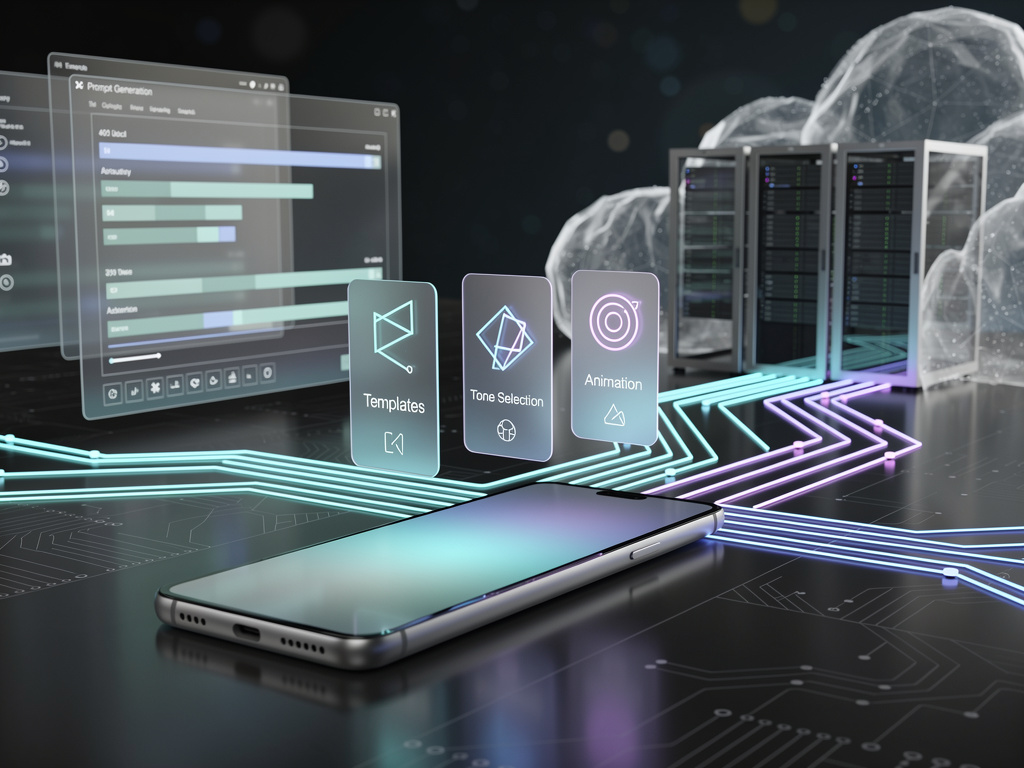
The battle for dominance in the generative artificial intelligence sector is shifting from raw model power to user interface utility, a transition underscored by code hidden deep within the latest version of the ChatGPT Android application. While OpenAI has historically focused on the capabilities of its GPT-4 and o1 models, new findings suggest a strategic pivot toward reducing the friction of prompt engineering for the average user. According to a recent application teardown by Android Authority, the company is preparing to launch a series of features—specifically Templates, Tone selectors, and an Animate function—that fundamentally alter how consumers interact with the chatbot.
These unreleased tools, discovered by analyzing the underlying code strings in the ChatGPT v1.2024.317 beta, indicate that OpenAI is moving to address the “blank page problem” that plagues new adopters. Rather than forcing users to craft elaborate prompts from scratch, the platform appears ready to offer structured guidance and post-processing tools. This development aligns with broader industry trends where competitors like Google and Anthropic have already begun implementing similar ease-of-use features to capture the enterprise and casual markets.
Standardizing the input process through the introduction of purpose-built templates to reduce user friction and error rates
The most immediately practical discovery within the application code is a feature referred to as “Templates.” The strings identify a new component that allows users to select from pre-defined formats for their inputs. The leaked code references a “template_id” and “template_category,” suggesting a library of options likely categorized by use case—ranging from coding assistance and creative writing to data analysis and summarization. This moves the platform away from being a purely conversational interface toward a more structured productivity tool.
For industry observers, this represents OpenAI acknowledging a critical barrier to entry: prompt fatigue. While power users have developed sophisticated techniques to extract value from Large Language Models (LLMs), the average corporate worker or casual user often struggles to frame requests effectively. By embedding templates directly into the interface, OpenAI effectively creates a guardrail system. This ensures the model receives the necessary context to perform complex tasks without requiring the user to be an expert in prompt syntax. As detailed in the Android Authority report, these templates appear designed to handle the “heavy lifting” of prompt structure, allowing users to simply fill in the blanks.
The commoditization of style and the strategic move to capture the editorial market through variable tone settings
Beyond structural inputs, the leaked code points to a significant enhancement in output control through a “Tone” selector. The findings reveal a command specifically for “magic_rewrite,” which includes options to alter the text’s delivery. This feature mirrors functionality currently seen in Google’s Gemini and writing assistants like Grammarly, allowing users to toggle between styles such as “Professional,” “Casual,” or “Concise” after the content has been generated. The presence of a “rewrite_tone_constant” string implies that users may soon be able to set a persistent voice for the chatbot, ensuring continuity across a conversation or a project.
This development suggests OpenAI is aggressively targeting the editorial and communications sector. Currently, achieving a specific voice in ChatGPT requires persistent, detailed instruction. By codifying these styles into UI buttons, OpenAI reduces the latency between draft and final product. This poses a direct threat to third-party “wrapper” applications that have built businesses solely around offering tonal presets on top of OpenAI’s API. If the native application manages style effectively, the value proposition for external writing aids diminishes significantly.
The integration of visual motion and the anticipated arrival of Sora-powered video generation within the mobile interface
Perhaps the most technically ambitious feature unearthed in the APK teardown is the “Animate” function. The code strings explicitly mention a “visual_style_prompt” and the ability to “animate” static images. This strongly implies the imminent arrival of video generation capabilities within the standard ChatGPT mobile app, likely powered by OpenAI’s much-discussed text-to-video model, Sora. The strings include references to “visual_style_id,” indicating that users will not only generate video but will have granular control over the aesthetic style of the motion content.
The inclusion of animation tools directly in the chat interface signals a massive escalation in the multimodal AI race. While competitors like Runway and Pika have dominated the niche video generation market, their workflows are often siloed from general text and code generation. By integrating video creation into the same window used for writing code or drafting emails, OpenAI creates a consolidated workspace. The Android Authority analysis notes that this feature could allow users to upload a static image and request the AI to bring it to life, a workflow that bridges the gap between static design and motion graphics.
Analyzing the competitive pressure from Google and the necessity of feature parity in the current market environment
These updates do not exist in a vacuum; they are a direct response to the intensifying pressure from Google. Google’s Gemini Advanced has aggressively rolled out integration with Google Workspace, offering tone modification and template-like features within Docs and Gmail. OpenAI, lacking a native office suite, must build these utilities directly into the chatbot to remain competitive. The “Tone” and “Template” features bring ChatGPT to feature parity with Gemini’s consumer-facing tools, neutralizing one of Google’s key usability advantages.
Furthermore, the timing of these leaks suggests OpenAI is preparing for a significant retention push. As models from Anthropic (Claude 3.5 Sonnet) and Meta (Llama 3) close the intelligence gap, the differentiator becomes the application wrapper—the software experience surrounding the model. A model that is slightly smarter but harder to use is less valuable to an enterprise customer than one that is adequately smart but offers one-click templates and tone correction. These features are designed to increase “stickiness,” making it harder for users to switch platforms simply because a competitor released a slightly faster model.
The technical infrastructure required to support high-fidelity video generation on mobile devices and cloud servers
The “Animate” feature also raises questions regarding infrastructure and cost. Video generation is orders of magnitude more computationally expensive than text or static image generation. The presence of these features in the mobile app code suggests OpenAI has reached a point of optimization with its video models where they can be deployed at scale, or that they have established a tiered access system to manage the compute load. The code references specific style prompts, which effectively act as filters, limiting the infinite variability of video generation to manageable, optimized presets that are less likely to hallucinate or fail.
This moves the conversation from “can the AI do it?” to “can the AI do it affordably and reliably?” The constraints found in the code—specific styles and templates—are likely engineering compromises designed to ensure quality control. By limiting the user to specific animation styles or templates initially, OpenAI can gather usage data and refine the model’s performance before opening the floodgates to unrestricted video generation, which carries higher risks of safety violations and server overload.
Implications for the creator economy and the potential disruption of entry-level graphic design and animation workflows
If the “Animate” and “visual_style_prompt” features function as the code suggests, the barrier to entry for motion graphics will collapse. Marketing teams, social media managers, and small business owners often outsource simple animation tasks—animating a logo, creating a moving background, or bringing a product photo to life. Integrating this into ChatGPT democratizes these tasks. A user could theoretically draft a marketing email (using the Templates), refine the voice (using the Tone selector), and generate a promotional video asset (using Animate) in a single session.
This consolidation of tools threatens distinct sectors of the freelance economy. Just as ChatGPT impacted copywriters, the “Animate” feature targets the lower tier of the motion design market. However, for the professional sector, these tools likely represent a new prototyping mechanism rather than a replacement. The ability to quickly iterate on visual concepts using text prompts allows creative directors to visualize ideas before committing resources to high-end production.
The shift toward an app-centric operating model and the decline of the chat-only interface paradigm
The aggregation of these features marks the end of the “simple chat” era. The original ChatGPT interface was stark, mimicking a terminal window. The introduction of buttons, sliders for tone, and template galleries transforms the application into a complex software suite. This evolution is necessary for mass adoption but introduces distinct design challenges. OpenAI must balance the power of these new tools with the simplicity that drove its initial viral success. Cluttering the interface with too many options could alienate the core user base that prefers the conversational dynamic.
Ultimately, the code unearthed by Android Authority paints a picture of a company maturing from a research lab into a product-focused consumer software giant. The features are less about scientific breakthroughs and more about product-market fit. Templates, tone controls, and animation capabilities are not just features; they are a declaration that OpenAI intends to be the operating system for creative and professional work, not just a backend provider of intelligence.


 WebProNews is an iEntry Publication