
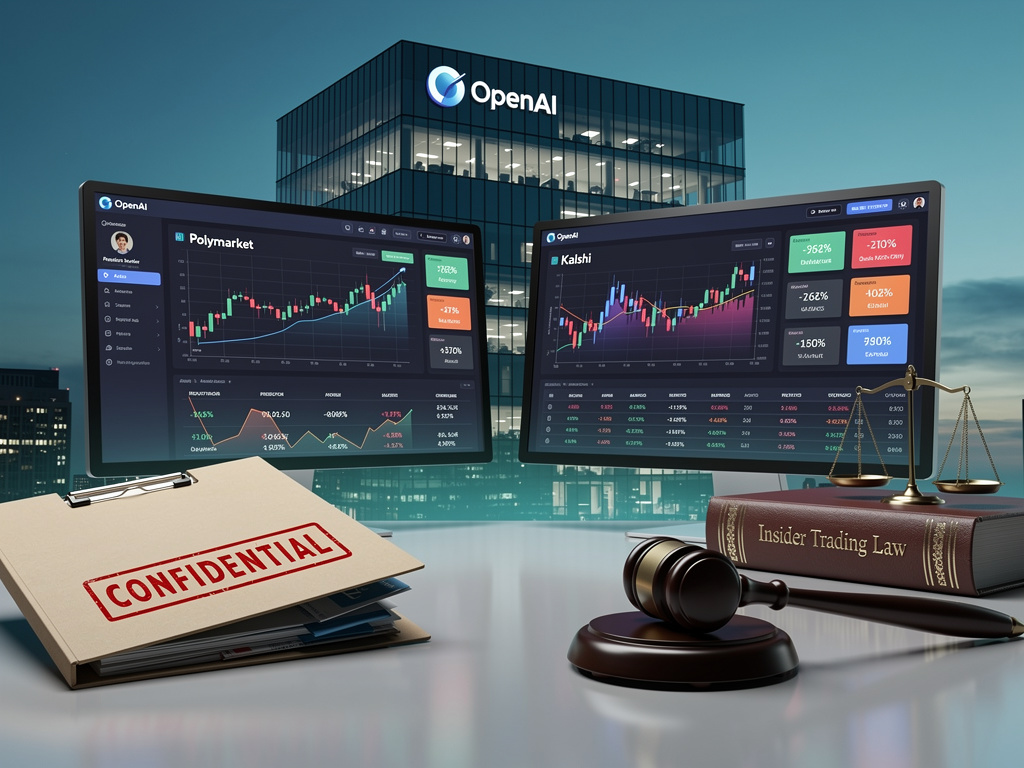
In what may be the first documented case of its kind in the artificial intelligence industry, OpenAI has terminated an employee for allegedly using confidential company information to place bets on prediction markets. The firing, which has sent ripples through both Silicon Valley and the nascent but fast-growing prediction market sector, raises urgent questions about the intersection of corporate secrecy, financial speculation, and the booming business of betting on real-world events.
The incident, first reported by Wired, involved an OpenAI staffer who allegedly traded on platforms such as Polymarket and Kalshi — two of the most prominent prediction markets currently operating — using inside knowledge of upcoming OpenAI product announcements, partnerships, or strategic decisions. While the specific details of which contracts were traded and how much money changed hands remain unclear, the case has drawn immediate comparisons to insider trading scandals that have long plagued Wall Street, now transplanted into the world of technology and decentralized finance.
Prediction Markets Meet Corporate Espionage
Prediction markets allow users to buy and sell contracts tied to the outcome of future events — everything from election results and Federal Reserve interest rate decisions to whether a particular company will launch a product by a certain date. Polymarket, a crypto-based platform that surged in popularity during the 2024 U.S. presidential election cycle, and Kalshi, a CFTC-regulated exchange based in New York, have both seen explosive growth as mainstream interest in event-driven trading has intensified. On these platforms, contracts related to AI companies — including OpenAI — have become some of the most actively traded.
The appeal is obvious: anyone with advance knowledge of a major OpenAI announcement could, in theory, buy contracts at favorable prices before the news becomes public, then sell at a profit once the market adjusts. This is precisely the kind of behavior that securities law prohibits in traditional stock markets. But prediction markets exist in a regulatory gray zone. Polymarket operates offshore and primarily in cryptocurrency, placing it largely outside the reach of U.S. securities regulators. Kalshi, while regulated by the Commodity Futures Trading Commission, is still a relatively new entity, and the rules governing insider trading on event contracts are far less developed than those covering equities.
OpenAI’s Internal Response and the Broader Compliance Challenge
According to Wired, OpenAI moved swiftly once the trading activity was discovered, terminating the employee and launching an internal review. The company has not publicly identified the individual or provided a detailed account of the trades in question. OpenAI declined to comment beyond confirming that an employee had been let go for violating company policy.
The episode highlights a growing compliance headache for AI companies, which increasingly find themselves at the center of global attention. OpenAI’s product launches — such as the releases of GPT-4, ChatGPT’s voice mode, and its various enterprise partnerships — are market-moving events that attract intense speculation. Unlike publicly traded companies, which are bound by SEC disclosure rules and have well-established quiet periods and trading blackout windows, OpenAI is a private entity. Its employees are not subject to the same statutory insider trading prohibitions that apply to, say, employees of Apple or Google who trade on advance knowledge of earnings reports.
The Legal Gray Zone: Can You Insider-Trade on a Prediction Market?
This legal ambiguity is at the heart of the matter. Traditional insider trading law under the Securities Exchange Act of 1934 applies to the buying and selling of securities — stocks, bonds, options — based on material nonpublic information. Prediction market contracts, however, are not classified as securities. On Kalshi, they are regulated as event contracts under the Commodity Exchange Act, which has its own, less developed body of law around information asymmetry. On Polymarket, which operates as a decentralized platform using cryptocurrency, the regulatory framework is even murkier.
Legal scholars have been debating for years whether prediction markets need their own insider trading rules. Professor Eric Zitzewitz of Dartmouth College, who has studied manipulation in prediction markets, has noted that information-based trading can actually improve market accuracy — a core argument made by prediction market proponents. But there is a meaningful difference between a well-informed analyst making a bet based on public research and a corporate insider placing a wager based on information that no one else has access to. The former improves price discovery; the latter undermines market integrity.
A Wake-Up Call for the Prediction Market Industry
The OpenAI incident arrives at a particularly sensitive moment for prediction markets. Kalshi has been locked in a prolonged legal battle with the CFTC over the scope of permissible event contracts, having won a landmark court ruling in 2024 that allowed it to list contracts on U.S. congressional elections. Polymarket, meanwhile, has faced scrutiny from French authorities and questions about whether its largest traders have access to privileged information. Both platforms have been working to establish legitimacy and attract institutional participants.
An insider trading scandal — even one that occurs at the company whose information was traded rather than on the platforms themselves — threatens to undermine that effort. If prediction markets become known as venues where corporate insiders can profit from nonpublic information with impunity, regulators may feel compelled to impose stricter rules or even restrict the types of contracts that can be offered. The CFTC, which has been cautiously supportive of regulated prediction markets, could face political pressure to tighten oversight.
Silicon Valley’s Information Advantage Problem
The case also underscores a broader tension within the technology industry. AI companies like OpenAI, Anthropic, Google DeepMind, and Meta’s AI division are sitting on enormous amounts of market-sensitive information — from model capabilities and benchmark results to partnership deals and regulatory negotiations. As prediction markets expand to cover more AI-related events (Will OpenAI release GPT-5 before July? Will Anthropic raise a new funding round above $10 billion?), the temptation for insiders to trade on that information will only grow.
Unlike the financial services industry, where compliance departments have decades of experience monitoring employee trading activity, most AI companies have limited infrastructure for detecting this kind of behavior. OpenAI’s ability to identify and act on the alleged insider trading suggests that the company may have more sophisticated internal monitoring than many of its peers, but the incident also suggests that existing policies were insufficient to prevent the behavior in the first place.
What Comes Next: Policy, Regulation, and Corporate Governance
Industry observers expect the OpenAI firing to accelerate several trends. First, AI companies are likely to begin implementing explicit policies prohibiting employees from trading on prediction markets using company information — similar to the personal trading policies that investment banks and hedge funds have maintained for decades. Some companies may go further, banning employees from using prediction markets altogether, at least for contracts that relate to their employer or its competitors.
Second, prediction market platforms themselves may need to develop more sophisticated surveillance systems. Kalshi, as a regulated exchange, already has obligations to monitor for manipulative trading. But detecting insider trading requires cooperation with the entities whose information is being traded — a level of cross-industry collaboration that does not yet exist in any formal way. Polymarket, operating in the decentralized crypto space, faces even greater challenges, as its users often trade pseudonymously.
Third, regulators will be watching closely. The CFTC has signaled interest in developing rules around information-based trading on event contracts, and the OpenAI case provides a concrete example of the kind of abuse that such rules would need to address. Congressional staffers working on prediction market legislation are reportedly aware of the incident and may reference it in upcoming hearings.
The Stakes for OpenAI and the AI Industry at Large
For OpenAI specifically, the incident adds another layer of complexity to an already turbulent period. The company has faced a series of high-profile departures, governance controversies, and questions about its transition from a nonprofit to a for-profit structure. CEO Sam Altman has repeatedly emphasized the importance of trust and transparency as OpenAI scales its operations and influence. An insider trading scandal, even a relatively contained one, cuts against that narrative.
More broadly, the case serves as an early warning for an industry that is generating enormous amounts of value and attention but has not yet developed the compliance and governance frameworks to match. As AI companies grow larger, go public, and become even more central to the global economy, the kinds of information asymmetries that prediction markets can exploit will only become more pronounced. The question is whether the industry — and its regulators — will build the guardrails before the next, potentially larger, scandal occurs.
For now, the fired OpenAI employee remains unnamed, and no criminal or civil charges have been filed. But the precedent has been set: trading on inside knowledge from an AI company, even on a prediction market rather than a stock exchange, can cost you your job. Whether it can also cost you your freedom remains an open legal question — one that regulators, lawyers, and prediction market operators will be grappling with for years to come.


 WebProNews is an iEntry Publication