
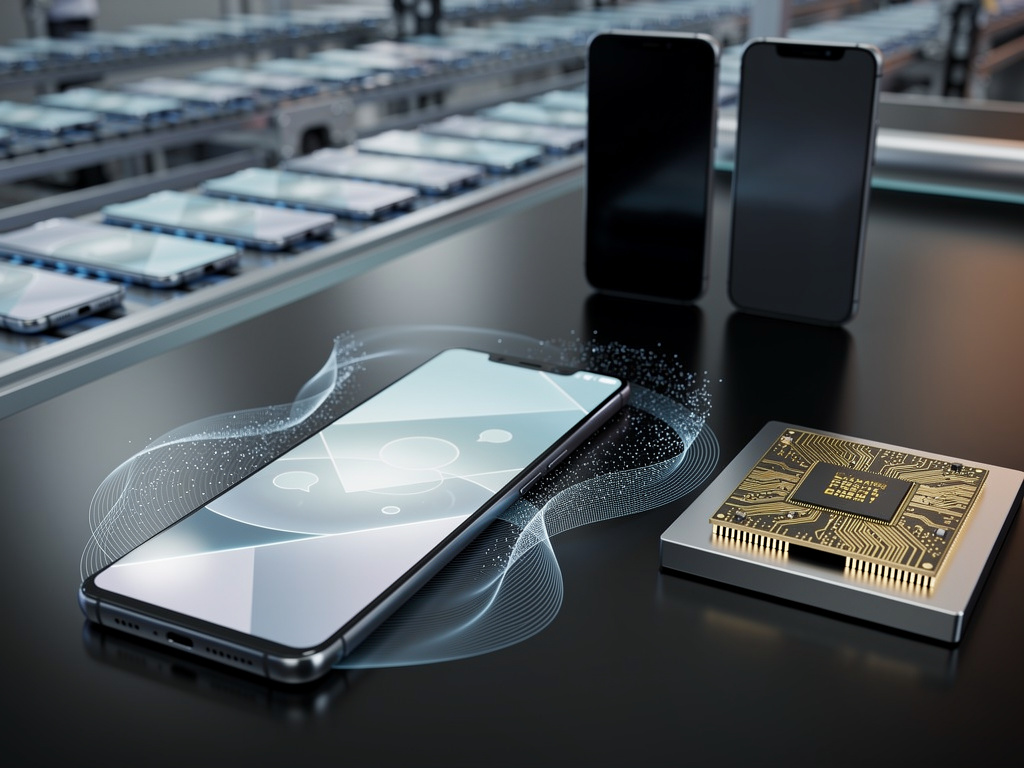
OpenAI is racing into smartphone manufacturing. Analyst Ming-Chi Kuo says mass production starts in the first half of 2027. The company could ship 30 million units over the next two years. That’s a bold entry into a market dominated by Apple and Samsung.
Kuo, from TF International Securities, shared these details in a recent note. MediaTek will supply the sole processor—a customized Dimensity 9600 chipset built on TSMC’s N2P node. It features LPDDR6 memory, UFS 5.0 storage, and a dual-NPU setup for heavy AI workloads. One NPU handles image enhancement. The other tackles object detection and language processing. An upgraded image signal processor boosts high dynamic range for sharper visuals, feeding data straight to AI models. Security gets pKVM and inline hashing. Partners include Qualcomm for semiconductors and Luxshare for chargers, cables, antennas, and connectors. CNET broke the story on May 5, 2026.
The phone ditches apps. AI agents take over. Need a ride? Tell the agent. Want dinner reservations? Same thing. Entertainment, info access—all handled by voice or context. No home screen grid. No scrolling. The device stays aware of your surroundings, location, habits. On-device processing runs light tasks. Cloud kicks in for the heavy lifts. Kuo projects this agent-first design will drive adoption, projecting those 30 million units across 2027 and 2028. Kuo’s X post spells it out.
But hold on. Earlier reports painted a different picture. Back in April 2026, Kuo pegged mass production for 2028, with ambitions of 300-400 million units annually—surpassing iPhone sales. Qualcomm shares jumped 13% on that news. MediaTek and Luxshare were in from day one. TechCrunch covered the shift. Bloomberg noted the stock surge. Now, timelines tightened. Production sped up. Volume forecasts dialed back. OpenAI didn’t comment.
From Software Powerhouse to Hardware Challenger
Why hardware now? Control. OpenAI wants its own OS and silicon to lock in users. Apps fragment experience. Agents unify it. Sam Altman has hinted at this for months. He called the iPhone the “crowning achievement of consumer products.” Yet he envisions something calmer, more aware—a third device beside phone and laptop. Pocket-sized. Screen-free at first. But phones? That’s the big play. Smartphones remain the dominant platform. Full stack ownership means data flows directly to OpenAI’s models, not rivals.
OpenAI’s hardware push started with the $6.5 billion acquisition of Jony Ive’s io in May 2025. Ive’s team handles design. Over 200 people now toil on devices. Plans once included a $200-300 smart speaker with camera for February 2027. Glasses and lamps too. The Information reported that in February 2026. Legal filings confirm no shipments before late February 2027. The Wall Street Journal says Altman mulled spinning out hardware and robotics last year—to avoid dragging the core AI business pre-IPO. He scrapped it. Hardware reports directly to him.
And the market? AI smartphones exploded from 52.1 million units in 2023 to a projected 1.9 billion by 2030, per Grand View Research. Consumers hesitate, though. A CNET survey shows wariness on AI features. But supply chains bet big. Luxshare, Apple’s assembler, commits fully here.
Challenges loom large. OpenAI missed revenue and user targets recently, per reports. Data center bills balloon. Losses hit $14 billion projected for 2026. Building phones means factories, retail, carrier deals. Against Apple Intelligence, Google Gemini, Samsung Galaxy AI. Ecosystem lock-in favors incumbents. Agents must work flawlessly—privacy risks skyrocket with always-on sensing.
Risks and Rewards in the Agent Bet
Success flips the script. OpenAI owns the interface layer. No more app stores skimming 30%. Agents pull from any service, but OpenAI routes the traffic. Revenue from subscriptions, cloud compute, premium agents. At 30 million units, even modest margins reshape finances. Scale to 300 million? Trillion-dollar valuation territory.
Failure hurts. Burn more cash. Dilute focus from AGI chase. Hardware flops tank stock pre-IPO. But Altman bets users crave simplicity. Talk. Get results. No taps. No learning curves.
Supply chain whispers acceleration. Specs finalize by late 2026 or Q1 2027. MediaTek’s Dimensity edges Qualcomm here—cost, AI focus. Visual AI shines: better photos, real-time analysis. Gaming too, with that chipset.
Industry watches. Qualcomm rebounds on rumors. MediaTek gains. Apple, Samsung push AI harder. Google eyes agents. OpenAI’s phone tests if AI can kill the app era. Or if it’s just another gadget in a crowded shelf.
Kuo’s track record? Spot-on for Apple. If he’s right, 2027 changes everything. Mass production hits. Agents awaken. Phones listen.


 WebProNews is an iEntry Publication